Know the strengths and weaknesses of your organization, internally and externally.
- Bring in the whole leadership team plus people from every department. Leaders see the whole organization, and every department adds its own view.
- Ask each SWOT question through your framework's perspectives. Financial, customer, internal and learning & growth lenses keep the discussion structured.
- Accept every answer at first, then look for connections. Check which strengths support opportunities and which fixed weaknesses would open new ones.
- Run a brown paper exercise before finalizing the matrix. Print it large and let employees add Post-it notes where leadership missed something.
- Build the results into your strategy map. Your SWOT should decide which goals you prioritize, which measures you track and which projects you fund.
Corporate planning has always been difficult. Many organizations have failed to get everyone on the same page and agree on the details of a plan. More often than not, their efforts were ineffective and time consuming. Something had to be done.
What is a SWOT Analysis?
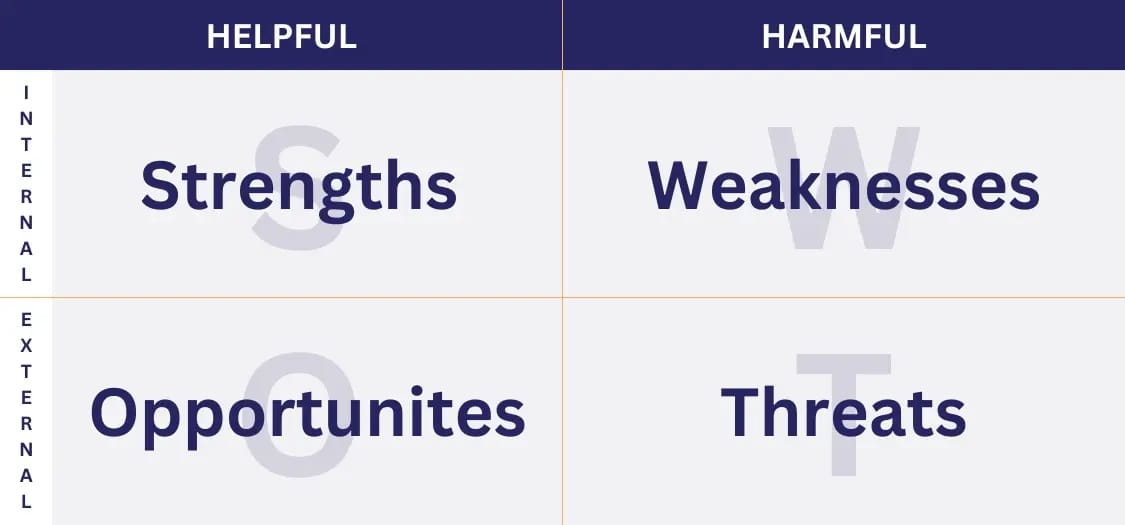
A SWOT analysis is a high-level strategic planning model that originated in the 1960s (initially called SOFT) and is widely used by all types of organizations. It helps organizations identify where they’re doing well and where they can improve, both from an internal and an external perspective. SWOT is an acronym for “Strengths, Weaknesses, Opportunities, and Threats:
- Strengths and weaknesses are internal factors (things you can control), like team members, software, and geographic location.
- Opportunities and threats represent external factors (things you can’t control), such as competitors, regulations, and economic trends.
Organizations use SWOT to plot a course that plays on their strengths and minimizes risks. It is worth taking the time to look at your organization from different perspectives and honestly assess your prospects. Then put what you learn to use in the strategic planning process.
How To Do A SWOT Analysis
To help you get started, we’ve created this step-by-step SWOT analysis template. The examples below are specific to the airline industry (since that’s the example we use in our grid), but the SWOT analysis exercise is applicable to all businesses.
You’ll notice we divided our hypothetical examples for strengths, weaknesses, opportunities, and threats based on the four Balanced Scorecard perspectives. You don’t have to use the Balanced Scorecard to run a good SWOT analysis, but it gives your discussion a strong framework.
If you use a different strategic management framework, look to its guiding principles for ways to think about your business. For example, the VRIO framework emphasizes value, rarity, imitability, and organization; you can conduct a SWOT analysis through the lens of these criteria instead.
1. Create a SWOT matrix
This is the grid-like matrix that will house the information you gather. Using a matrix helps present your findings in a clear, easy-to-understand way.
2. Gather the right participants
Pull people from all departments to participate in the analysis. Involve your entire leadership team. They see the whole organization and know the competition.
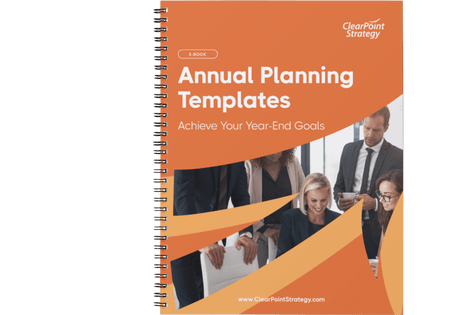
Get the ebook of 8 strategic planning templates
3. List your strengths
Ask the group: What are we good at? How are we better than our competitors? These are broad questions, but in the beginning stages of your discussion, you should accept all answers.
Examine these questions in relation to the Balanced Scorecard perspectives. For the fictional company Upward Airlines, the discussion might look like this:
- Financial strengths: What is our most reliable source of financial growth? Is it our service destinations? A large fleet size? Our customer loyalty program?
- Customer strengths: Where is our customer growth coming from? Is it due to excellent service ratings or low prices? Why are customers choosing us over our competitors?
- Internal strengths: What do we do very well as an organization? Are our operations easily scalable? Do we have an exceptionally high employee retention rate? How complex is our maintenance program?
- Learning & growth strengths: Where do we excel as far as our employees are concerned? Is it our compensation model? Could it be our workforce development program? Are people coming or leaving because of our culture?
Below is a sample of the strengths portion of the SWOT analysis for Upward Airlines:
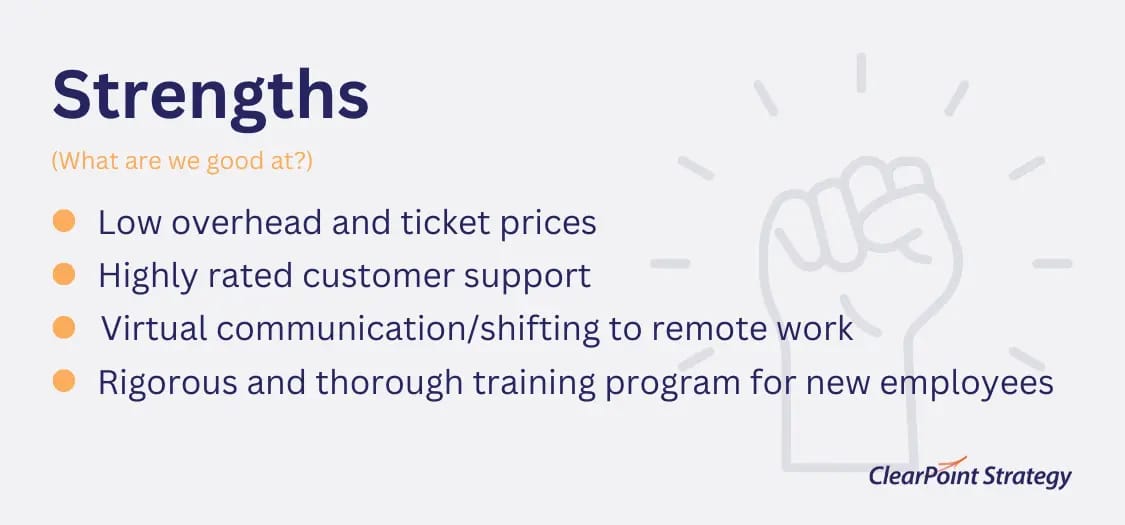
TIP: You can use ClearPoint to simplify this and the remaining information-gathering steps. Rather than asking everyone to brainstorm at once in a conference room, give people time to review the relevant data (also in ClearPoint) for strengths, weaknesses, and opportunities. Participants can then enter their thoughts in ClearPoint, link to key supporting metrics, and add context on their reasoning.
Watch our video to learn about ClearPoint Strategy's proven Success Framework
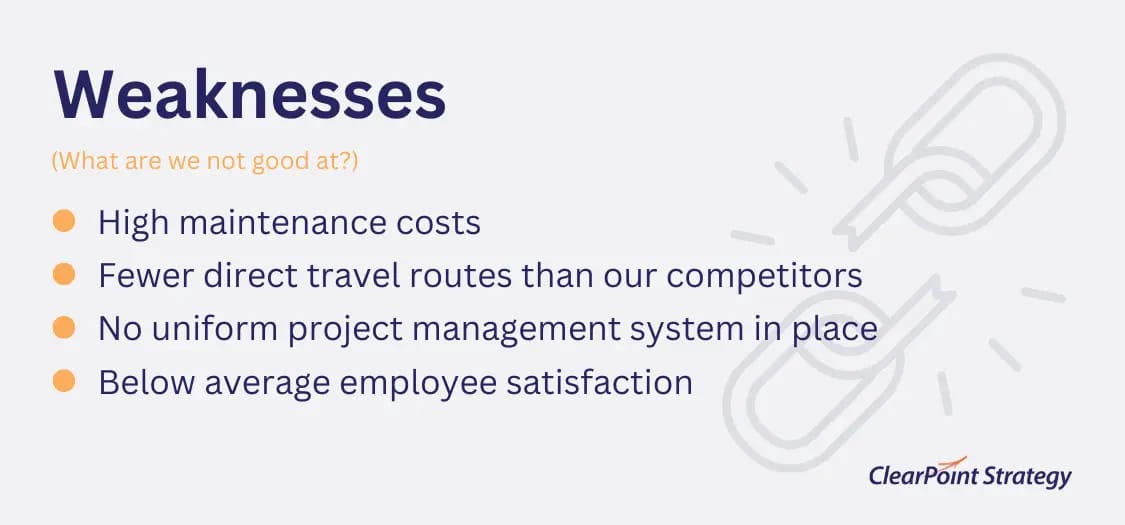
4. List your weaknesses
Ask the group: What are we not good at? Where can we grow? What are we lacking? The Upward Airlines discussion might look like this:
- Financial weaknesses: What is our biggest financial weakness? Our destinations are all in the U.S., which may be limiting our growth. Or, we know that a large number of new competitors entering the market are decreasing our market share. Do we have challenges with debt or credit?
- Customer weaknesses: Where do our customers think we need to improve? This could be related to frequently canceled flights, lost baggage, complexity of the reservation process, or cleanliness, for instance.
- Internal weaknesses: What do we do poorly? Are we slow at handling customer complaints? Are our maintenance costs above industry average? What about plane utilization?
- Learning & growth weaknesses: What are our biggest challenges with employees? Is our staff security training proving ineffective, or is there a negative perception of the organizational culture? Do our employee surveys reveal low engagement?
5. Identify your opportunities
Ask the group: Where do we see big (and small) possibilities for our organization? What do we see happening in the future?
The Upward Airlines group might discuss the following:
- Financial opportunities: What is our biggest opportunity to improve our finances? This might mean taking advantage of federal loans in a time of crisis (like COVID-19) or adopting specific technology to lower costs. Maybe there is an opportunity to purchase a weaker competitor.
- Customer opportunities: Where could we dramatically improve with our customers? Could we enhance our online interface? Can we create and promote new standards of cleanliness? What about finding new ways to engage with customers when travel opportunities are low?
- Internal opportunities: What processes will drive us well into the future if we could improve upon them? Climate initiatives that reduce our carbon footprint, for instance, will make us more eco-friendly (and more appealing to customers). Maybe now is the time to upgrade a reservation or pricing system.
- Learning & growth opportunities: What opportunities do we have to make better use of staff? For example, do we have cross-training opportunities? Could we make a few tweaks to improve our culture and thus our retention?
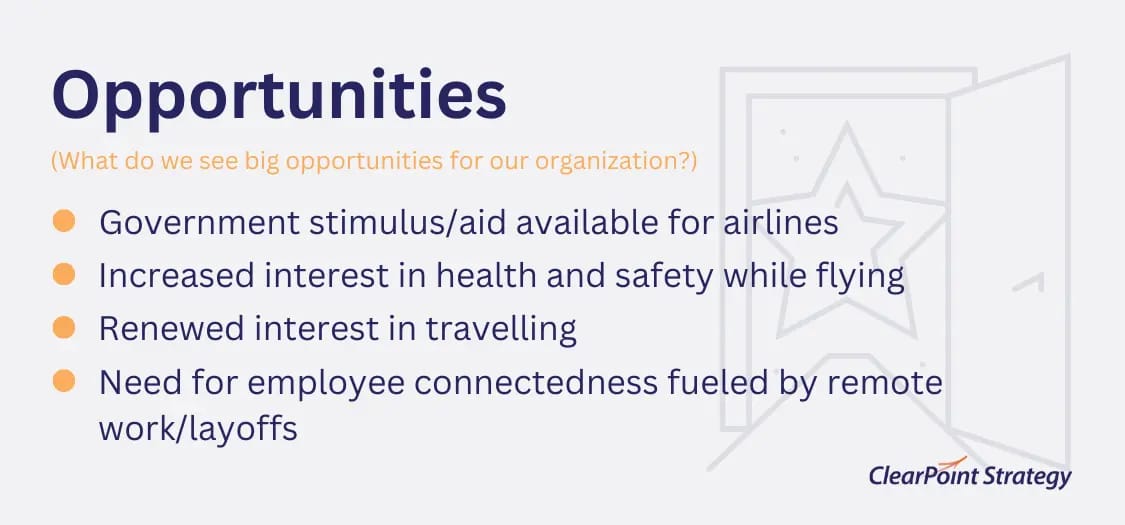
Upward Airlines’ opportunities for the foreseeable future might be:
6. Identify your potential threats
Ask the group: What do we see as a threat? What obstacles do we anticipate? What is changing that could hurt us? As a travel-related company in a tough economy, Upward Airlines might uncover a number of potential threats:
- Financial threats: What threats could seriously impact our financial health? This could be low-cost competitors, ongoing global health issues that prevent travel, or rising oil costs.
- Customer threats: What is our biggest concern about our customers? Has a competitor created a more attractive loyalty program? Is our number of business clients trending downward?
- Internal threats: What current areas of our business might harm us later? Is a contract dispute imminent that could disrupt business? Is a potential merger or acquisition on the horizon?
- Learning & growth threats: What threatens the people within your organization? This could be anything from instability in our customer support department to staff member departures to a department-specific pushback against new technology.
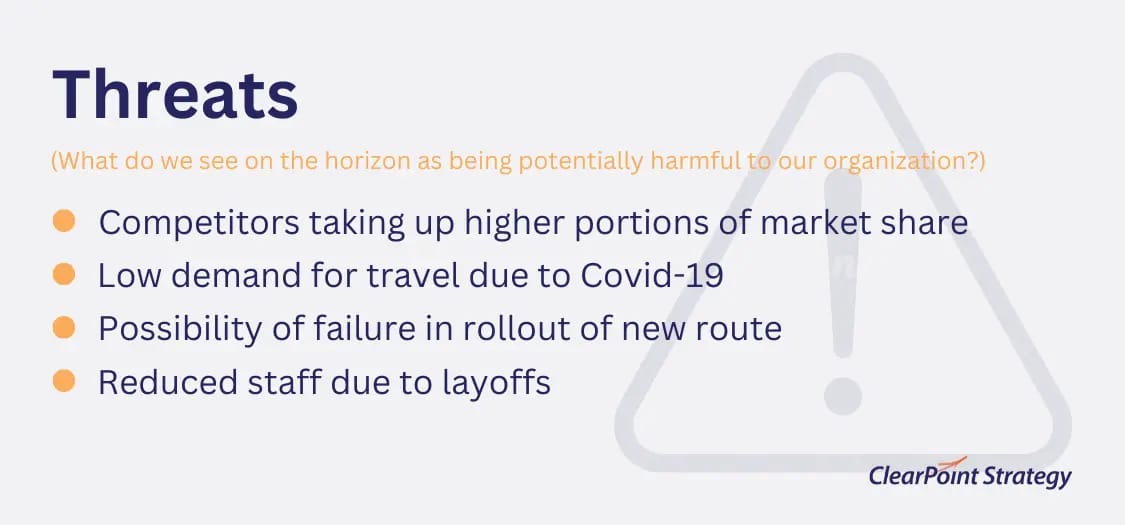
The external threats deemed most imminent for Upward Airlines might be:
7. Examine your matrix for connections
Look at your SWOT matrix for strengths that naturally support the opportunities you identified, and for weaknesses that would open up more opportunities if you removed them.
At this point, we recommend a “brown paper exercise.” Print your SWOT matrix large and ask employees to add Post-it notes in any of its four boxes where they feel the leadership team missed something. The exercise sparks discussion across the office and lets leaders hear from staff in the field.
Pro Tip: Make sure there is a clear and strong link between your SWOT analysis and your strategy map. For example, if you’re a for-profit organization, your financial perspective will be the top priority. Build your analysis into your map so it drives those finances in the right direction.
Go beyond SWOT by downloading our eBook on 8 effective strategic planning templates
Complement Your SWOT With A PEST Analysis
PEST stands for political, economic, social, and technological: the four areas outside your business most likely to affect it. These factors tend to play out over long time frames. An economic slowdown, for instance, could take years to resolve, but you can take action to address staff training issues fairly quickly.
That’s why many organizations pair a SWOT analysis with a PEST analysis. Together, they give a complete picture of your business environment.
A PEST analysis is more useful than SWOT for longer-term plans and business strategies. We recommend doing a SWOT analysis first, then a PEST analysis.
Don’t Let Your SWOT Sit On The Shelf
A SWOT analysis isn’t the end of strategy work. It’s the bridge to creating a realistic, achievable strategic plan. Your SWOT should directly inform:
- Which goals you prioritize
- Which measures you track
- Which projects you commit resources to
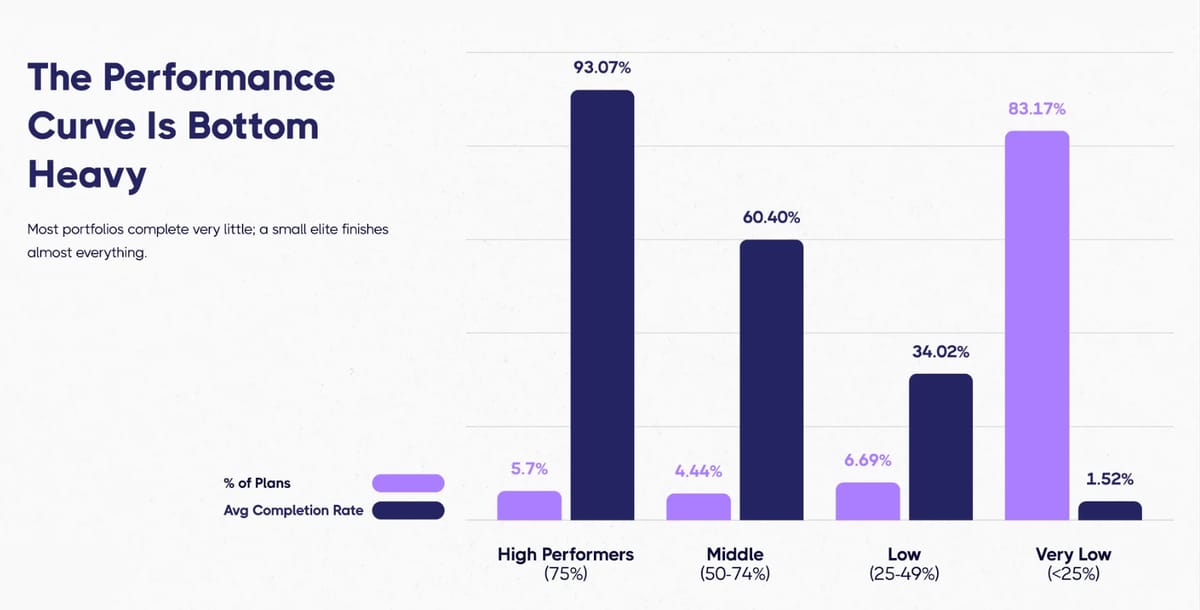
With this foundation — and the right execution systems — in place, your organization will be well-positioned to join the elite few organizations (only 5.7%) who actually achieve 75% or more of their objectives. (See the chart below 👇; which group are you in?)
The good news: Just as you can learn to do a thorough SWOT analysis, you can also learn strategy execution.
For the first time ever, there’s a reliable resource that details how strategic plans get executed — consider it your playbook for better performance. Get all the data surrounding exemplary execution by downloading the 2026 Strategy Planning Report now.
Optimize Your Strategic Planning with ClearPoint
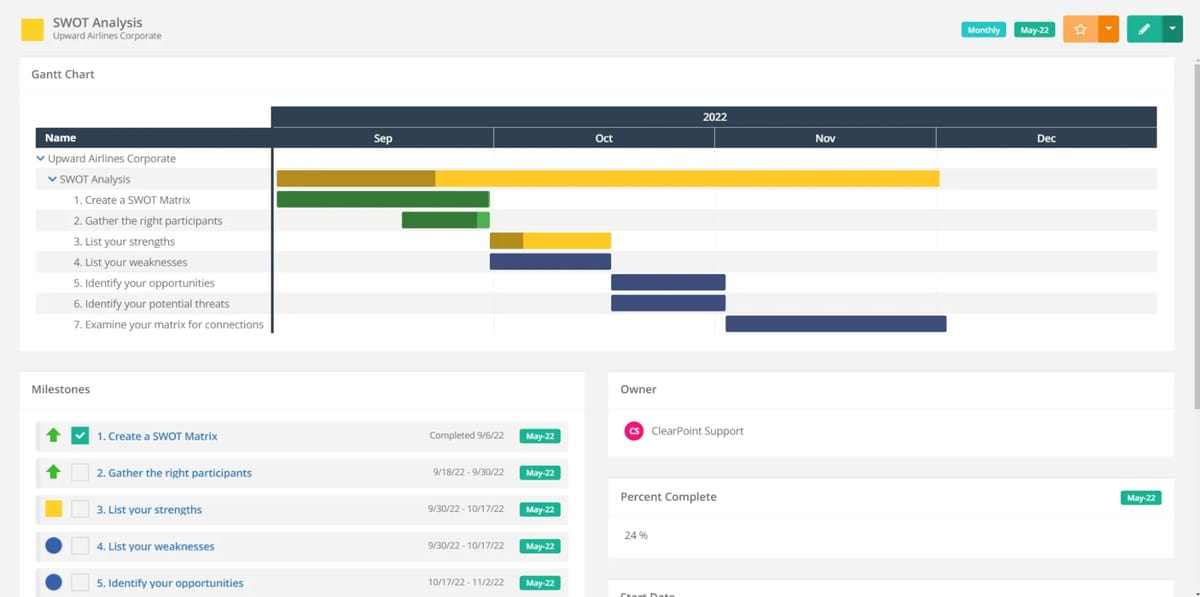
ClearPoint Strategy simplifies the SWOT analysis process and helps you carry what you learn into your strategic plan. ClearPoint’s AI Assistants can help you take your Q3 results, run a SWOT and PEST analysis, decide next steps, and plan for next year.
Book a personalized demo with our experts to see how our software can help you conduct SWOT analyses, track progress, and reach your strategic goals.
Common questions
How do you turn SWOT findings into strategic objectives?
Pair the quadrants: use each strength to pursue a specific opportunity, and fix the weaknesses that would block one. Each pairing becomes a draft objective with a measure and an owner. Then cut to the few that matter most, because a SWOT that produces twenty actions is a wish list, not a plan.
Is a new regulation or competitor a weakness or a threat?
It is a threat, because you cannot control it. Control is the test for every item: strengths and weaknesses are internal and within your power, while opportunities and threats come from outside. If the change exposes something you can fix, such as a slow approval process, list that part separately as a weakness.
How often should you update a SWOT analysis?
Update it at least once a year as part of your strategic planning cycle, and again whenever something significant changes: a new competitor, a funding or regulatory shift, a merger, or a major launch. Run a quick refresh before any big decision that relies on it, so you are not acting on last year's list.
What are the most common SWOT analysis mistakes?
The most common mistake is vagueness: entries like "great people" or "tough economy" that nobody can act on. Others are skipping evidence, mixing internal and external factors, listing everything instead of prioritizing, and filing the matrix away. Write each item specifically enough that someone could attach a measure or a project to it.