.svg)
Google AI answers
Better answers, right in Google.
Google lets you choose the sites its answers come from. Choose ClearPoint, and you’ll see ours first.
One click. Only changes what you see — undo it anytime.

Free strategic planning templates for government, healthcare, and education. Built on insights from 30,000+ real plans.
- Generic templates fail because a local government's priorities — infrastructure, public safety, citizen engagement — look nothing like a hospital's clinical and compliance goals.
- Each sector template starts from a different planning horizon, from 2-3 years in healthcare to 4-6 years in higher education tied to accreditation cycles.
- Healthcare plans carry dual pressure: meeting Joint Commission and state licensing standards while improving clinical outcomes and financial sustainability.
- Utilities templates must balance grid reliability, decarbonization mandates, and regulatory compliance against capital planning that runs ten-plus years.
- Templates work for years one and two; as tracking scales, move to software built on clear ownership, automated data, and a review rhythm.
Why Most Strategic Planning Templates Don't Work
Generic templates treat all organizations the same. A local government's priorities (infrastructure, public safety, citizen engagement) bear no resemblance to a hospital's (patient outcomes, regulatory compliance, workforce retention). When templates don't reflect your sector's constraints and success drivers, they become friction rather than foundation.
Prefer to build it instead of downloading a file? Use the free strategic plan template builder — it works in the browser, no account, email only if you want to export.
Effective templates must include:
The templates below solve these problems by starting with your sector's DNA built in.
Local Government Strategic Plan Template
Typical Planning Horizon: 3-5 years
Local governments are executing at scale. Across 7,776 government plans tracked by ClearPoint, the most successful ones organize around four core outcome categories. For detailed guidance on building municipal strategies, see our complete guide to strategic planning for local government.
- Safe, healthy communities (public safety, emergency response, community health outcomes)
- Economic vitality and opportunity (workforce development, business retention, infrastructure readiness)
- Efficient, responsive government (constituent satisfaction, process efficiency, budget stewardship)
- Sustainable infrastructure and environment (transportation networks, utilities, climate resilience)
- Crime rates and emergency response times
- Business formation and job creation
- Permit processing times and constituent satisfaction scores
- Infrastructure asset condition ratings and green energy adoption rates
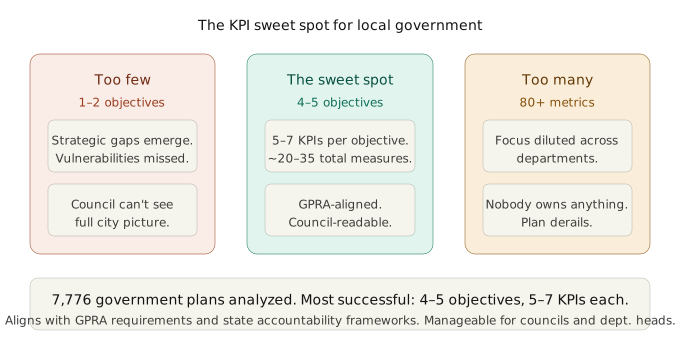
Why it works: These templates align with Government Performance and Results Act (GPRA) requirements and state accountability frameworks while keeping plans manageable for councils and department heads. Most successful government plans track 4-5 objectives with 5-7 KPIs each—avoiding the "80-metric nightmare" that derails many municipalities.
Learn more about local government strategic planning →
Healthcare Strategic Plan Template
Typical Planning Horizon: 2-3 years
Healthcare organizations operate under dual pressures: meeting Joint Commission and state licensing standards while improving clinical outcomes and financial sustainability. ClearPoint's healthcare templates integrate accreditation requirements from day one. For detailed guidance on healthcare-specific strategic planning aligned with clinical quality and compliance frameworks, see our healthcare strategic planning guide.
- Clinical quality and patient safety (mortality rates, hospital-acquired infection prevention, patient satisfaction)
- Access and financial sustainability (payer mix, average length of stay, operating margin)
- Workforce capability and retention (RN turnover, training investment, physician engagement)
- Community health and population outcomes (chronic disease management, preventive care access, health equity)
- Readmission rates and patient safety incident trends
- Occupancy rates and revenue per patient day
- Turnover rates and training hours per FTE
- Community screening participation and health outcome gaps by demographic
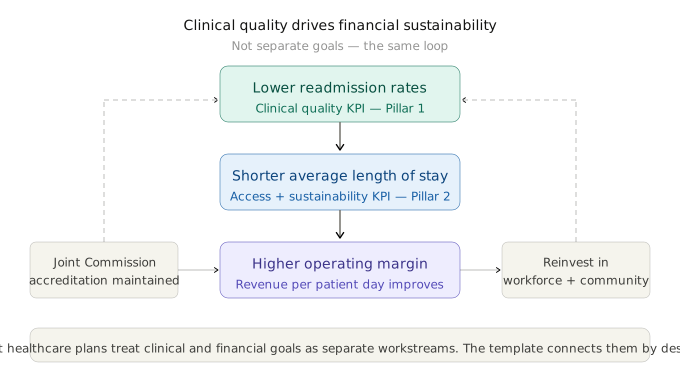
Why it works: These templates map directly to accreditation cycles and joint commission performance standards. They also embed the complexity of healthcare finance—helping CFOs and executive teams see how clinical quality drives sustainability rather than treating them as separate goals.
Higher Education Strategic Plan Template
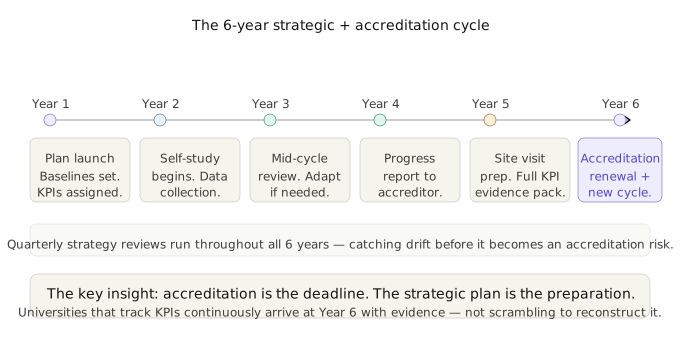
Typical Planning Horizon: 4-6 years (aligned to accreditation cycles)
Universities operate on extended planning horizons tied to accreditation reviews. These templates account for institutional effectiveness reporting requirements while keeping enrollment and student success front and center. For comprehensive guidance on building university strategies aligned with accreditation cycles and institutional effectiveness, see our higher education strategic planning guide.
- Student success and outcomes (six-year graduation rate, employment rate, student satisfaction)
- Academic quality and innovation (program accreditation status, research funding, curriculum alignment)
- Enrollment and market position (application volume and yield, student diversity, net revenue per student)
- Institutional effectiveness and sustainability (endowment growth, operational efficiency, board alignment)
- Graduation rates and time-to-degree metrics
- Program accreditation currency and research grant funding
- Enrollment trends by program and demographic
- Operational cost per FTE and strategic initiative completion rates
Why it works: These templates structure around accreditation reporting cycles while making enrollment and revenue implications visible. The best university plans connect academic strategy directly to financial sustainability—these templates enforce that link from the start.
Utilities & Energy Strategic Plan Template
Typical Planning Horizon: 3-5 years (with 10+ year capital planning)
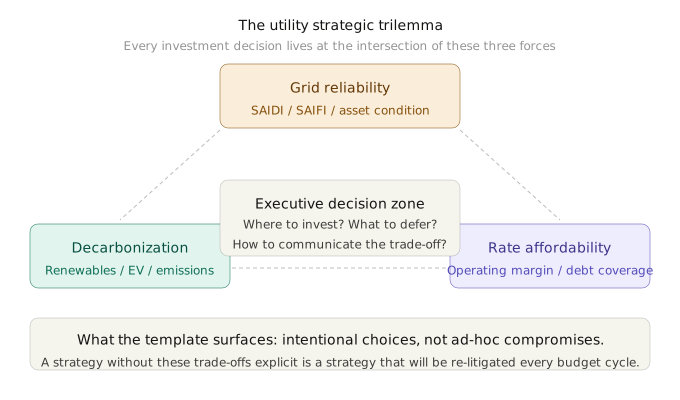
Utilities face unique pressures: grid reliability, decarbonization mandates, regulatory compliance, and customer service expectations. Strategic plans must balance infrastructure investment with short-term rate constraints. See our guide on strategic planning frameworks for how utilities align long-horizon capital strategies with operational KPIs.
- Grid reliability and resilience (outage duration and frequency, storm recovery time, asset condition index)
- Decarbonization and clean energy transition (renewable energy percentage, emissions reduction rate, electric vehicle infrastructure)
- Customer service and satisfaction (call answer time, outage communication, bill accuracy)
- Regulatory compliance and financial health (rate case outcomes, operating margin, debt service coverage)
- System Average Interruption Duration Index (SAIDI) and System Average Interruption Frequency Index (SAIFI)
- Renewable energy penetration and carbon emissions per customer
- Customer satisfaction scores and complaint resolution time
- Regulatory approval rates and return on equity
Why it works: Utilities operate under multi-stakeholder pressure. These templates surface the often-hidden trade-offs between reliability investment, rate affordability, and environmental goals—helping executive teams make intentional choices rather than ad-hoc compromises.
How to Customize Any Template
Your sector template is a starting point, not a straitjacket. Here's how to customize without losing focus. For a detailed walkthrough of the strategic planning process, see our 7-step strategic planning framework.
Start with the template's suggested objectives. Are all five critical to your organization's 3-5 year success? Remove any that are "nice to have"—this is your hardest decision and also your most important one.
For each objective, identify 5-7 metrics that measure progress. Avoid the temptation to include every possible metric—our analysis shows strategy teams with 6.72 members perform best when tracking 5-7 KPIs per objective. More metrics create noise, not clarity. See our
What's your current state? Where do you want to be in 18 months? In 3 years? Realistic baselines prevent teams from abandoning plans mid-cycle when targets feel unreachable. For guidance on setting realistic targets tied to organizational capability, see our
Who owns each objective? When does the team review progress (monthly, quarterly)? Templates should include decision rights—who escalates misses, who approves course corrections?
Most strategy fails not because individual objectives miss, but because teams don't see how missing one objective cascades into others. Map what objectives depend on each other—this dependency view prevents isolated optimization that damages overall strategy. For deeper guidance on execution and preventing these interdependency failures, see our
From Template to Software: When to Upgrade
Templates work beautifully for years one and two. But as your organization scales and tracking evolves, spreadsheets become a liability. As organizations implement the 4-pillar execution framework—clear ownership, automated data, review rhythm, and adaptive planning—the limitations of manual tracking become apparent:
- Your plan has 4-5 objectives and 20-30 total KPIs
- Updates happen quarterly or less frequently
- 5-8 people touch the plan
- Your organization has minimal multi-department dependencies
- Multiple departments own objectives that interconnect
- You need monthly or real-time progress visibility to maintain the
that drive execution
- Larger teams require permissions and audit trails
- You're managing 30,000+ updates annually (that's the median across our customer base)
- Your strategy needs to integrate with departmental OKRs, project portfolios, or financial systems
The core issue that triggers migration to software is the phantom ownership problem. When 81% of assigned metric owners never update their data, spreadsheets amplify the problem—there's no automated data flow, no escalation when updates miss, and no visibility into who's fallen behind. Strategic planning software removes this friction through automated data collection, real-time dashboards, and structured review rhythms that keep strategy alive.
ClearPoint Strategy handles the complexity spreadsheets can't: role-based access for teams of 50+, automated alert systems when KPIs miss thresholds, integration with your planning budget cycle, and the institutional memory that survives staff turnover.
If your organization is executing 30,000+ strategy updates across teams, functions, and cycles annually—that's when software isn't a luxury, it's the difference between strategy that gets done and strategy that stalls.
Frequently Asked Questions
Q1: What should a strategic plan template include?
A strategic plan template should include: (1) 4-6 core objectives aligned to your sector's key success drivers, (2) 5-7 KPIs per objective with measurement definitions, (3) a realistic planning horizon (government: 3-5 years; healthcare: 2-3 years; education: 4-6 years), (4) objective owner and team member fields, (5) baseline and target fields, (6) a monthly or quarterly update schedule, and (7) assumption and risk documentation. The best templates also map to your sector's regulatory or accreditation requirements—this prevents nasty surprises in compliance cycles. ClearPoint's templates across 30,000+ plans show that this structure increases completion rates by 30-40% versus generic frameworks.
Q2: Are free strategic planning templates effective?
Yes, but only if they're sector-specific. A government template is worthless for a hospital, and vice versa. Generic templates fail because they don't account for your industry's constraints, success drivers, and measurement expectations. Free templates built on patterns from real plans—like ClearPoint's templates derived from 30,000+ strategic plans—are highly effective because they embed sector expertise from the start. The catch: templates are a starting point, not the finish line. Your team still has to align on what success looks like and how you'll measure it.
Q3: How do I customize a strategic planning template?
Start by validating the template's objectives against your organization's 3-5 year priorities. Keep it to 5-6 core objectives max. For each objective, identify 5-7 KPIs—don't exceed this range or you'll create metric overload. Set realistic baselines and targets, assign clear owners, define your review cadence (monthly, quarterly), and map dependencies between objectives so your team sees how one miss cascades. Our data shows that strategy teams with 6.72 members manage 5-7 KPIs per objective more effectively than teams trying to track 10+ metrics. Less is more when it comes to what actually moves.