The Ansoff Matrix sets out four ways to grow, from selling more to current customers to new products in new markets. Each strategy, its risk, and how to apply it.
- Take stock of your current products, customers, strengths and weaknesses first. That groundwork decides where growth effort should go.
- Brainstorm options in all four quadrants before narrowing. Generate a wide range of ideas, even far-fetched ones; you can refine them later.
- Rank each option by risk against your risk tolerance. Market penetration is the least risky; diversification, new products in new markets, carries the highest risk.
- Turn the chosen strategies into an action plan with owners, resources and timelines. You cannot pursue every opportunity at once, so fund the most promising.
- Pair the matrix with a SWOT analysis and market data, and revisit it as conditions change. Treating it as a one-time exercise is a common mistake.
The Ansoff Matrix, also known as the Product/Market Expansion Grid, gives a business four ways to grow: market penetration, market development, product development and diversification. Each one pairs existing or new products with existing or new markets, and each carries a different level of risk. This guide explains the four strategies, how to weigh their risk, how to apply the matrix in six steps, and where it falls short.
What is the Ansoff Matrix?
Developed by Igor Ansoff, the matrix is a framework for identifying and comparing growth opportunities. Its purpose is to help a business decide where to put its resources and effort. It works for a startup as well as an established enterprise.
The four growth strategies
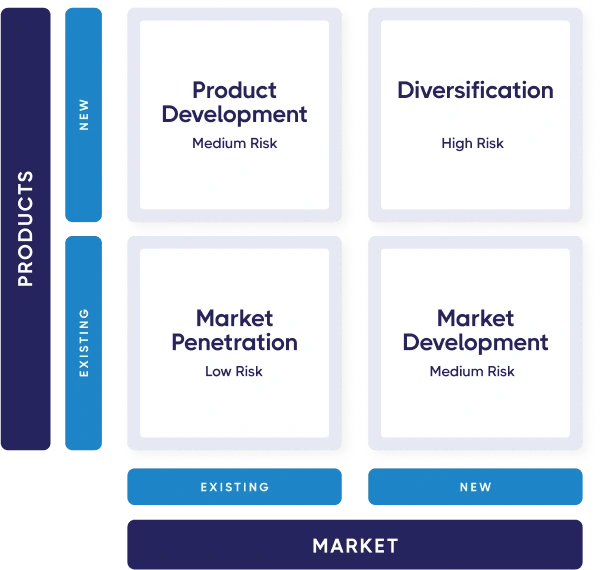
The matrix sets out four strategies (Corporate Finance Institute). Risk rises as you move away from the products and customers you already know.
Market penetration: existing products, existing markets
Market penetration means selling more of your current products to your current market. Typical moves are loyalty programs, pricing adjustments and winning customers from competitors. It is the least risky of the four because you already know the customers and the product. It is hard in saturated markets: gaining share in a mature category such as bottled water takes creativity and a close understanding of your audience.
Market development: existing products, new markets
Market development takes current products to new geographic regions, customer segments or distribution channels. A regional coffee chain expanding nationally is one example; a software company that serves large enterprises tailoring its product for small businesses is another. The risk is moderate. Introducing a line of organic dog treats in a new country, for instance, means researching local regulations, understanding the culture and perhaps adapting the marketing, so market research matters here.
Product development: new products, existing markets
Product development creates new products, or improves existing ones, for the customers you already serve. Apple releasing new iPhone models and a clothing retailer adding a line of sustainable apparel both fit. It requires investment in research and development and, like market development, carries moderate risk: you know what your customers like, but the new product still has to be tested and refined.
Diversification: new products, new markets
Diversification launches new products into new markets. It offers the largest potential reward and the highest chance of failure, because the business is starting close to scratch on both counts. A software company known for project management tools deciding to make kitchen appliances would face a steep learning curve and a large investment. It needs careful planning and a thorough understanding of both the new product and the new market.
Weigh risk against your goals
Laying the four options side by side shows the risk of each, which helps you decide where to allocate resources and how to limit the downside. A company that is not ready for diversification might find that taking an existing product into a new market offers manageable risk with real growth potential. No growth path is risk-free, so understand the risks, plan how to mitigate them, and pick the path that fits your risk tolerance and long-term objectives. An annual risk assessment is one way to keep those risks visible.
How to apply the Ansoff Matrix in six steps
The matrix is most useful when it starts a discussion that leads to action.
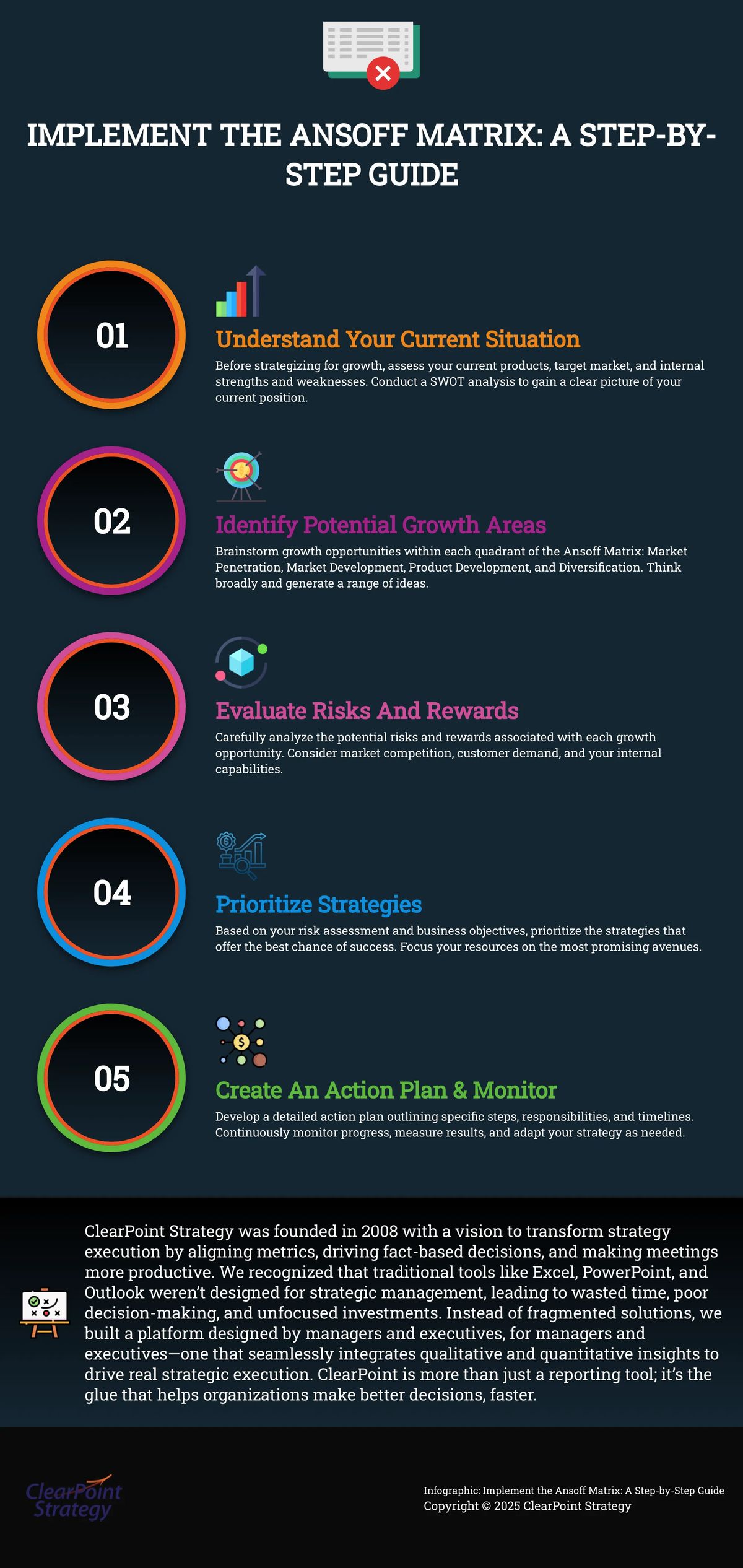
- Understand your current situation. List the products or services you offer, who your current customers are, and your internal strengths and weaknesses. A SWOT analysis helps here.
- Identify potential growth areas. Brainstorm options in all four quadrants. Generate a wide range of ideas, even ones that seem far-fetched; you can refine them later.
- Evaluate risks and rewards. Assess each option against market competition, customer demand and your internal capabilities, and ask which offers the best chance of success given your resources and risk tolerance.
- Prioritize strategies. You cannot pursue every opportunity at once. Choose the strategies that best serve your business objectives and focus resources on them.
- Create an action plan. Set out specific steps, assign owners, allocate resources and set realistic timelines.
- Monitor and adjust. Track key performance indicators (KPIs) and review progress against your projections. If a strategy is not delivering, adjust it or try another quadrant; a stalled market penetration effort might lead you toward product development.
ClearPoint Strategy can support the last three steps: managing the strategic initiatives behind each chosen strategy, tracking the related KPIs, and reporting progress toward your strategic goals.
Limitations of the Ansoff Matrix
The matrix is simple, and that is also its main weakness. Business does not divide neatly into four boxes, and the grid gives a high-level view that misses detail. A "new" product could be a minor change to an existing offering or an entirely new invention, and that difference matters when you judge risk and reward.
Another pitfall is relying on the matrix alone. Use it alongside frameworks that describe your environment: a SWOT analysis covers internal strengths and weaknesses, while PESTLE analysis and Porter's Five Forces cover external factors and competition. Market data matters too. Before choosing market development, for example, find out the new market's size, demographics, buying behavior and competitors. Finally, treat the matrix as something you revisit as markets, competitors and your own capabilities change, not a one-time exercise.
Common questions
Is the Ansoff Matrix relevant for small businesses?
Absolutely! While often used by large corporations, the Ansoff Matrix is a valuable tool for businesses of all sizes. It helps small businesses think strategically about growth, even with limited resources. Focusing on market penetration, for example, can be a cost-effective way for a small business to grow within its existing market.
How often should I revisit my Ansoff Matrix strategy?
The business world is constantly changing, so it's wise to review and adjust your Ansoff Matrix strategy at least annually, or more frequently if your industry is particularly dynamic. Regularly revisiting your strategy ensures it remains aligned with your business goals and the evolving market landscape. Think of it like checking your GPS—you need to make adjustments along the way to reach your destination.
Can I use the Ansoff Matrix for more than just product and market decisions?
While traditionally used for product/market expansion, the Ansoff Matrix can be adapted to guide other strategic decisions. For example, you could use it to think about expanding your service offerings, entering new geographic regions, or even exploring new customer segments. The core principles of assessing risk and opportunity remain applicable across various business decisions.
What's the biggest mistake businesses make when using the Ansoff Matrix?
The most common mistake is treating the Ansoff Matrix as a one-time exercise. It's not a magic bullet; it's a tool for ongoing strategic thinking. Businesses should regularly revisit their matrix, analyze their progress, and adjust their strategies based on market feedback and internal performance.
How does ClearPoint Strategy complement the Ansoff Matrix?
ClearPoint Strategy provides a platform to put your Ansoff Matrix strategy into action. It helps you track progress, measure results, and make data-driven adjustments. Think of it as the engine that drives your strategy forward, providing the insights and accountability needed to achieve your growth goals.