.svg)

Google AI answers
Better answers, right in Google.
Google lets you choose the sites its answers come from. Choose ClearPoint, and you’ll see ours first.
One click. Only changes what you see — undo it anytime.

Learn how to align KPIs to strategy so every metric drives progress. Includes the cascade model and leading vs. lagging indicator frameworks.
A KPI is aligned to strategy when you can trace it upward without a gap — individual metric to department objective to organizational strategy to mission. You get there by starting from the strategic plan rather than the data you already collect, and by giving every strategic objective both a leading and a lagging indicator.
- The alignment framework is four steps: start with your strategic plan and not your existing dashboards, break the strategy into objectives for each perspective or theme, choose one leading and one lagging indicator for every objective, then link each initiative to the KPI it is meant to move.
- Alignment fails at the ownership layer, not the design layer. In ClearPoint's June 2026 ownership analysis, covering 52,247 strategic objectives across 324 organizations, 77% had no owner and 64.6% had never been formally assessed; objectives with a named owner were 2.2x more likely to be on track (23.6% versus 10.6%).
- Three signs your KPIs are not aligned: vanity metrics that reward volume over value, orphan KPIs kept for historical reasons, and activity measures disguised as outcomes. The test for each is a single sentence — “this metric matters because it moves [strategic objective]”. If you cannot write it, delete the metric.
- Leaner cascades outperform longer ones. Across 21,000+ strategic plans in ClearPoint's SOS database, organizations average 26.72 measures per plan and 3.71 measures per strategic goal — past that, the cascade produces noise rather than clarity.
- Cascade ownership level by level. Organizational KPIs owned by the C-suite, departmental KPIs by department heads, team metrics by managers, individual goals by contributors — so every person can say how their daily work connects to the mission.
- Part of ClearPoint's Performance Management hub.
The Alignment Gap That's Costing Your Organization
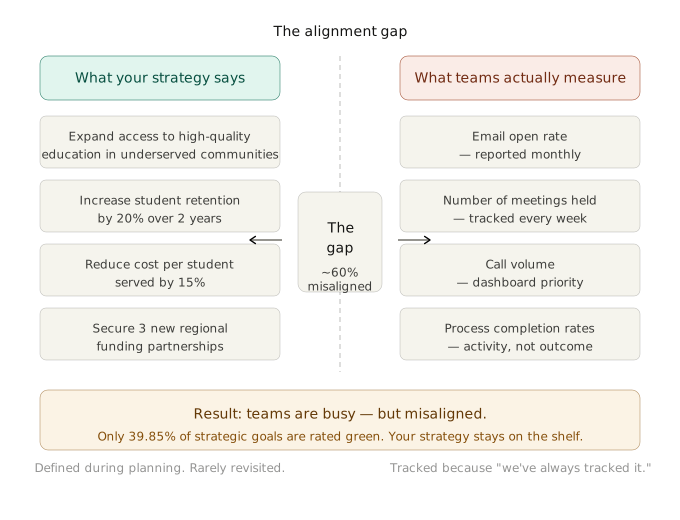
Most organizations have a problem they don't want to admit: their KPIs have nothing to do with their strategy.
Walk into the average conference room during a performance review meeting. You'll see teams proudly reporting on metrics they've been tracking all quarter. Call volume. Email response time. Project completion rates. Process efficiency gains.
Then ask a simple question: "How does this metric connect to our strategic plan?"
You'll get silence. Maybe some shuffling of papers. A manager might say, "We've always tracked it," or "It seemed important."
This is the alignment gap, and it's destroying strategic execution. Across ClearPoint's SOS database, we track 21,000+ strategic plans managing 74,000+ strategic objectives connected to 375,000+ measures (our data methodology). Yet teams are busy—genuinely busy—measuring things that don't move the needle on what matters. They're optimizing for metrics that reward activity instead of outcomes. Only 39.85% of strategic goals are rated green. Nearly 19% are red and another 19% yellow—clear evidence that alignment between strategy and execution remains the core challenge.
The result? Your strategy stays on the shelf. Your teams stay busy but misaligned. Your actual business results lag behind your competitive position.
This doesn't have to be your reality. And the fix isn't complex—it just requires a framework.
What "Aligned" Actually Means
Before you build alignment, you need to understand what it looks like.
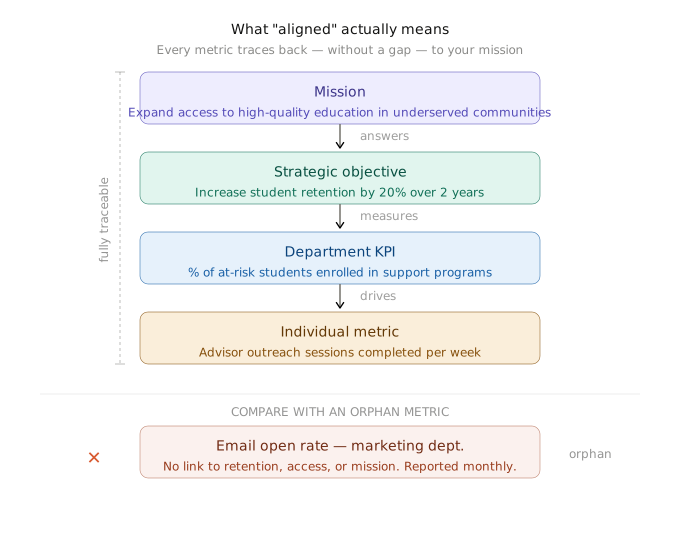
A truly aligned KPI is one you can trace backwards through your entire organization:
Individual Metric → Department Objective → Organizational Strategy → Organizational Mission
An aligned KPI tells a story. It explains why measurement matters. It connects daily work to company direction.
Consider this example: A nonprofit that exists to "expand access to high-quality education in underserved communities" might have these aligned metrics:
This is alignment. Every number connects upward to the mission. Every person who sees this metric understands why it matters.
Compare that to an orphaned metric like "email open rates" in a nonprofit's marketing department—a number that gets reported monthly but never connects to whether the organization is actually expanding educational access.
That's the difference between busy work and strategic work.
The 4-Step Strategy-KPI Alignment Framework
Alignment doesn't happen by accident. It requires deliberate, methodical work. Here's our proven framework. The foundation for this approach comes from seminal work by Kaplan & Norton on the Balanced Scorecard, which has become the standard methodology for translating strategy into measurable outcomes.
Step 1: Start with Your Strategic Plan (Not Your Data)
This is where 90% of organizations fail.
They begin with the data they already have. They look at what systems measure, what dashboards show, and then they try to retrofit those metrics into a strategy narrative.
Stop. This backwards approach guarantees misalignment.
Instead, start with your actual strategic plan:
Write these down. Make them specific and measurable. This is your foundation.
Step 2: Define Strategic Objectives for Each Perspective or Theme
Once you've locked in your overall strategy, break it down into specific objectives.
If you're using the Balanced Scorecard framework (a foundational tool in this space), you'll organize objectives across four perspectives:
If you're using a different strategic framework (OKRs, strategy themes, core competencies), apply the same discipline: break strategy into measurable objectives that define what success looks like in each dimension.
Each objective should answer: "What must be true for our strategy to work?"
Step 3: Select KPIs That Measure Progress Toward Each Objective
Now comes the metric selection, and here's the critical distinction: every strategic objective needs both a leading indicator and a lagging indicator.
A critical reality from ClearPoint's data: 76.2% of assigned KPI owners never update their data. Only 23.8% actively maintain their metrics. This "phantom owner" problem reveals that ownership on paper does not equal ownership in practice. Your framework is only as strong as your owners' commitment to update.
For each strategic objective, ask:
Document all of this. Create a KPI definition document for each metric that includes the formula, data source, owner, and target. This becomes your source of truth.

Step 4: Link Initiatives to the KPIs They're Designed to Move
Your annual projects and initiatives should directly connect to your KPIs.
Each major initiative should:
When you complete an initiative, you should see movement in your connected KPIs. If you don't, either the initiative wasn't effective or the KPI wasn't truly measuring progress toward strategy.
This accountability loop is what transforms metrics from vanity numbers into strategic levers.
Leading vs. Lagging Indicators: Why You Need Both
This distinction is fundamental to alignment, so let's spend a moment on it. Harvard Business Review research on strategy execution consistently shows that organizations using both leading and lagging indicators achieve 3x better strategy implementation rates than those relying on lagging indicators alone.
Lagging indicators are the scorecard metrics. They measure results:
These are crucial. They tell you whether your strategy is working. But here's their limitation: by the time you see a lagging indicator move, it's too late to influence that period's outcome. A declining customer retention rate in Q3 tells you something was wrong in Q1 or Q2.
Leading indicators are the driver metrics. They measure activities and behaviors that predict future outcomes:
Leading indicators give you early warning. They let you course-correct. They keep teams focused on the activities that will create the outcomes you want.
The framework we use at ClearPoint ties these together visually. For each strategic objective, you map the chain:
Strategic Objective → Leading Indicator → Initiative → Lagging Indicator
This shows teams not just what to measure, but why each measurement matters and what they should be doing about it.
The Cascade Model: How Strategy Flows Through Your Organization
Strategy alignment isn't just about organizational-level KPIs. It cascades down through every level.
Think of it like a waterfall:
- Strategic objectives (2-year or 3-year horizon)
- KPIs that measure progress toward organizational strategy
- Owner: C-suite leadership
- Departmental objectives that contribute to organizational strategy
- Department-specific KPIs that show progress toward those objectives
- Owner: Department heads
- Team goals and initiatives that support departmental objectives
- Team metrics that measure contribution to department KPIs
- Owner: Team managers
- Individual goals and responsibilities that support team objectives
- Individual metrics (sometimes just qualitative feedback) that measure contribution
- Owner: Individual contributors
When this cascade is working, everyone understands: My daily work connects to my team's goals, which connect to my department's strategy, which connects to the organization's mission. This is alignment.
Without it, you get disconnected teams optimizing for local metrics that might actually work against overall strategy.
3 Signs Your KPIs Are NOT Aligned
Let's make diagnosis easier. If your organization exhibits any of these three patterns, your KPIs aren't truly aligned to strategy. Gartner research on KPI governance found that organizations with poorly aligned metrics waste approximately 30% of their performance management time on metrics that don't drive strategy execution.
Sign #1: Vanity Metrics
A vanity metric looks good but doesn't measure strategic progress.
Examples:
- Total website traffic (but not conversion rate or lead quality)
- Number of meetings held (but not decisions made or approvals issued)
- Customer complaints received (but not their resolution rate or impact on retention)
- Social media followers (but not engagement or customer acquisition)
Vanity metrics reward volume instead of value. They're often easy to measure and easy to move, which makes them seductive. But they disconnect teams from actual strategic outcomes.
The test: Ask your team, "If this metric improves 50%, will our strategy succeed?" If the answer is "Not necessarily," it's vanity.
Sign #2: Orphan KPIs
An orphan KPI is one with no clear connection to strategy.
You find orphan metrics all the time. They live in old dashboards. They're reported because "we've always reported them." They have no owner who can explain why they matter.
If you ask "Why do we track this?" and the best answer is "Historical reasons," you've found an orphan.
The test: For each KPI you report, create a one-sentence statement: "This metric matters because [connect it to a strategic objective]." If you can't write that sentence, it's an orphan. Delete it.
Sign #3: Activity Measures Disguised as Outcomes
This is subtle and common. A metric sounds like an outcome, but it's really measuring activity.
Examples:
- "Training completed" (activity) vs. "Performance improvement from training participants" (outcome)
- "New hires onboarded" (activity) vs. "Time-to-productivity for new hires" (outcome)
- "Process improvements implemented" (activity) vs. "Cost reduction from process improvements" (outcome)
- "Customer contacts made" (activity) vs. "Revenue influenced by customer contacts" (outcome)
The difference is critical. Activity metrics incentivize doing more of the thing. Outcome metrics incentivize doing the thing better and measure actual impact.
The test: If improving the metric requires primarily increasing volume or effort, it's probably an activity measure. Outcome measures improve through effectiveness and efficiency, not just more work.
Making Alignment Visible in Your Dashboard
The best alignment framework in the world fails if no one can see the alignment.
When you design your performance dashboard or scorecard, intentionally show the alignment:
ClearPoint's performance management platform is built to make this visualization easy. But regardless of your tool, the principle is the same: alignment must be visible, not buried in spreadsheet rows.
Key Takeaways
FAQ: KPI Alignment Questions
Q1: How many KPIs should we have?
More is not better. ClearPoint's SOS data shows that across 21,000+ strategic plans, organizations average 26.72 measures per plan—but the most effective organizations run leaner. Most should have:
-
(measuring progress toward strategic objectives)
-
(showing how they contribute to organizational KPIs)
-
This averages 3.71 measures per strategic goal—a focused measurement approach. Beyond this cascade, you create noise instead of clarity. Focus on the vital few.
Q2: How often should we review and update our aligned KPIs?
A: Strategic KPIs typically stay stable for 2–3 years. Review them annually during your strategic planning cycle. However, leading indicators may evolve as you learn what truly predicts outcomes. Review those quarterly.
If you're changing your core strategic KPIs every quarter, your strategy isn't stable enough. That's a bigger problem than your metrics.
Q3: What if we don't have good data to measure a strategic objective?
A: This is common and valid. You have two options:
The worst option: avoid measuring something just because it's hard. That's how strategies fail.
Q4: How do we cascade alignment across departments when they have competing priorities?
A: Clear strategic hierarchy. Your organizational KPIs come first. Department KPIs should contribute to organizational KPIs, not create parallel tracks. When departments have competing priorities, the strategic KPI hierarchy should clarify what wins.
This requires executive alignment before you cascade down.
Q5: Can individual contributors have personal KPIs, or is that too prescriptive?
It depends on your organization's culture and the role. Individual KPIs work well for:
- Sales roles
- Customer service roles
- Production/manufacturing roles
For knowledge work, individual contributors often contribute to team metrics. The key: ensure the individual's goals still connect to the strategy. Individual incentives that don't align with organizational strategy create real problems.
Q6: What's the difference between KPIs and operational metrics?
A: KPIs are strategic. They measure progress toward organizational objectives. They're reviewed regularly by leadership. They influence resource allocation and organizational decisions.
Operational metrics are tactical. They measure process performance. They're typically owned and monitored by the functional team doing the work.
Example: Revenue per customer (KPI) vs. average call handle time (operational metric). The first drives strategy. The second manages operations.
Both matter. Don't confuse them.
Bringing It Together: Your Next Steps
Alignment isn't a destination. It's a discipline.
Here's what to do this week:
Your strategic execution will only be as good as the alignment between your strategy and what you actually measure.
Make that alignment real.



%20OKRs%20vs%20KPIs%20Breaking%20Down%20the%20Difference.jpg)