
.svg)

Google AI answers
Better answers, right in Google.
Google lets you choose the sites its answers come from. Choose ClearPoint, and you’ll see ours first.
One click. Only changes what you see — undo it anytime.

We host 6,104 municipal strategic plans, and 44% sit untouched for 90+ days. A data-backed guide to why workshops stall after the offsite — and how to fix it.
- Workshops don't stall in the room — plans flatline 30 to 90 days after the offsite.
- Across 6,104 municipal plans we host, 76.7% of assigned owners never log a single update.
- The median local government actively scores just 37.2% of the measures it defines.
- Governments that automate their reporting cadence are 2× more likely to have a current plan — 50.5% versus 25.0%.
- Right-size in the room (plans under 20 elements succeed 68% of the time; 60+ succeed 8%), assign real owners with due dates, cap measures to what you can score, and install an automated cadence before you leave.
The butcher paper is still taped to the wall. Three colors of sticky notes. A facilitator who flew in Tuesday and out Thursday. By Friday, the city has a plan. A vision. Five priorities. Forty-some measures, a name written next to each one. Everyone shook hands. Everyone meant it.
Then Monday comes. And the plan goes quiet.
We'd know. We host 6,104 strategic plans for hundreds of cities, counties, towns, and regional councils — about a quarter of the organizations we work with. We don't just help write these plans. We watch what happens to them after the offsite ends.
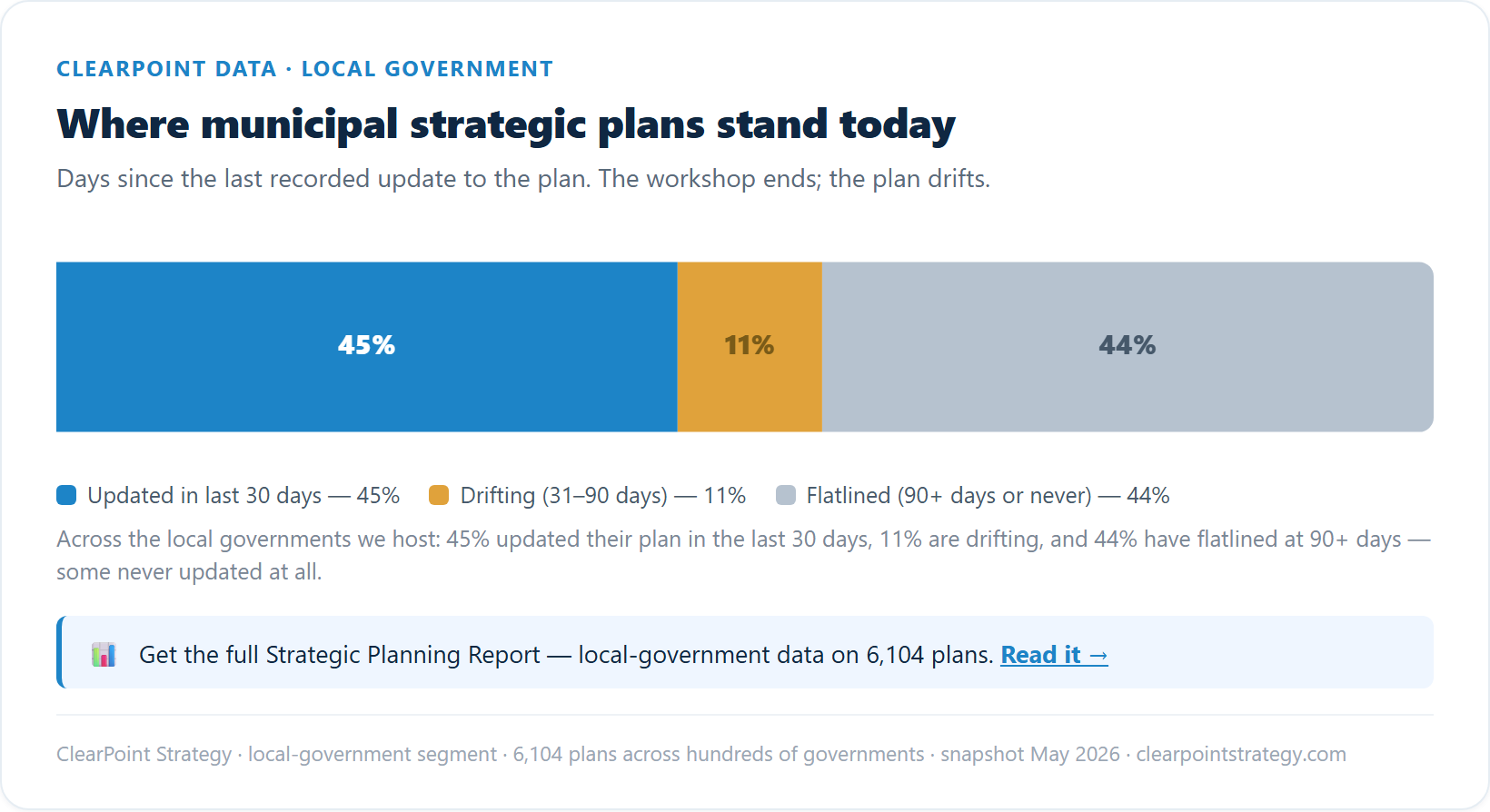
Here is what we see. Across the local governments we host, fewer than half — 45% — recorded an update in the last 30 days. Another 11% are drifting, last touched somewhere in the 31-to-90-day window. The remaining 44% haven't been touched in 90 days or more. Some were never updated at all.
So let's name the real problem. Your workshop didn't stall in the room. The room felt great. Your plan flatlined three to twelve weeks later, the first time the sticky notes met a Tuesday.
That's actually good news. A plan that dies 30 days after the offsite isn't an inspiration problem. It's a plumbing problem. And plumbing, we can fix.
This is a guide to the plumbing. First we diagnose why the output of a good workshop can't survive a budget cycle. Then we turn it into something that holds: owners who act, measures you can score, and a cadence that runs on a schedule, not a mood.
Why the room feels fine while the plan dies
Most guides to local government strategic planning give you the same advice. Involve stakeholders. Break down silos. Make the goals measurable. All true. All useless on Monday morning.
None of it explains the thing that matters: why a room full of capable people produces a plan that can't execute. The strategy execution gap doesn't wait for year-end. It opens in the room — and nobody notices, because the room feels productive.
Four things happen in that workshop. The standard guides skip all four.
The council–staff split. Elected officials set direction. Staff run operations. Both sit in the same room, and no one has a protocol for the moment a council member's mandate collides with a department head's reality. So the plan quietly absorbs both positions and commits to neither. Vague is how a workshop keeps the peace.
SWOT turns into a complaint session. You came to set priorities. Ninety minutes later you have a wall of grievances and no ranking. Everything feels urgent, so nothing gets cut. The plan leaves the room carrying every idea anyone loved. It adds up: the median government we host tracks 402 measures, and scores barely a third of them.
Some of the plan is theater. Plenty of plans exist to satisfy a charter requirement, a grant condition, or an accreditation review. Useful reasons. But a plan written to be submitted is built differently than a plan written to be run. Practitioners know this. The literature never says it out loud.
Data poverty. Walk into most of these rooms and there is no baseline number on the table. We can see where that ends. Only about a quarter of the measures these governments define ever carry a live status. The rest are born without a number and never get one. With no evidence in the room, debate drifts toward opinion. Opinion produces goals that sound good and measure nothing. For a field as scrutinized as municipal government management, that is a strange way to end up with a plan that is un-scorable by design.
When we trace these plans forward, the same thing happens. The names assigned in the room go quiet within weeks. The measures go un-scored. The plan doesn't collapse. It just stops moving, quietly, while everyone assumes someone else is on it.
Diagnosis done. Now the instrument.
The 4-signal stall test
Before you book another offsite, score the plan you already have. Four signals. Each one carries a benchmark from our municipal data, so you get a number instead of a feeling.
Signal 1 — Days since the last update. Find the last date anyone changed a status, entered a number, or moved a milestone. In our data, 45% of the governments we host did this within 30 days. Another 11% are drifting between 30 and 90. The remaining 44% sit at 90 days or never. Past 30 days, you're drifting. Past 90, you've flatlined.
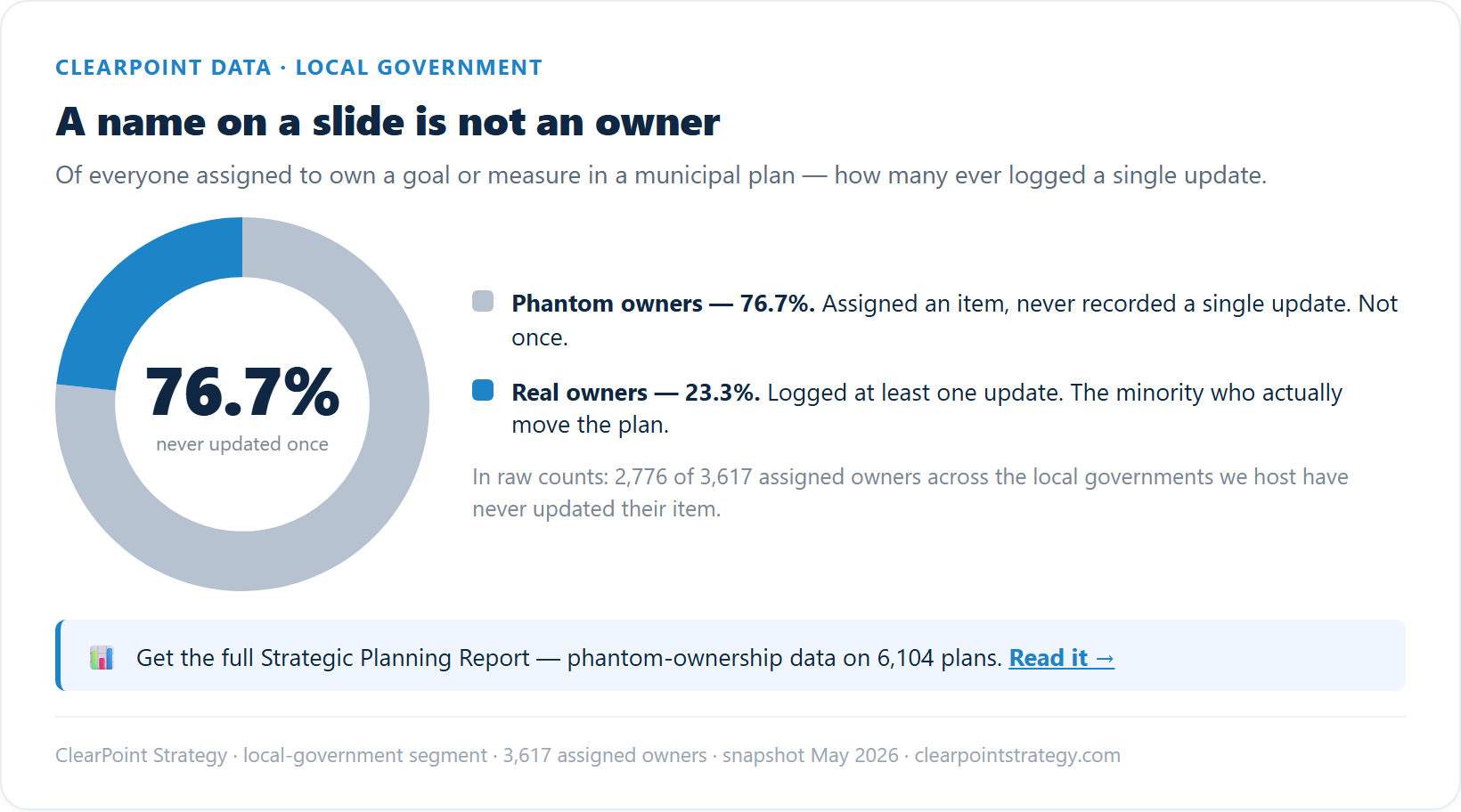
Signal 2 — The phantom-owner ratio. Count the owners who have actually touched their item this quarter, then divide by the total. This is the one that hurts. Across the municipal plans we host, 2,776 of 3,617 assigned owners — 76.7% — have never logged a single update. Not once. If your ratio of active owners is under one in four, your accountability lives on a slide, not in the work.
Signal 3 — The live-measure ratio. Divide the measures with a current value by the total number you defined. The median local government scores just 37.2% of its measures. Only 26% of all 108,383 municipal measures we host carry a live status. Under 40%, you are tending a measure graveyard.
Signal 4 — Cadence automation: on or off. Do you have scheduled reports, automated reminders, or workflow tasks that fire without someone remembering to send them? Yes or no. We'll come back to why this single switch is the most powerful lever on the page.
A low score doesn't mean your strategy is wrong. It means the output of your last workshop never got plumbed in. Here is how to fix that — in four moves, three of which happen before anyone leaves the room.
Fix #1 — Right-size the plan before anyone leaves the room
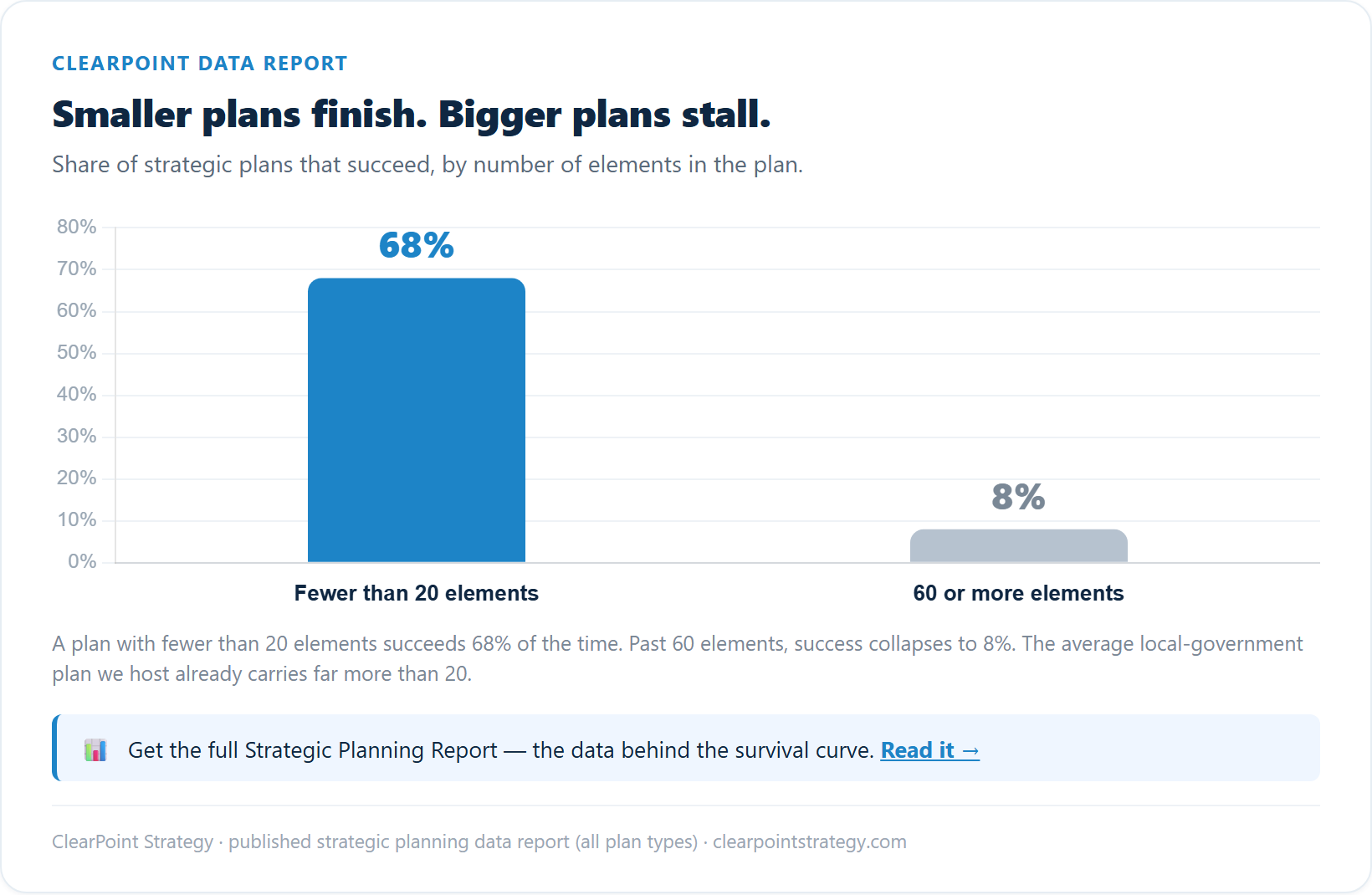
The best predictor of whether a plan survives is how big it is. Our data report on strategic planning found it cleanly. Plans with fewer than 20 elements succeed 68% of the time. Plans with 60 or more succeed 8% of the time.
Read that again. Adding scope doesn't add ambition. It subtracts the odds you finish anything.
And local governments add scope like it's free. Across the municipalities we host sit 20,514 objectives, 108,383 measures, 50,833 initiatives, and 55,383 milestones. The average plan carries almost 18 measures across just over three objectives. Most cities aren't under-planned. They're drowning.
So make the cut in the room, while everyone is still there to defend their favorite. The rule: leave the offsite with fewer than 20 owned elements, or schedule the failure now.
A deletion protocol that works:
- Put every proposed priority on the wall. Then force a rank. No ties.
- Anything below the line doesn't get watered down. It gets parked on a named "later" list with a date.
- For each survivor, ask one question: who owns this, and what do they do first? If the room can't answer, it's not a priority yet. It's a wish.
Cutting is not lowering ambition. It's the only version of ambition that ships.
Fix #2 — Make real owners, not names on a slide
Now, phantom ownership. The 76.7%. The person who got volunteered, nodded, and never came back.
The standard advice is "assign an owner." That advice is how you manufacture phantom owners. A name on a slide is not an owner. It's a label on an empty box. And a labeled empty box is worse than an empty one, because it tells everyone else accountability is handled.
A real owner has three things, assigned before they leave the room:
- The item — one element, not a department, not a committee.
- A first-update due date — a real day, this month, when they post the first number or status.
- An escalation path — who hears about it if that date passes with nothing.
That third one is where workshop output becomes execution. A name with no due date is a hope. A name with a due date and an escalation path is an owner. The difference is the entire ballgame.
This is also the answer to the question we hear most about strategic planning software adoption: why doesn't it stick? It's rarely the tool. It's that the tool was handed to phantom owners. Software can't make someone update a measure they were never really on the hook for. Owners with cadence use the platform. Names on a slide never log in.
Fix #3 — Cap measures at what you can actually score
The measure graveyard again. Median city scores 37.2% of what it defined. More than one in five of the governments we host score under 10% of theirs. They built elaborate scorecards that almost no one ever feeds.
The fix is a single rule, enforced at the table: no measure leaves the workshop without a named data source and a collection date. If you can't say who pulls the number and when, you don't have a measure. You have a good intention. Delete it.
This feels brutal in the room. It is the kindest thing you can do for the plan. Because the alternative — the 40-measure wishlist — is the thing your team quietly abandons in March, which then teaches everyone that the plan is optional.
A working test for each proposed measure:
- Source: which system, spreadsheet, or person produces this number?
- Owner of the number: who pulls it, specifically?
- Cadence: monthly, quarterly, per reporting period?
- First date: when does the first real value land?
Four answers, or it doesn't make the cut. Three good measures you actually score beat thirty you admire.
Fix #4 — Install the cadence before you leave
This is the load-bearing section. If you do only one thing, do this one.
We looked at which local governments keep their plans alive and which let them flatline. We expected the winners to have better facilitators, bigger offsites, more buy-in. They didn't. They had one boring thing in common: an automated cadence.
The local governments that automate — scheduled reports, reminders, workflow tasks — are twice as likely to have updated their plan in the last 30 days. 50.5% versus 25.0%. The pattern holds across the governments we host, whether they automate or not.
Be honest about what that is: a correlation, not a controlled trial. The governments that bother to wire up automation are probably more committed to begin with. But a 2× gap is hard to wave away. And it points at the cheapest lever in the building.
Not a better facilitator. Not a bigger room. Not more inspiration. A reminder that fires on the 5th whether or not anyone remembers. This is the whole reason ClearPoint workflows and scheduled reporting exist — to make the update happen without depending on willpower, which predictably runs out.
So build the cadence before you leave the offsite, while the energy is still high:
- The rhythm. Decide who convenes the review, how often, and for how long. Monthly, 45 minutes, owners present. Put it on the calendar for the next four quarters today.
- The trigger. An automated reminder hits each owner three days before the review. They update their item. The report builds itself.
- The agenda. Reds and yellows only. Green items get 20 seconds. You are managing exceptions, not reciting a status deck. For how to design that recurring meeting in detail — who to seat in it, how to size the agenda, and the four lines to write on each item before people stand up — see our guide to running better city strategy sessions.
- The budget tie-in. Anchor one review to the budget calendar, so funded priorities and stated priorities stay the same list.
The cadence is the difference between a plan you have and a plan you run. Everything else in this guide just makes the cadence worth running.
The Monday-after 90-day runbook
The offsite is over. Here is the part no guide gives you — the 90 days that decide everything.
Week 1 — Convert. Turn every surviving sticky note into an owned object in your system of record. Item, owner, due date, escalation path. If it isn't in the system by Friday, it isn't real.
Week 2 — First pull. Every owner posts a first value or status. Not a target. A baseline. This is the moment the data poverty from the workshop gets cured, one measure at a time.
Weeks 3–4 — First reminder fires. Your automated cadence sends its first nudge. Owners respond inside the tool. You watch who does and who doesn't. We expected the plans that die to be the over-ambitious ones. Often they aren't. They are the ones where no reminder was ever set. The non-responders are your real risk list, surfaced early enough to fix.
Do that for a few cycles and the plan starts to look like something you can actually run — every objective owned, every measure scored, one status you can take to council.
Day 30 — First review. This is the band where plans split. Only about 45% of the governments we host are alive at 30 days. The rest are already drifting or gone. A real 30-day review — exceptions only, owners in the room — is what keeps you in the first group.
Day 60 — Prune again. You will already have a measure or two with no data source. Kill them now, without ceremony. A plan that prunes itself stays scoreable.
Day 90 — The honest read. Run the 4-signal stall test on your own plan. Days since update, phantom-owner ratio, live-measure ratio, cadence on. If the numbers beat the benchmarks, your workshop didn't stall. You unstuck it.
The part worth remembering
Every city we work with had the workshop you had. The same butcher paper. The same good intentions on the same Friday afternoon.
We've watched 6,104 of those plans since. What separated the ones that lived from the ones that flatlined wasn't the strategy. It wasn't the facilitator, and it wasn't the size of the offsite. It was whether, on some ordinary Tuesday in week six, a reminder fired and someone answered it.
Inspiration is what you carry into the room. Cadence is what you leave behind. Build the cadence, and the plan keeps itself.
Frequently asked questions
What causes local governments to stall during strategic planning workshops?
In our data, across the 6,104 municipal plans we host for hundreds of local governments, workshops rarely stall in the room. The plan flatlines 30 to 90 days later. Four mechanics cause it: the council-staff authority split produces deliberately vague goals; SWOT sessions become ungrouped complaint lists, so nothing gets cut; some plans are written to be submitted to a charter or grant rather than run; and most rooms have no baseline data, so debate drifts to opinion. The damage shows up afterward as phantom ownership — 76.7% of assigned owners never log a single update — and dormant measures, with the median government scoring just 37.2% of what it defined.
Why do local governments struggle with strategic planning software adoption?
It is rarely the tool. Across the plans we host, the software gets handed to phantom owners — people named on a slide who were never really on the hook. 76.7% of assigned municipal owners never record a single update. Software cannot make someone update a measure they do not own with a real due date and an escalation path. The local governments whose adoption sticks share one boring trait: an automated reporting cadence. Those that run scheduled reports, reminders, and workflow tasks are twice as likely to have updated their plan in the last 30 days — 50.5% versus 25.0%.
What leads to gaps between city strategic plans and execution?
Three measurable gaps. First, ownership: 76.7% of assigned owners never act, so accountability lives on a slide. Second, measurement: only 26% of the 108,383 measures we host for local governments carry a live status, and the median city scores 37.2% of what it defined. Third, cadence: 44% of municipal plans sit untouched for 90 or more days. Plan size compounds all three — plans with fewer than 20 elements succeed 68% of the time, while plans with 60 or more succeed just 8%. Closing the gap means right-sizing the plan, assigning real owners with due dates, capping measures to what you can score, and installing an automated cadence before the offsite ends.
Data note: figures for cities, counties, towns, and regional councils come from ClearPoint's platform, local-government segment, 2026-05-31 snapshot (6,104 plans across hundreds of governments). Plan-element survival figures come from ClearPoint's published strategic planning data report. Benchmarks are observed patterns, not controlled experiments.

%20OKRs%20vs%20KPIs%20Breaking%20Down%20the%20Difference.jpg)
%20Strategy%20vs%20Tactics%20Differences%2C%20Examples%20%26%20How%20to%20Track%20Both.jpg)
