.svg)
Google AI answers
Better answers, right in Google.
Google lets you choose the sites its answers come from. Choose ClearPoint, and you’ll see ours first.
One click. Only changes what you see — undo it anytime.

Research from 117,547 active strategic goals shows why most goals fail—and how fewer goals, clear ownership, and better measures improve execution.
- Across 20,582 plans, the median is five active strategic goals and the average 6.7 — most organizations set more goals than they can realistically own.
- Setting a goal without naming an owner is wishful thinking: 74.3% of active goals have none, and goals with active owners see a 12% completion boost.
- A strategic-sounding goal still needs a measurable outcome, a finish line, and a named owner — without all three, there is nothing to track.
- Goals need backing measures, but most overdo it: the median plan runs 9 active measures while the average balloons to 24.7.
- High performers cap the portfolio before the planning session, keep goals cross-departmental, and pair every goal with at least one measure that shows movement.
What if the real reason your strategy isn’t working isn’t the strategy itself, but the way your strategies are set in the first place?
Most planning teams spend plenty of time debating their goals, but far less time questioning how those goals are chosen, structured, and managed once the plan is approved. The result is familiar: long lists of priorities, inconsistent progress, and a growing gap between strategy on paper and what actually gets done.
This post breaks down what the data actually shows about how organizations set goals, what separates high performers, and what to do differently before you write a single objective this year.
Get all the data (benchmarks, portfolio sizes, cadence, and more) that defines high performance. Download the 2026 Strategic Planning Report now.
How Many Goals Should a Strategic Plan Have?
This is the first question every planning team argues about. The data has a clear answer.
Across 20,582 strategic plans spanning 2017 to 2024:
- Median: 5 active strategic goals per plan
- Average: 6.7 active strategic goals per plan
The gap between median and average matters.
It means large organizations are pulling the average up — setting far more goals than the typical organization and dragging performance down with them.
The report is explicit on why this happens. Plans with fewer than 20 total strategic elements succeed 68% of the time. Plans with 60 or more elements succeed just 8% of the time.
More goals don’t create more focus. They create more noise.
The data-backed target: 5–9 strategic goals. That range gives teams enough specificity to act while keeping the plan governable by real people with real workloads.
<div class="index-cards"><div class="index-card"><div class="index-card-title"><h3><strong>Does Industry Matter?</strong></h3></div><div class="index-card-content"><p>You might assume your industry sets the standard for how many goals to have. The data says otherwise.</p><p>Manufacturing, Nonprofits, and Professional Services average 10 goals, the highest of any sector. Government and Financial Services average just 5. And the two sectors with the leanest goal counts both outperform the cross-sector average on project completion.</p><p>The takeaway: <strong>Industry norms are a poor guide.</strong> Whatever your peers are doing, the data is consistent. Keeping 5 to 9 goals increases your odds of execution significantly.</p></div><div></div>
The Ownership Problem Starts at the Goal Level
Setting a goal without naming an owner isn’t goal setting. It’s wishful thinking.
The data on this is uncomfortable:
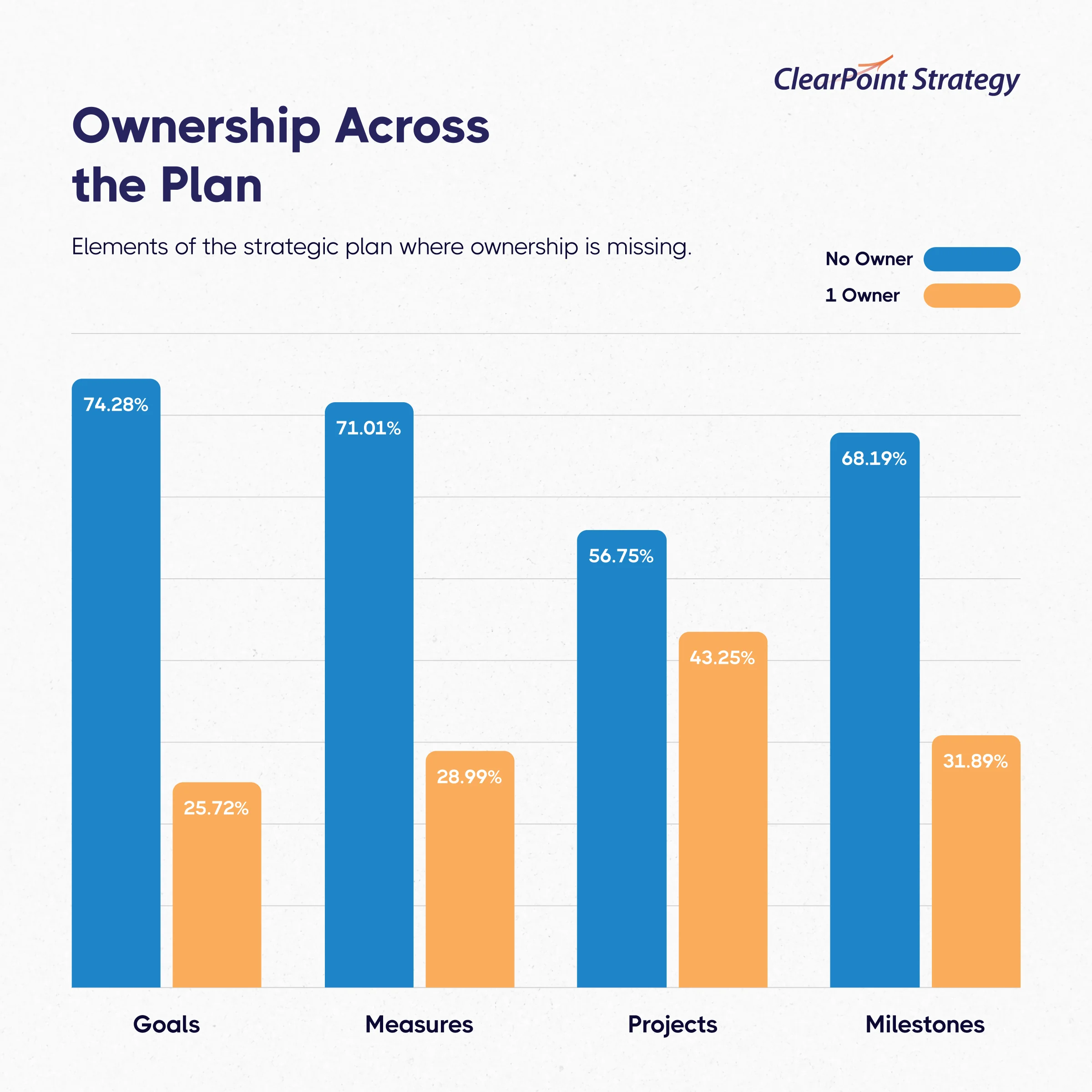
- 74.3% of active strategic goals have no named owner
- Goals with active owners see a 12% boost in completion rates
- Only 13.8% of assigned owners are active (updated in the last 90 days)
That last number is the most revealing. Even when ownership is assigned, it’s mostly symbolic. For every active owner in the dataset, there are approximately 6.3 inactive ones.
The fix is structural, not motivational. Three rules that consistently appear in high-performing plans:
- One owner per goal — not a department, not a committee. A person.
- The 90-day rule — if an owner hasn’t updated in 90 days, reassign or remove.
- Active ownership on the dashboard — track the percentage of goals with active owners as a governance metric, visible to leadership every quarter.
Goal Clarity (Not Ambition) Drives Completion
A goal named "Strengthen Community Partnerships" sounds strategic. But strategic-sounding goals still need a measurable outcome, a finish line, and a named owner. Without those three things, there is nothing to track and no way to know if you succeeded. These types of goals will sit on the plan for three years and never move.
The report’s data on goal status tells the story:
- Only 39% of goals are rated green (on track or above plan)
- 18.96% are red (below plan)
- 18.90% are amber (at risk)
- 14.88% haven’t started
- 8.32% are unclear in status
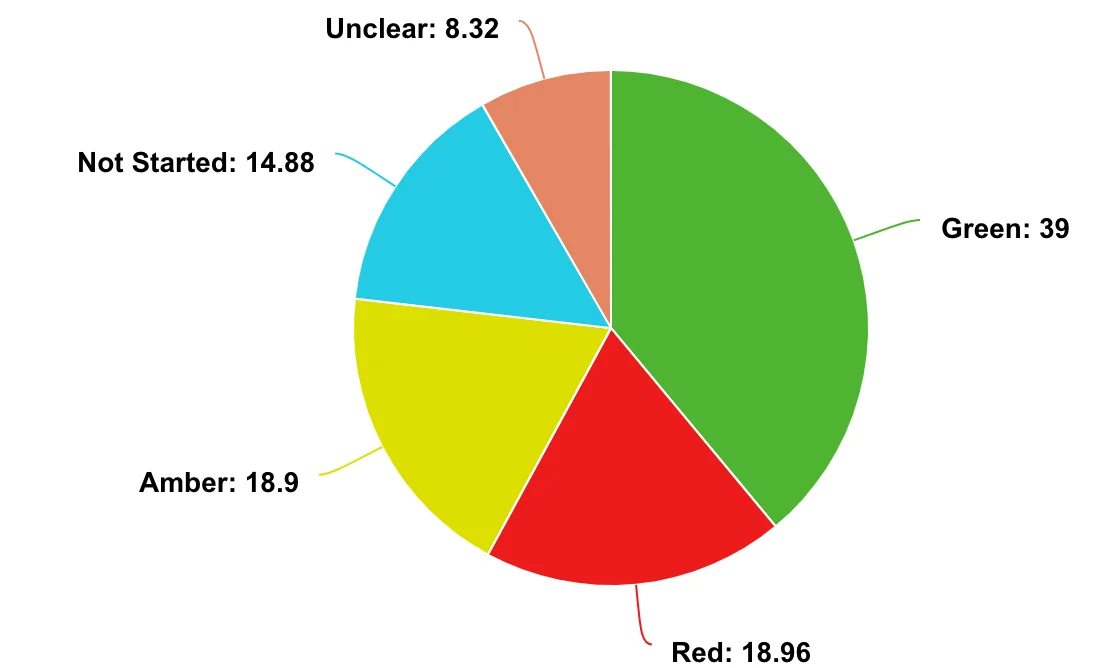
Nearly 53% of all active goals are either behind, at risk, or haven’t started.
That’s not a motivation problem. It’s a clarity problem. Goals that lack a clear owner, a measurable outcome, and a realistic timeline predictably stall.
How Many Measures Should Back Each Goal?
Goals without measures are intentions. The data shows most organizations know this — but overdo it.
Across the dataset:
- Median: 9 active measures per plan
- Average: 24.7 active measures per plan
That gap is enormous. Large organizations are stacking measures — creating what the report calls “tracking theater.” The appearance of accountability without the substance.
The high-performing benchmark is roughly two measures per goal.
More measures means more updating, more maintenance, and more cognitive load. If a measure doesn’t tell you whether the goal is moving, it belongs in an operational dashboard, not the strategic plan.
Set Goals At The Right Level
One of the most common goal-setting mistakes is confusion between strategic goals and operational objectives.
Strategic goals are cross-departmental by design. They span multiple functions, persist across multiple years, and connect to organizational outcomes.Increase annual revenue by 15% by Q4" is a strategic goal. “Complete the downtown streetscape project” is a project — it belongs in a project tracker, not the strategic plan.
When operational objectives migrate upward, a focused strategy document turns into an org chart with deadlines. Education organizations carry the most active projects of any sector (median of 13.9) and one of the lowest completion rates (14.29%). When plans try to track everything, they end up moving nothing.
Goal Setting Strategies That High Performers Use
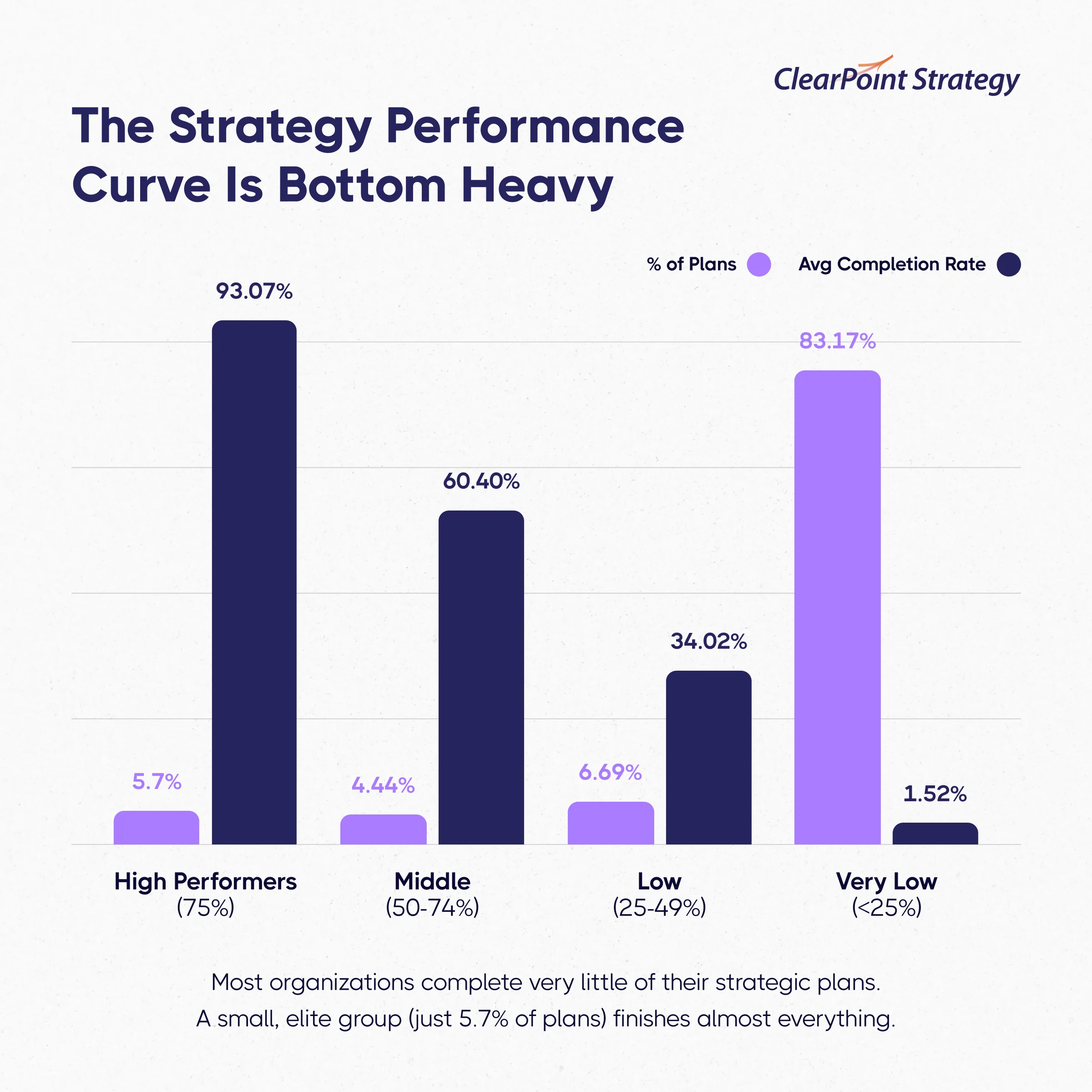
The top 5.7% of organizations — those completing 75% or more of their strategic projects — don’t set more ambitious goals. They set better-structured ones.
Three practices consistently appear:
- They cap the portfolio before the planning session starts. The constraint isn’t how many good ideas exist. It’s how many the team can own, measure, and report on over the next 12–18 months. That limit gets set before the whiteboard session, not after.
- They attach measures and owners at the goal level on day one. A goal without a measure and an owner doesn’t make it onto the plan. This single rule eliminates most wishful-thinking goals before they take root.
- They review goal health quarterly, not annually. November is the peak month for strategic engagement in the dataset — most organizations only look hard at their plans when year-end forces it. High performers make that review a quarterly habit so course corrections happen in time to matter.
A Practical Goal-Setting Checklist
Before any goal makes it onto your strategic plan, it should pass all five of these checklist items:
- Does it have one named owner (a person, not a department)?
- Does it have at least one measure that will tell you if it’s moving?
- Is it cross-departmental — or does it belong in a single department’s operational plan?
- Can the owner realistically update it every 90 days?
- Does it connect to a community or organizational outcome a leader would care about explaining to a board?
If the answer to any of these is no, the goal isn’t ready for the strategic plan.
<p style="font-size:80%;"><em>Data sourced from ClearPoint Strategy’s 2026 Strategic Planning Report, which analyzed 31.2 million rows of activity data from 20,582 strategic plans spanning 2017 to 2024.</em></p>
<p style="font-size:80%;"><a href="https://www.clearpointstrategy.com/go/strategic-planning-report"><em>Download the full 2026 Strategic Planning Report</em></a><em> for complete benchmarks, methodology, and industry comparisons.</em></p>