What strategy consultants do, how an engagement runs, and what drives its cost. Use it to choose a firm and keep the plan moving after the consultants leave.
- Define the problem and what success looks like before contacting a firm; clients unsure of their needs get misaligned effort and wasted resources.
- Choose a firm with experience in your industry, and ask for case studies and references that show outcomes like the ones you need.
- Weigh boutique against large firms: boutiques offer tailored, niche expertise; large firms bring more resources.
- Judge the return on KPIs such as revenue growth, customer satisfaction and employee engagement, not only immediate cost savings. This ROI calculation guide shows one method.
- Plan for execution: turn recommendations into owned actions and track them against KPIs after the engagement ends.
Strategy consulting helps a company decide where it wants to be in the long term, understand where it stands now, and plan how to close the gap. This guide covers what strategy consultants do, the large firms most companies consider, the skills to look for, how an engagement runs, what drives cost, and how to choose a partner. It ends with what happens after the consultants deliver their recommendations, which is where many plans stall.
What strategy consulting covers
Strategy consulting focuses on high-level, long-term planning. An engagement usually means setting goals, analyzing the company's internal and external position and its market, and turning that analysis into plans the company can act on. Consultants bring an outside view, challenge assumptions, and base recommendations on data rather than instinct.
Most firms tailor their work to the client's industry and problem, but the services usually fall into a few groups:
- Strategic planning: long-term plans built on market analysis, competitive assessments and defined key performance indicators (KPIs).
- Growth strategy: new market entry, product development, or mergers and acquisitions.
- Operational improvement: analyzing workflows, finding bottlenecks and applying better practices to raise efficiency and profitability.
- Innovation and transformation: new business models, new technology and digital transformation. Bain & Company, for example, frames growth around mastering the "rules of the game," leadership economics and shifting profit pools.
- Change management: communication plans, stakeholder engagement and training that help an organization through a major change with less disruption.
Leading strategy consulting firms
Five large firms and their specialties are a reasonable place to start a search. McKinsey & Company is known for rigorous problem-solving and deep industry knowledge, works closely with top executives, and is often brought in for complex, broad challenges. Bain & Company has provided strategy consulting since 1973, with an emphasis on practical, implementable results; it is known for private equity work and its Results Delivery® approach. Boston Consulting Group (BCG) combines data analytics with industry knowledge and is known for its proprietary frameworks, often on growth, innovation and large-scale transformation.
Deloitte Strategy & Operations covers corporate strategy, business model transformation and operational improvement, often alongside other Deloitte services. Strategy&, formerly Booz & Company, is PwC's strategy arm and concentrates on mergers and acquisitions and operational strategy, linking strategy work to execution. For a comparison of hiring a firm against running strategy in-house with software, see do you need a strategy consultant or management software.
Skills of a good strategy consultant
Most strategy consultants hold a bachelor's degree in business administration, finance, economics or a related field. An MBA is not required but adds specialized knowledge and a network, and certifications such as the Certified Management Consultant (CMC) signal a commitment to the profession.
The core skill is analysis and problem-solving: breaking a messy situation into parts, finding root causes and building recommendations on evidence. Many consultants work hypothesis-first, forming an educated guess and testing it against data. They also need to explain complex ideas clearly to executives and staff, in presentations, workshops and written reports. Finally, good consultants have broad business acumen: they read financial statements, understand competitive dynamics, pick up a new sector quickly, and are comfortable giving senior leaders unbiased advice.
How an engagement runs
An engagement typically runs in four stages:
- Assess and define the problem. Name the challenge, whether that is declining sales, lost market share, operational inefficiency or a planned expansion, and say what success would look like. Clients who are unsure of their needs complicate the consulting process and end up with misaligned effort and wasted resources.
- Gather and analyze data. Consultants combine internal and external sources, such as customer surveys, market research, financial statements and operational data, to find trends, patterns and root causes.
- Develop strategies and make recommendations. The team lays out strategic options, tests each for feasibility and recommends a course of action.
- Implement and follow up. The plan becomes implementation steps with owners, and progress is tracked against it so the strategy stays on course.
What drives the cost
Scope and complexity are the main factors: a focused project costs less than an organization-wide overhaul, and the size and expertise of the team you need follow from the scope. Highly specialized firms with a proven track record usually charge more. The level of collaboration needed between the consultants and your staff also affects the cost.
Judge the return on more than immediate cost savings. Track the KPIs the engagement was meant to move, such as revenue growth, customer satisfaction and employee engagement. ClearPoint's ROI calculation guide walks through one way to do this.
When to hire a strategy consultant
Internal resources are sometimes enough. An outside view helps when current strategies are delivering diminishing returns, when you lack the specialized skills for a specific challenge, or when your team is too absorbed in daily operations to see the bigger picture. Common triggers are major strategic moves such as entering new markets, restructuring, mergers and acquisitions, or digital transformation. A company planning to expand internationally, for example, can get help with target markets, regulatory hurdles and cultural differences.
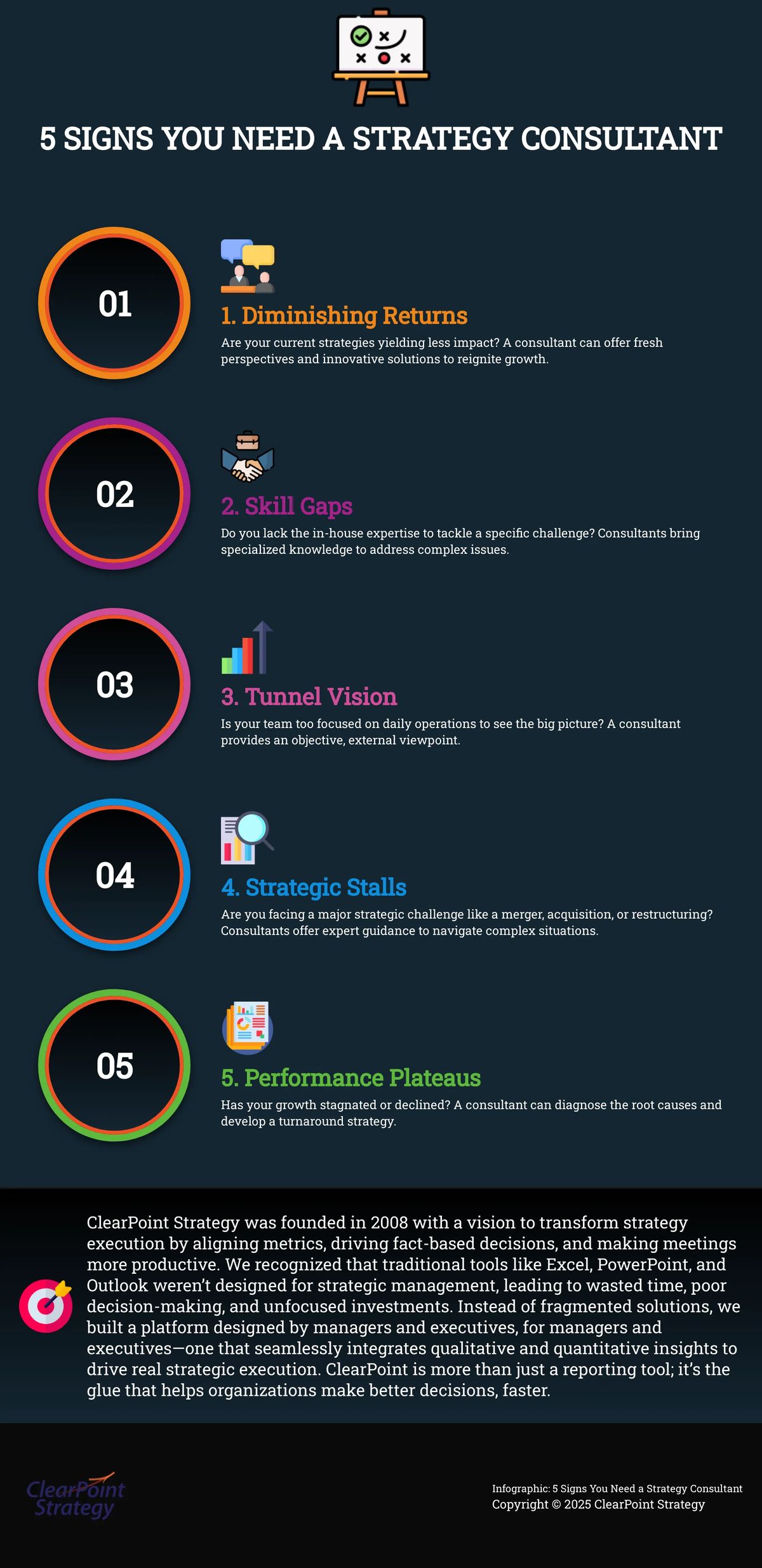
The other common trigger is stalled performance, such as flat growth or falling market share. A consultant can find the root causes, build a turnaround plan and help carry it out. Ask them to train your team on the tools and methods they use, so the capability stays after the engagement ends.
Choosing the right partner
Start with expertise and track record. Strategy consultants typically work with CEOs and boards on a company's overall direction, while general consultants usually implement solutions within a strategy already set. Look for experience in your industry, and ask for case studies and client references that show outcomes like the ones you need.
Then consider cultural fit and working style. Think about how you prefer to communicate, whether you want direct feedback or a more collaborative style, and whether the consulting team will work well with yours. A good fit makes the engagement smoother and more productive.
Finally, weigh firm size. The Big 4 (Deloitte, EY, KPMG and PwC) offer a wide range of services beyond consulting, while McKinsey, Bain and BCG, often called MBB, are smaller and more focused on strategy; this overview compares the two groups. Boutique firms and niche specialists offer more tailored service and industry-specific knowledge, and may respond faster, while larger firms bring more resources. The right choice depends on your needs and budget.
Executing the strategy after the engagement
A strategy on paper delivers nothing until it becomes concrete actions that someone tracks. This is where many organizations stumble. Two common causes are goals that were never made specific and measurable, and a plan that cannot adjust when conditions or data change.
ClearPoint is strategy execution software, not a consulting firm. Organizations use it after an engagement to keep the plan in one place, connecting project tracking with KPI reporting so leaders can see progress and adjust. Its Success Framework, built on five critical success factors, gives teams a structure for managing, tracking and aligning the work. More on the product is on the strategic planning software page.
Related articles
Common questions
What should we prepare before contacting a strategy consulting firm?
A written problem statement and a definition of success. Add the decisions you need made, the data the firm will need, an executive sponsor, and how much internal time you can commit. Firms price on scope and collaboration, so this preparation keeps proposals comparable and stops you paying consultants to work out what you want.
What should a strategy consulting statement of work include?
Scope, deliverables, named team members, timeline, fees, and the KPIs that define success, with baselines agreed up front. Also specify your own team’s time commitment and the handover: who on your staff will own each recommendation, and what training, tools and documentation transfer to you before the engagement ends.
How should we judge whether a consulting engagement paid off?
Against KPIs you baseline before the work starts, such as revenue growth, customer satisfaction or employee engagement, not against the quality of the final deck. Agree those measures with the firm up front, track them through the engagement, and keep tracking after the consultants leave, since most of the return arrives during implementation.
How do we keep the strategy moving after the consultants leave?
Turn every recommendation into an owned objective, measure or initiative before the engagement closes. Give each one a named owner, a target and a date, then review progress on a fixed monthly or quarterly cadence. Ask the firm to train your team on its tools and methods so execution does not depend on them.