We analyzed 20,582 strategic plans. Get a copy of the full report.
Rhythm Systems says it plainly: "made by CEOs for CEOs," "purpose-built for middle-market companies." We say it just as plainly: ClearPoint is built around 20,582 real strategic plans from cities, counties, health systems, campuses and utilities — where 81.1% of KPI owners never update their data and a council reads the result.
Every number sourced. Rhythm claims from rhythmsystems.com and their help center. ClearPoint claims from our published research.
.webp)
.webp)

.webp)


We published the analysis of 20,582 real strategic plans. Rhythm cites "40,000+ plans created" as a usage stat; we found no published dataset. Their blog cites our research.
Rhythm: "Built for $10M–$500M companies." We found no city, county, state agency, school district or public university on their site. ClearPoint: 150+ cities and counties, plus health systems, campuses and utilities.
Our customers publish live dashboards to the public. Rhythm's help center describes access "by anyone using the Rhythm service" — logged-in users — with no external sharing described.
Both products earn their seat. Here's where each is strongest, based on what each company says about itself.
In their own words: "The Patented Strategy Execution System for Mid-Market CEOs" · "Stop setting goals. Start achieving them."
Specialist platform built for organizations whose strategy is accountable to a public — councils, health boards, regulators, citizens.
of assigned KPI owners never update their data. Only 18.9% actively maintain their metrics. Your platform should tell you which owners have gone quiet.
ClearPoint research · 20,582 plans · 31.2M rows
of strategic goals are rated green. Nearly 19% are red and another 19% yellow. An owned objective is 2.2× more likely to be on track than an unowned one.
months — the median strategic project. A quarterly review checks in three or four times over that life. Continuous tracking is the difference.
of strategic measures are set up but never collected. Tracking a measure that never starts is invisible waste — until the board asks.
ClearPoint research · 20,582 plans
of state-government goals and 90% of healthcare goals have no named owner. Municipal 81%, county 72%. Sector matters.
Published research, one dataset. Open to anyone who wants to check the math.
See where the numbers come from →If you run a for-profit mid-market company, Rhythm is a strong choice. Six things they do well, from their own site.
Think Plan Do® is a method, not just a tool: quarterly plans, a 13-week race, weekly meetings, red-yellow-green. If you want the rhythm prescribed, it’s prescribed.
Methodology, software and expert coaching sold as one system, with an "Early Wins Guarantee." We include onboarding; we don’t sell a coach.
"Ask Patrick," a business coach co-developed with OpenAI, plus a Plan Builder and SMART Goal Writer.
An MCP connector for Claude and ChatGPT, listed in both directories in August 2026. Credit where due. (ClearPoint offers an MCP server too.)
422 reviews on G2 at 4.4/5. A lot of mid-market CEOs have used it.
"Give us 14 days" and a 30-day consulting guarantee. Clear terms.
Rhythm doesn’t publish a comparison of ClearPoint. Here are the three things a buyer weighing both usually raises, with the question to ask each vendor.
True. Rhythm prescribes Think Plan Do. ClearPoint runs the framework you already have — a scorecard, OKRs, a comprehensive plan, an accreditation model — and lets departments differ. Ask which matters: adopting their cadence, or reporting yours.
It does — 422 on G2 versus our 177 — and roughly 86% of its G2 reviewers are small business or mid-market (29.4% + 56.7%). On the same G2 compare page, ClearPoint scores higher on Custom Reporting (9.1 vs 6.6), Reporting Templates (9.0 vs 6.6) and Data Visualization (8.9 vs 7.5). Ask which score describes your job.
Neither company publishes pricing. Third-party listings show a Rhythm "starting price" of $40/month; ClearPoint starts at 10 users with onboarding included. Compare the whole number — coaching, seats, integrations, security — in writing, from both.
Source: g2.com/compare/clearpoint-strategy-vs-rhythm-systems-rhythm; rhythmsystems.com.
No named owner, by sector. A generic platform treats these the same. They are not — and then the plan itself outgrows a simpler tool.
ClearPoint Gap Analysis · n = 20,582 plans
Three moments where a public organization finds the mid-market shape doesn't fit.
Rhythm exports reports as PDF or DOCX and a PowerPoint "Strategic Foundation" (per their help center). We found no scheduled distribution and no external or public sharing. A council packet that ships itself monthly, and a resident dashboard, are the product for our customers.
Rhythm documents SAML SSO and 2FA; its data-security page describes encryption and hosting. We found no SOC 2, ISO 27001, FedRAMP or VPAT on their site. Public-sector procurement asks for them. ClearPoint: SOC 2 Type II, SAML SSO, WCAG 2.1 via plug-in.
Rhythm runs its own method and positions against "most OKR software"; we found no Balanced Scorecard or accreditation-framework support named. When the council wants a scorecard and public health wants PHAB evidence, one tool has to speak both.
Source: rhythmsystems.com/knowledge/downloading-reports, /knowledge/data-security, /software/rhythm/alternatives-and-competitors.
Three surfaces our customers use every week. Real screens, not concept art.

Residents see progress without asking. Live today at Fort Collins, Coral Springs, Buncombe County, Durham and Fort Lauderdale.
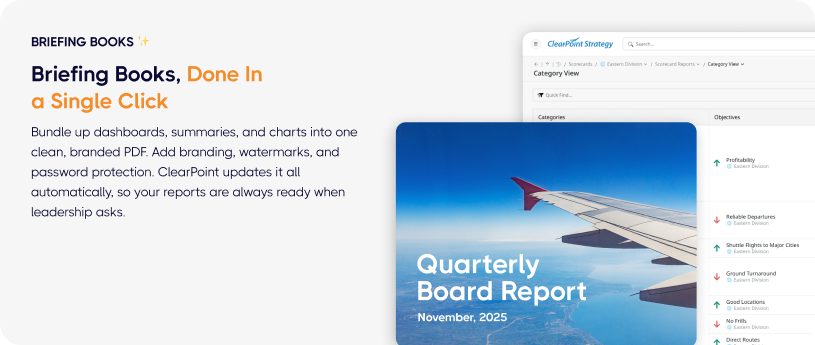
Dashboards, charts and summaries bundled into one branded PDF. Watermarked, password-protected, scheduled. Ready when leadership asks, not three days after.

Gantt and Kanban views with dependencies and critical path. The median strategic project runs 10.94 months; watch it the whole way, not once a quarter.
Three customers, in their own words.
A city that publishes its strategy to residents.
The Press Play 2029 strategic plan, published as a live dashboard.
Strategy reporting the public can read.
No form, no call. Click through the product as it ships today.
How to read this: "per their site" marks a claim Rhythm Systems makes about itself. "Not advertised" means we could not find it in their public materials on 2026-09-02 — it is an absence, not a verdict.
| Capability | ClearPoint | Rhythm Systems |
|---|---|---|
| Stated target market | Government, healthcare, higher ed, utilities, financial services | "Built for $10M–$500M companies"; "made by CEOs for CEOs" — per their site |
| Public-sector customers named | 150+ cities and counties; live dashboards linked above | None found on their site (checked homepage, case studies, reviews page) |
| Published dataset of real plans | 20,582 plans, 31.2M rows | "40,000+ plans created" (usage stat) — per their site; no dataset published |
| Strategic framework support | Scorecards, OKRs, custom | Proprietary Think Plan Do® (BHAG, Winning Moves, 13-Week Race) — per their site; Balanced Scorecard not named |
| Public-facing dashboards | Yes — live at Fort Collins, Coral Springs, Buncombe, Durham, Fort Lauderdale | Not advertised; help-center "Public Access" means other logged-in Rhythm users — per their help center |
| Board / council reporting | One-click briefing books, scheduled; PDF/PPT/Excel/HTML | Reports export "PDF or DOCX"; PowerPoint "Strategic Foundation" — per their help center; scheduled delivery not advertised |
| AI capabilities | ClearPoint AI: Exception Analysis, Strategy Analysis, Forecasting; AI Strategy Assistant; MCP server, Teams, Outlook | Rhythm Intelligence™: SMART Goal Writer, Plan Builder, Ask Patrick; Rhythm AI Connector (MCP) — per their site |
| Projects / Gantt | Gantt + Kanban, dependencies, critical path | Quarterly priorities, tasks, milestones — per their site; Gantt not named |
| Integrations | REST API; Power BI, Tableau, Snowflake, SQL Server, Oracle, Excel, ArcGIS, Jira, HubSpot; Zapier | REST API; Google Sheets, Excel, Zapier, Workato, Microsoft Teams, Miro, Salesforce, Slack, Asana — per their site; Power BI/Tableau not listed |
| SOC 2 | SOC 2 Type II certified | Not advertised in Rhythm’s public materials |
| Single sign-on | SAML — Okta, Azure AD, Active Directory | SAML SSO; email 2FA — per their site and help center |
| Accessibility | WCAG 2.1 / ADA / 508 via optional plug-in | Not advertised in Rhythm’s public materials |
| Accreditation frameworks | PHAB template; Baldrige templates; ARPA/SLFRF content | Not advertised in Rhythm’s public materials |
| Coaching | Onboarding included; we sell software, not coaching | Expert coaching bundled; "Early Wins Guarantee" — per their site |
| Pricing transparency | Not published — pricing call | Not published — /pricing redirects to a contact form; third-party listings show "$40/month" starting price |
| Reviews (2026-09-02) | G2 4.6/5 · 177; Capterra 4.8/5 · 52 | G2 4.4/5 · 422; Capterra 4.6/5 · 16 |
| G2 feature scores (compare page) | Custom Reporting 9.1 · Reporting Templates 9.0 · Data Visualization 8.9 | Custom Reporting 6.6 · Reporting Templates 6.6 · Data Visualization 7.5 |
AI-drafted executive summaries. Exceptions surfaced by AI Scorecard Review & Exception Analysis. Next move suggested. ClearPoint AI is informed by our research across 20,582 real plans, so what it flags is real, not generic.
Rhythm states its market as "$10M–$500M companies." We found no public-sector customer on their site. Different buyer; we say so.
Live public dashboards at Fort Collins, Coral Springs, Buncombe County, Durham and Fort Lauderdale. Open them and check.
Rhythm’s homepage says "4.8 on G2 & Capterra"; G2 shows 4.4 (422 reviews) and their own reviews page says "4.4 out of 5 stars." Check the live listing before you compare.
Neither vendor publishes pricing. Ask both what the number includes — coaching, seats, security, onboarding.
"Reporting that used to eat a week now takes an afternoon."
"Our council sees the same numbers we do, on the same day."
"The team knows who owns each measure. That alone changed the meetings."
4.6/5 on G2 (177 reviews) · 4.8/5 on Capterra (52 reviews). Checked September 2026.
Spreadsheet, PDF or an export from your current tool. We map objectives, measures and owners for you.
You see your own scorecard, not a demo account. Adjust before anyone else logs in.
Owners get their measures, leadership gets its briefing book, residents get the dashboard.
If you’re a CEO of a $50M company who wants a method and a coach, Rhythm is built for you and we’d tell you so. If your strategy is a public promise read by a council or a board, you need the platform built by people who have read 20,582 of them.
Book a Free DemoYes, often — for the buyer it’s built for. Rhythm says "Built for $10M–$500M companies" and "made by CEOs for CEOs." If that’s you and you want methodology, software and coaching in one, it’s a serious option. We build for public accountability.
Their site names "healthcare" among customer industries; we found no city, county, state agency, school district or public university on their case-studies, homepage or reviews pages. Ask them for a public-sector reference.
We found none advertised by Rhythm; their help center’s "Public Access" refers to other logged-in users. ClearPoint customers publish live public dashboards today — links above.
Rhythm Intelligence™ offers an AI coach ("Ask Patrick," co-developed with OpenAI), a Plan Builder and a SMART Goal Writer, plus an MCP connector. ClearPoint AI — Scorecard Review & Exception Analysis, Strategy Analysis, Forecasting — is informed by our research across 20,582 real plans and is reachable via MCP, Microsoft Teams and Outlook. Different jobs: coaching a CEO versus reviewing 400 measures for exceptions.
Neither does. Rhythm’s /pricing goes to a contact form; ClearPoint’s goes to a pricing call. Ask both for the tier you’d buy, everything included, and year-five cost in writing.
Most teams are up and running in two to three weeks. We build your first scorecard from the plan you already have, set owners with you, and hand it over once you have reviewed it. Most teams run their first live review inside a month.
Yes. Send the spreadsheet, the PDF or an export from your current tool. We map objectives, measures and owners into ClearPoint.
The strategy team owns the content; we host the public site (see Fort Collins, Durham and Fort Lauderdale — all on clearpointstrategy.com subdomains). IT is involved for single sign-on and any custom domain.
Ask any vendor — including us — to put the export format and the notice period in the contract before you sign, and to show you an export before you buy.
ClearPoint publishes SOC 2 Type II, SAML SSO, AES-256 and a 99.9% SLA, with WCAG 2.1 via plug-in. Rhythm documents SAML SSO and 2FA; its data-security page describes encryption and hosting. We found no SOC 2, ISO 27001 or VPAT statement. Ask them — absence on a website is not proof.
rhythmsystems.com. Source for "Built for $10M–$500M companies", "made by CEOs for CEOs", Think Plan Do®.
rhythmsystems.com/software/rhythm, /rhythm-intelligence, /askpatrick. Feature and AI names.
rhythmsystems.com/knowledge. downloading-reports, data-security, setting-access-restrictions, integrations.
rhythmsystems.com/press-media. MCP connector (May 2026), Claude/ChatGPT directory listings (Aug 2026).
rhythmsystems.com/clients/rhythm_software_reviews. "4.4 out of 5 stars".
g2.com/compare/clearpoint-strategy-vs-rhythm-systems-rhythm; capterra.com/p/149687/Rhythm — review counts and feature scores, 2026-09-02.
See your own plan in ClearPoint — with benchmarks from our research across 20,582 plans.

.svg)