.svg)

How to report strategic plan progress to your board of trustees: the 90-second read, the one-page-per-priority format, and benchmarks from 17,800+ plans.
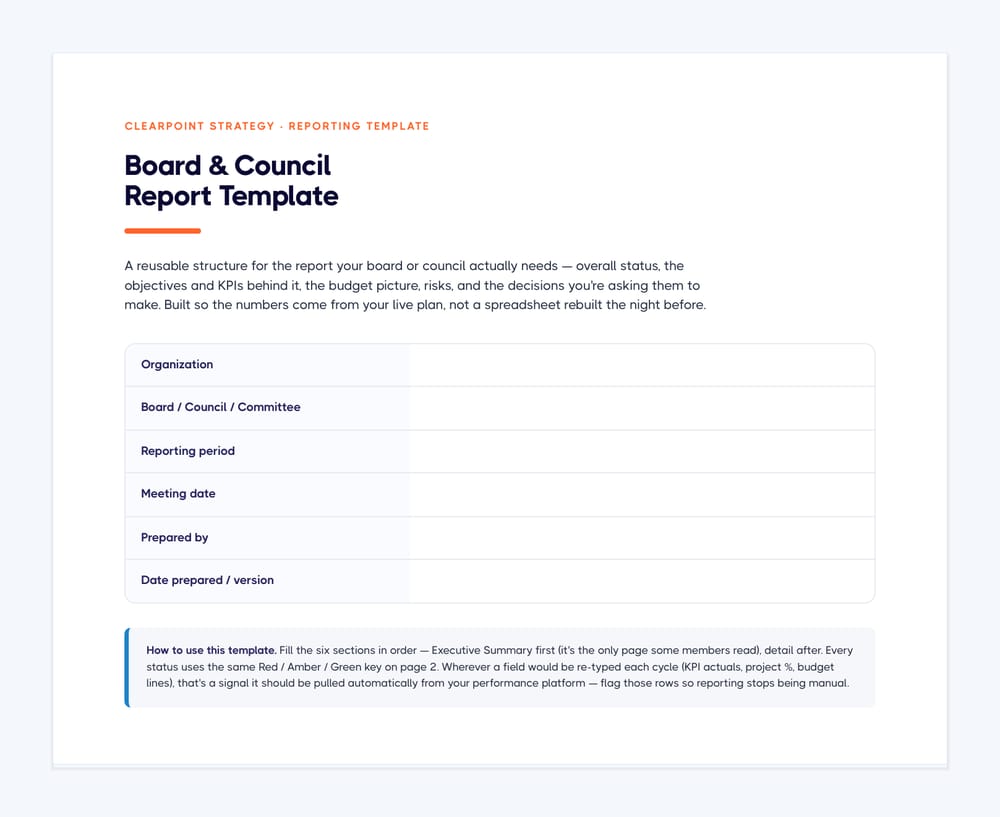
- Give trustees one page per priority, four priorities at most. Each page carries a status, owner, recent changes, two or three KPIs and one decision.
- End every page with the one decision only the board can make. A report with no ask wastes the room.
- Name the accountable cabinet member on every line. Ownerless objectives were rated off-track 18.9% of the time, against 9.6% with an owner.
- Send trustees a one-page pre-read before each board meeting. Trustees who read it walk in ready to decide instead of catching up during the meeting.
- Pair activity counts with outcome measures from the top KPIs for education institutions. One in five higher-ed metrics only counts activity.
Twice a year, a president reports the strategic plan to the board of trustees. The slides are clean. Most of the dots are green. The board nods, approves, and moves to the next agenda item. The hard question — progress on what, exactly? — rarely gets asked.
This is the playbook for answering it well. We pulled the strategic plans of real higher-education institutions to see what boards are actually asked to approve. The pattern changes how you should build the report. Here is the 90-second version first.
How to report strategic plan progress to your board of trustees
To report strategic plan progress to a board of trustees, give trustees one page per strategic priority — for no more than three or four priorities total. Each page carries five things:
- A single status: on track, at risk, or off track.
- The owner — the named cabinet member accountable for that priority.
- What changed since the last board meeting, in two or three sentences.
- Two or three KPIs with context — the number plus what it means, not a raw dashboard.
- The one decision you need from the board.
Report on the board’s rhythm, not the calendar: a trustee pre-read before each board meeting (quarterly for most institutions), a mid-year review, and a full annual report. Keep the board version to oversight, risk, and decisions. Leave the operational detail in the cabinet version — same data, higher altitude. And lead every line with the owner and the next step, not the metric. A number with nobody behind it is not progress.
That is the whole method. The rest of this page makes each piece real — and shows why most higher-ed board reports quietly fail the test.
The problem isn’t the report. It’s the plan underneath it.
Before you redesign the board deck, look at what it reports on.
We analyzed the strategic plans of 14 higher-education institutions on the ClearPoint platform — part of a dataset of 565 organizations and 17,837 active plans. Open them one at a time, read down the metrics and objectives a board is asked to approve, and ClearPoint surfaces the same three checks.
- Initiatives with a named owner complete at 2.5x the rate (21.5% vs. 8.7%) in ClearPoint data, and ClearPoint shows which higher-ed metrics still need an owner.
- ClearPoint shows which objectives still need a first assessment.
- Metrics still waiting on data. ClearPoint shows which ones still need a first measurement.
a named owner
So before a board approves “progress,” check that the green dot sits on a metric someone owns, attached to an objective someone has rated, fed by data that was actually collected.
A good board report doesn’t paper over that. It surfaces it. Which is why the format matters less than the discipline it forces.
What goes on a board of trustees report: one page per priority
The Association of Governing Boards is blunt about scope. A strategic plan should carry no more than three or four priorities. That is not a reporting limit. It is a focus limit. A board can hold three priorities in its head. It cannot hold seventeen.
So the format follows the focus: one page — or one screen — per strategic priority. Each page answers the five questions a trustee actually has.
| Element | What it shows | Why trustees need it |
|---|---|---|
| Status | One rating: on track, at risk, or off track | The headline. Read in two seconds. |
| Owner | The named cabinet member accountable | A priority with no owner is a wish — and ClearPoint shows which HE metrics still need one. |
| What changed | Two or three sentences since the last meeting | The board met a quarter ago. Tell them what moved. |
| KPIs in context | Two or three indicators, each with a short narrative | Not a dashboard screenshot. The number and what it means. |
| The decision | The one ask only the board can answer | A report with no ask wastes the room. |
Here is that page filled in. The institution is illustrative and the numbers invented — but this is the altitude a trustee should read at.
One screen. A trustee reads it in under a minute and knows exactly what to vote on. Notice what is not on the page: the raw dashboard, the 40-metric scorecard, the operational detail. That lives in the cabinet report. Trustees govern. They don’t operate. The board page is built for oversight — risk, direction, and the handful of decisions only a board can make.
Board report vs. cabinet report: same data, different altitude
One source of truth. Two reports. This is the move most institutions miss.
The cabinet report is for the people who own the work. It is detailed — every initiative, every metric, every milestone. Monthly or quarterly. It is where execution gets managed.
The board report is that same data raised to governance altitude. Fewer metrics. More narrative. Every line tied to a priority and a decision.
When both come from the same system, the numbers always agree. When they come from separate decks built by hand, they drift. Eventually a trustee notices that the board number doesn’t match the one the provost quoted last month. That is the moment trust leaks — and it is entirely avoidable.
How often should a university report to its board? The cadence framework
Match the governance rhythm. Most institutions run four layers of reporting, each at its own altitude and frequency.
| Report | Audience | Frequency | What it carries |
|---|---|---|---|
| Cabinet review | President’s cabinet | Monthly–quarterly | Full operational detail — every metric and initiative |
| Trustee pre-read | Board of trustees | Before each board meeting (≈quarterly) | One page per priority — status, owner, change, decision |
| Mid-year review | Board + cabinet | Semiannual | Narrative review of each priority; course corrections |
| Annual report | Board + public | Yearly | The full-year story; often the public-facing version |
The pre-read is the layer institutions underuse. Trustees who read a tight one-pager before the meeting walk in ready to decide. Trustees who see the data for the first time on a slide spend the meeting catching up. The pre-read is where good governance is actually bought.
Five things that get a board report ignored
Most board reports fail in predictable ways. Here are the five that show up most often — and what the data says about each.
- Raw dashboards instead of narrative. A screenshot of 40 metrics tells a trustee nothing. Two metrics and a sentence tell them everything. Pair every indicator with what it means.
- Metrics with no owner. ClearPoint shows which higher-ed metrics still need one. A board can’t hold anyone accountable for a number with no name on it. And ownership isn’t cosmetic: on the plans we analyzed, objectives with no owner were about twice as likely to be rated off-track.
- Activity dressed up as outcome. One in five higher-ed metrics is a “number of” counter — number of events, number of visits, number of posts. Counting activity isn’t measuring progress. Boards care about outcomes: retention, graduation, research, financial health.
- No decision ask. If the board can’t act on a page, the page is a status update, not a governance document. Every priority should end in a question only the board can answer.
- Surprises. A red status that appears for the first time at the board meeting is a failure of reporting, not just performance. Boards forgive bad news. They don’t forgive being blindsided.
When nobody owns an objective, it doesn’t just go unwatched. It goes wrong nearly twice as often. That is the case for putting a name on every line of the board report — before the board ever sees it.
Where software earns its place
You can run all of this in a spreadsheet and a slide deck. Plenty of institutions do. It works until the plan gets big, the audiences multiply, and the hand-built decks start to disagree with each other.
Software earns its place when one set of data has to become three reports — board, cabinet, department — without anyone re-keying a number. ClearPoint was built for that: every metric has an owner and a status, the board pre-read generates from the same data the cabinet manages, and “what changed since last meeting” writes itself because the system already tracked it. The 565 organizations in our dataset aren’t running better strategy because they bought software. They run it because the report stopped being a chore and became a by-product of the work.
That is the bar. The report should fall out of the system — not get built the night before the board meeting.
One practical note for higher ed: if you already run Watermark or Nuventive for assessment and accreditation, you usually keep them. Those systems serve the institutional-effectiveness office and faculty assessment workflows. A strategy-execution platform sits above them as the executive layer — the cabinet review, the board pre-read, the public dashboard — and pulls their evidence in rather than replacing it.
Standing it up: about one quarter
This is not a multi-year program. Most institutions can put board-ready reporting in place in about a quarter, in three phases.
- Kickoff (weeks 1–2). Load the plan structure — priorities, objectives, measures, owners. Set the status rules. Decide which committee sees which view.
- Build (weeks 3–8). Connect the data sources, configure the committee-filtered views, set the update cadence, and train the measure owners. This is where the supply line behind the report gets built.
- Launch (weeks 9–12). Run the first live cabinet review, then the first board cycle on the new reporting. Time it one full quarter before a board meeting that matters.
The institutions that get this right don’t work harder in board week. They have made board week uneventful.
The bottom line
A board of trustees doesn’t need a prettier dashboard. It needs to know three things: what the institution promised, where it stands, and what it must decide.
A strategic plan is a promise an institution makes to itself. The board report is how you prove, every quarter, that the promise is still being kept.
Related resources
Common questions
How often should a university report strategic plan progress to its board of trustees?
Most institutions report to the board on a quarterly rhythm through a trustee pre-read tied to each board meeting, with a mid-year review and a full annual report. Underneath that, the president’s cabinet reviews the same plan monthly or quarterly in greater operational detail.
What should a board of trustees strategic plan report include?
One page per strategic priority. Each page shows a single status (on track, at risk, or off track), the named owner, what changed since the last meeting, two or three KPIs with context, and the one decision needed from the board. Keep it to three or four priorities total.
What’s the difference between a board report and a dashboard?
A dashboard displays data. A board report explains it — what changed, why it changed, who owns the next step, and what leadership should do. Trustees need the narrative and the decision, not a raw screen of metrics.
Who should own board reporting at a university?
The reporting process is usually owned by the office of institutional effectiveness or the president’s chief of staff. Each strategic priority then has its own named cabinet-level owner accountable for progress. On higher-ed plans, ClearPoint shows which metrics still need an owner — fixing that is the first step toward a credible board report.
Can ClearPoint replace Watermark or Nuventive for accreditation?
They solve different layers, and most institutions run both. Watermark and Nuventive serve assessment and accreditation evidence workflows. ClearPoint is the executive strategy layer — cabinet reviews, board-of-trustees reporting, and public dashboards — and integrates with assessment systems rather than replacing them.

%2520OKRs%2520vs%2520KPIs%2520Breaking%2520Down%2520the%2520Difference.jpg)

%2520Strategy%2520vs%2520Tactics%2520Differences%252C%2520Examples%2520%2526%2520How%2520to%2520Track%2520Both.jpg)












.png)


.png)






.webp)