.svg)
Google AI answers
Better answers, right in Google.
Google lets you choose the sites its answers come from. Choose ClearPoint, and you’ll see ours first.
One click. Only changes what you see — undo it anytime.

QBR templates that turn quarterly reviews into strategic decision-making sessions. Includes the 5-component template and preparation timeline.
- Most QBRs fail because they're data presentations, not decision forums — a great QBR spends 60% of time on decisions and actions, not updates
- Use the 5-component template: Strategic Scorecard Snapshot → Exception Report → Initiative Portfolio Review → Forward Look → Decision Log — this structure scales from C-suite reviews to departmental syncs
- Pre-reads are non-negotiable: distribute 48 hours before the meeting so everyone arrives oriented — if someone is seeing a metric for the first time in the QBR, the preparation failed
- Time-box ruthlessly: 30 minutes on scorecard + exceptions, 20 minutes on initiatives + forward look, 10 minutes on decisions and commitment — overruns don't happen when the facilitator is disciplined
- The Decision Log is the single most important QBR output: every decision gets an owner, a deadline, and documented next steps — write it down in real-time or it evaporates
- Follow-through makes or breaks the QBR: 24-hour decision confirmation, weekly initiative check-ins, 30-day mid-quarter pulse check — across ClearPoint’s platform, 76.2% of assigned owners never update their metrics without visible accountability
- In the 2017–2024 research archive, the median completed project ran 10.94 months — almost exactly 4 quarterly reviews — making the QBR the natural cadence for strategic project accountability
A quarterly business review is a decision meeting, not a status meeting. The working format is 60 minutes: 30 on what happened, 30 on what you are going to do about it. Five components carry it — strategic scorecard snapshot, exception report, initiative portfolio review, forward look, and decision log — with the pre-read distributed 48 hours ahead.
The single change that separates a QBR that moves strategy from one that documents it: the exception report. Green items get one sentence. The meeting belongs to the yellow and red ones, and every one of them leaves with an owner, a recovery action, and a date in the decision log.
Quarterly Business Review Templates: How to Run QBRs That Actually Change How Your Organization Operates
Most quarterly business reviews are exercises in futility disguised as governance.
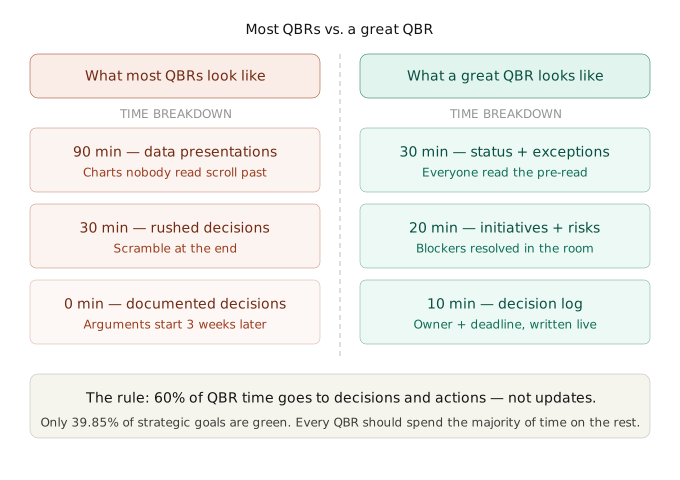
Here's what typically happens: You schedule a 2-hour QBR. 90 minutes disappear into presentations of data that nobody read beforehand. Charts scroll past. Numbers get cited. Nods are exchanged. The remaining 30 minutes become a rushed scramble to cover the decisions that actually matter—the ones that will determine whether the organization hits its targets or misses them.
The meeting ends. People leave. Nothing changes until someone remembers the decisions weren't documented, and an argument breaks out three weeks later about what was actually agreed.
There's a better way.
A strategic quarterly business review is a 60-minute conversation where everyone arrives prepared, 30 minutes is spent on status updates, and 30 minutes is spent on the decisions and actions that shape the next quarter. Across the 21,000+ strategic plans on ClearPoint’s platform, 76.2% of the people assigned to a metric have never once updated it. In our 2017–2024 strategic planning research archive, only 64.2% of the measures that carry a status are green—meaning a QBR that spends its time on the green items is spending it in the wrong place. It's the difference between a compliance checkbox and an event that actually moves strategy forward.
This guide walks you through the anatomy of a great QBR, a battle-tested template structure that works for executive teams and department leaders alike, and the facilitation practices that keep conversations strategic instead of slipping into operational minutiae.
What a Great QBR Actually Looks Like
Before we get to the template, let's define what we're optimizing for.
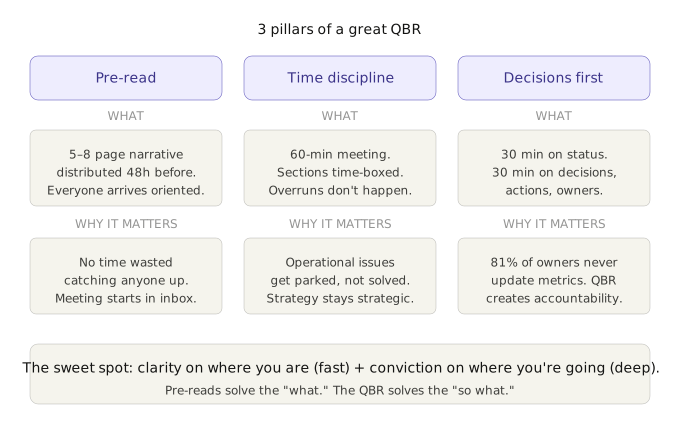
A great quarterly business review has three defining characteristics:
1. Pre-reads create shared context (distributed 48 hours ahead)
The meeting doesn't start when people walk into the room. It starts two days before, when the QBR deck lands in inboxes with a clear note: "Read this before Thursday—we'll use this time to discuss decisions, not present."
Pre-reads compress raw data into narrative insights. They answer the question executives actually need answered: "What changed, and what does it mean?" They're typically 5–8 pages of clean design and strategic narrative, not 40 slides.
People arrive already oriented. No time wasted on catching anyone up.
2. The agenda respects time discipline (30 min max presentation)
The actual meeting is time-boxed. Ruthlessly.
- Minutes 1–30: Strategic Scorecard Snapshot + exception report (what's happening; what demands attention)
- Minutes 30–50: Initiative review + emerging risks (what's in flight; what could derail us)
- Minutes 50–60: Decisions, actions, owners, deadlines (what are we doing about it)
This structure is locked in. Overruns don't happen because the facilitator is trained to say, "That's a great topic—let's table it for an operational discussion and keep this strategic."
3. 60% of time goes to decisions and actions, not updates
The moment someone says, "Let's review what happened in Q3," stop. That's not the point of the meeting.
Yes, you need to know the results. But that information should be absorbed beforehand. The QBR itself is for:
- Deciding what to do differently next quarter
- Resolving blockers on strategic initiatives
- Reassigning resources based on new priorities
- Escalating risks that need executive attention
- Committing to outcomes and deadlines
If you're spending 90 minutes presenting, you're wasting 60 minutes of executive time. If you're spending 30 minutes on real decisions, you're not going deep enough.
The sweet spot is clarity on where you are (fast) and conviction on where you're going (deep).
The QBR Template: 5 Essential Components
The structure below is designed to fit into 50–60 minutes. It works for C-suite reviews, board preparation, departmental check-ins, and cross-functional sync meetings. The components scale—adjust depth based on audience and scope.
Component 1: Strategic Scorecard Snapshot
What it is: A one-page visual that shows your Tier 1 metrics (typically 6–12 KPIs) with three pieces of information for each:
- Current status (where are we today?)
- Trend (are we moving the right direction?)
- vs. Target (on track, at risk, or off-track?)
What it answers: "Are we hitting our strategy?"
Format example:
MetricCurrentTargetStatusTrendCommentsRevenue (YTD)$12.4M$15MOff-Track↓Q3 pipeline weakness; expects recovery Q4Customer Retention94%96%At Risk→Churn increase in Mid-Market segmentNPS Score5260+Off-Track↓Product release delays impacting perceptionTime-to-Value6.2 weeks5 weeksAt Risk↑Implementation staffing constraintsOperating Margin22%25%On-Track↑Cost controls working; sustain discipline
Key rule: If it's green/on-track, one sentence max. If it's red/off-track, that metric gets its own section in the exception report.
Pre-read note: This scorecard is in your pre-read. The QBR doesn't repeat it—it assumes everyone saw it. Spend 5 minutes answering clarifying questions, not 20 minutes walking through it.
Component 2: Exception Report
What it is: A narrative deep-dive on any metric that's off-track or has changed materially since last quarter.
For each exception, include:
- What happened (the data point; the change observed)
- Why it happened (root cause; what led to this)
- What we're doing about it (actions underway; timeline for improvement)
- What we need (resources, decisions, escalations required from leadership)
What it answers: "What do we need to address to get back on track?"
Example:
Off-Track: Revenue YTD ($12.4M vs. $15M target)
What happened: Q3 closed at $3.2M, 18% below plan. Pipeline for Q4 is at $4.8M (vs. $5M needed), down from $6.2M forecast last month.
Why it happened: Two deals slipped beyond quarter close due to enterprise approval delays (customer-side). Mid-market segment softened due to client budget uncertainty. One major prospect paused evaluation.
What we're doing about it: Sales team executing recovery plan focused on three deals in advanced stages. Marketing increasing outreach to mid-market segment with ROI-focused messaging. VP Sales conducting win/loss analysis on paused deal.
What we need from leadership: Decision on whether we adjust FY revenue target or reallocate resources to boost pipeline in Q4. Current plan assumes Q4 closes $5.1M (requires one large deal + three mid-market closures).
Facilitation note: Exceptions aren't blame sessions. They're "what's the issue and what's our move?" conversations. Keep the tone forward-looking.
Component 3: Initiative Portfolio Review
What it is: A status update on your 4–6 major strategic initiatives (projects that drive the strategy forward).
For each initiative, provide:
- Current status (on track, at risk, blocked)
- Completion timeline (on schedule; accelerated; slipped)
- Resource status (fully resourced, understaffed, over-resourced)
- Key blockers or dependencies (what could derail this; what depends on this)
- Owner and escalation path (who's accountable; who do they escalate to)
Example table:
InitiativeStatusTimelineResourcesBlockers / DependenciesOwnerCustomer Success Platform RedesignOn TrackComplete Q4 2026Understaffed (1 of 2 engineers allocated)Awaiting design approval from CMO; delayed 1 weekSarah ChenEnterprise Pricing ModelAt RiskSlip to Q2 2026Fully ResourcedRequires finance reforecast; legal review of contract templatesMike RodriguezEMEA Expansion ProgramOn TrackSales ramp Q2 2026Understaffed (need 1 more sales rep)Hiring for EU-based sales role; interview phasePriya PatelData Platform MigrationBlockedSlip TBDPartially ResourcedAwaiting infrastructure team capacity; dependency on legacy system sunset decisionJames Wu
What it answers: "Are our strategic initiatives on track, and what do we need to keep them moving?"
QBR moment: For any initiative that's at risk or blocked, use 5–10 minutes to resolve what's needed: accelerate a resource allocation, make a decision on a dependency, escalate a blocker to an executive sponsor.
Component 4: Forward Look
What it is: The next quarter's priorities and emerging risks, stated clearly.
Include:
- Q4 Strategic Priorities (3–5 objectives for next quarter; typically tied to annual goals)
- Emerging Risks (market changes, competitive moves, internal constraints that could impact strategy)
- Resource Requests (any new hires, budget requests, or allocations needed to execute priorities)
- Key Success Metrics (how we'll know Q4 was successful)
ClearPoint data shows peak strategic updates in January and October—aligning with Q1 planning and Q4 year-end reviews. Organizations that maintain consistent monthly updates see better QBR outcomes and more reliable execution.
Example:
Q4 2026 Strategic Priorities
- Drive Enterprise revenue recovery through focused sales effort on 3 pipeline deals
- Complete Customer Success Platform redesign and launch to pilot cohort
- Hire and onboard 2 EMEA-based sales reps to meet 2026 expansion target
- Finalize enterprise pricing model and execute 3 pilot negotiations
Emerging Risks
- Competitive pressure in mid-market segment increasing; client budget uncertainty persists through Q4
- Enterprise sales cycles extending 2–3 weeks longer than historical average
- Talent market for engineering remains tight; hiring timeline for platform redesign at risk
Resource Requests
- Approve budget for two EMEA-based hires ($180K annual loaded cost; hire by Jan 31 to meet ramp timeline)
- Allocate 0.5 FTE from Product team to support enterprise pricing negotiations
What it answers: "What are we focused on next, and what could go wrong?"
Component 5: Decision Log
What it is: The single most important output of the QBR.
A decision log is a running record, updated in real-time during the meeting, of:
- The decision (what are we committing to?)
- Owner (who is accountable for execution?)
- Deadline (when does this get done?)
- Next steps (what happens before the next QBR?)
.svg)
In our 2017–2024 strategic planning research archive, the median completed project ran 10.94 months—almost exactly 4 quarterly reviews—making QBRs the natural cadence for project accountability. Additionally, 76.2% of assigned owners never update their metrics. The QBR is your best tool to convert phantom owners into real ones by creating visible accountability in front of leadership.
Example:
#DecisionOwnerDeadlineNext Steps1Approve budget for 2 EMEA sales hires ($180K)CFOApprovedFinance to process; HR begins recruiting March 142Prioritize data platform migration over legacy system sunsetCTO + VP OpsMarch 20CTO to present 90-day execution plan at ops review3Reallocate 1 engineer to platform redesign (1.5 total allocation)VP EngImmediateEngineering team briefing March 144Conduct win/loss analysis on paused enterprise dealVP SalesApril 15Present findings and recovery strategy at May QBR5Launch customer success platform beta to pilot cohortSarah ChenJune 30Weekly check-in starting March 20
Facilitation rule: Every decision gets written down, assigned to an owner, and given a deadline—all during the meeting. If you don't do this in real-time, decisions evaporate.
Post-QBR rule: The decision log becomes the accountability document. It's reviewed at the next QBR to track what got done and what slipped.
QBR Preparation Checklist: Who Does What, When
A great QBR doesn't happen by accident. It requires clear ownership and a two-week preparation cycle.
Two weeks before the QBR
- [ ] Confirm attendees and meeting time (block 60 min; treat as non-negotiable)
- [ ] Define the scope: which metrics, which initiatives, which risks belong in this QBR?
- [ ] Assign pre-read owner (typically the meeting facilitator or strategy lead)
- [ ] Data owners submit scorecard metrics and initiative status (baseline data)
One week before the QBR
- [ ] Draft pre-read: strategic scorecard, exception narratives, initiative portfolio, forward look
- [ ] Identify major decisions or escalations that will be needed in the QBR
- [ ] Circulate draft to core team for feedback; revise based on input
- [ ] Finalize pre-read and send to all attendees with clear instructions: "Read this before the meeting"
48 hours before the QBR
- [ ] Pre-read should be in all attendees' inboxes
- [ ] Confirm meeting setup: room booked, video link tested, any supporting materials ready
- [ ] Facilitator reviews agenda and confirms time blocks for each section
- [ ] Brief decision-makers on major items that will require their input (avoid surprises)
Day of the QBR
- [ ] Start on time; assume everyone read the pre-read
- [ ] Open with a 2-minute recap of QBR purpose: "We're here to confirm our direction, resolve blockers, and commit to next quarter's priorities"
- [ ] Work through sections in order; stick to time blocks
- [ ] Document all decisions in real-time on shared screen or shared doc (everyone sees them as they're made)
- [ ] Close with a clear summary: "Here's what we decided; here's what happens next"
One week after the QBR
- [ ] Distribute final decision log to all attendees; confirm they agree on owners and deadlines
- [ ] Send one-page summary of key decisions and metrics to relevant stakeholders (even those not in the QBR)
- [ ] Schedule 30-minute check-in with initiative owners on any decisions that impact their work
- [ ] Calendar the next QBR (90 days out)
QBR Facilitation Tips: How to Keep It Strategic, Not Operational
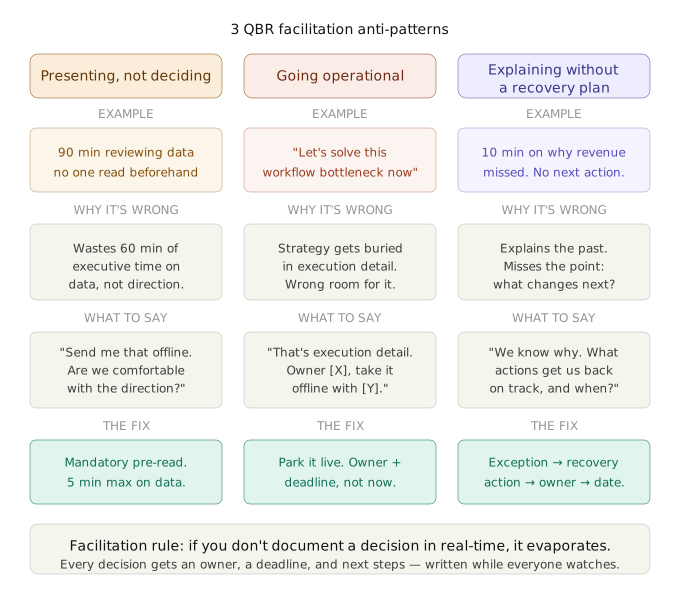
A QBR can slip into operational problem-solving in seconds. One person asks a clarifying question about a metric. Someone else jumps in with a process issue. Suddenly you're troubleshooting a workflow instead of discussing strategy.
Here are the facilitation practices that keep it strategic:
Rule 1: Pre-reads solve the "what." The QBR solves the "so what."
If someone in the meeting is seeing a metric for the first time, the preparation failed. Assume everyone read the pre-read. Spend 5 minutes answering questions about what the numbers mean. Spend 30 minutes on what we're going to do about them.
What to say: "That's a great question about how we're calculating that metric. Send me the details after, and I'll get you clarity offline. For the QBR, let's focus on whether we're comfortable with the direction and what we need to change."
Rule 2: Decisions get made; operational issues get parked.
The QBR is for strategic decisions: resource allocation, priority shifts, risk escalation, outcome commitments. It's not for workflow optimization or project details.
If an operational issue comes up (a process bottleneck, a technical implementation detail), acknowledge it and park it: "That's an operational issue that needs attention, but let's not solve it here. Owner [X], will you take that offline with [Y] and report back next week?"
What to say: "I hear you. That's not a strategic decision—that's an execution detail. Let's solve that outside this meeting and keep this focused on our direction."
Rule 3: If it's off-track, you need a recovery action—not an explanation.
When a metric is red, people feel obligated to explain why. Explanations are fine. But the QBR conversation should move to recovery.
Go from "Here's why it happened" to "Here's what we're going to do differently, who's accountable, and when we'll see improvement."
What to say: "We know why it happened. The question for the group is: What actions get us back on track? What do we need to change? And what's the timeline?"
Rule 4: Silent attendees are a sign something's wrong.
If someone hasn't spoken in 15 minutes, they're either disengaged or holding back. Pull them in directly.
What to say: "[Name], we haven't heard from your team on the Q4 plan. What are your thoughts on the priorities and resource needs?"
Rule 5: Confirm decisions out loud; write them down immediately.
The moment a decision is made, state it clearly: "So we're deciding [X]. [Owner], you're accountable. Deadline is [Y]." Write it on a shared screen or document while everyone watches.
If you don't document it in real-time, it evaporates.
After the QBR: The Follow-Through That Makes It Count
The QBR meeting is just a moment. The real value comes from what happens after.
The 24-hour window (decision clarity)
Within a day, every person listed as a decision owner should know what they own, when it's due, and what success looks like. If there's any ambiguity, the facilitator clarifies it immediately.
Example follow-up email: "Based on Friday's QBR, you're the owner for [decision]. Here's what we committed to: [specific outcome]. Timeline: [deadline]. Please confirm you can hit this, or escalate any blockers by [date]."
Weekly check-ins on major initiatives (momentum maintenance)
For strategic initiatives that are on-track or at-risk, schedule a quick 30-minute sync the week after the QBR. The agenda is tight: status update (2 min), blockers (5 min), resource needs (3 min), next week's target (3 min).
This keeps initiatives from drifting back into "we'll get to it eventually."
30-day mid-quarter pulse check (course correction)
Four weeks into the quarter, pull the core team back together (30–40 min) to review:
- Are we on track against the priorities we committed to?
- Did any of the risks we identified actually materialize?
- Do we need to adjust resource allocation based on what we're learning?
This is a lightweight version of the full QBR. Its purpose is to catch course corrections early, not six weeks into the quarter.
90-day full cycle (the next QBR)
You come back to the full QBR format. Review what you said you'd do in the last QBR. Look at metrics. Review initiatives. Identify new exceptions and emerging risks. Make decisions for the next quarter.
The discipline is the cycle. Quarterly review, 30-day check-in, weekly momentum check-ins, and the decision log that ties it all together. That's what transforms a QBR from a compliance meeting into a strategic ritual.
FAQ: 6 Questions About Running QBRs
Q1: How many people should be in a QBR?
For a C-suite QBR: 5–8 people (CEO, CFO, VP of each major function, maybe a board observer). For a departmental QBR: 3–6 people (leader, functional heads, maybe a peer leader for cross-functional input).
ClearPoint data shows the average strategic plan has 6.72 team members (owners + collaborators). This means your QBR pre-reads need to reach a focused group—not the entire organization. The rule is: include decision-makers and people accountable for the initiatives under review. Don't invite people just to give them context—that's what the pre-read is for.
Q2: What if we don't have clear metrics yet?
Start with what you have. Identify 6–10 metrics that matter most to your strategy. Don't aim for perfection—aim for clarity on direction. Over time, you can refine the metrics. But waiting for the perfect KPI structure means you never have the conversation.
Q3: Should the board be in our QBRs?
Depends on the board's engagement model. If your board meets quarterly, consider having the CEO run the company QBR first, then use that as the foundation for a board QBR (which might be a 30-minute deep-dive on exceptions and forward look).
Don't run the board meeting as a performance review. Run it as a strategic conversation: "Here's where we are. Here's what we're focused on. Here's where we need your input."
Q4: What if a decision can't be made in the QBR?
Park it with a clear owner and a specific decision deadline. Example: "We need 48 more hours to model the options on pricing. Sarah, can you have a recommendation to me by March 15? Then we'll decide."
Decisions deferred without a deadline evaporate.
Q5: How do we keep the pre-read concise?
Scorecard + exceptions: 1–2 pages. Initiative portfolio: 1 page. Forward look: 0.5 page. Visuals that tell the story (don't repeat in text). Aim for 5–8 pages max.
If your pre-read is longer than that, you're including operational details that don't belong in a QBR.
Q6: How often should we do QBRs?
Every quarter is standard for most organizations. If your business moves faster (volatile market, startup mode, rapid scaling), consider doing them monthly for the first year or two. As operations mature, quarterly is usually the right rhythm.
Internal Links & Resources
- Balanced Scorecard: Examples, Templates & How to Build One
- KPI Dashboard Best Practices
- How to Align KPIs to Strategy
- Performance Reporting for Executives
- Performance Management for Government
- Strategic Planning: A Comprehensive Guide
- See ClearPoint Strategy in Action



%20OKRs%20vs%20KPIs%20Breaking%20Down%20the%20Difference.jpg)