
.svg)
![What's The Exact Right Number Of KPIs To Track? [DATA]](https://cdn.prod.website-files.com/637e14518f6e3b2a5c392294/6933449aba311e40db9ed2fa_what-is-the-exact-right-number-of-kpis-to-track-blog-header.webp)
Google AI answers
Better answers, right in Google.
Google lets you choose the sites its answers come from. Choose ClearPoint, and you’ll see ours first.
One click. Only changes what you see — undo it anytime.

The answer might surprise you — but it’s critical to executing on your strategy successfully.
- The data points to 9 to 11 measures per strategic plan, with a median of 9 and a standard of about two measures per goal.
- Beware measurement theater: 22% of measures are never started and 71% have no owner assigned.
- Earn the right to add a third measure to a goal only after two consecutive quarters of reliable updates.
- Separate strategic from operational metrics; mixing them creates a bloated plan that no one can act on.
- Archive any measure stuck at "Not Started" for two consecutive quarters; the number matters less than the link between measurement and action.
"How many KPIs should we track?"
Usually, people want a simple number. Three? Five? Ten? They're looking for a rule they can apply without thinking too hard about it.
I get it. Simple rules are appealing. But after analyzing tens of thousands of strategic plans, I can tell you the answer isn't a single number.
It's a range. And that range depends on what you're actually trying to accomplish.
The median strategic plan tracks nine measures. But that number conceals enormous variation — and enormous dysfunction. Some organizations track three measures and execute brilliantly. Others track 50 and accomplish nothing.
The data reveals something more interesting than "the right number." It reveals the right relationship between measurement and execution. Once you understand that relationship, the number becomes obvious.
The Measurement Trap: When More Data Means Less Insight
Let's start with what doesn't work: measurement theater.
Here's what the data shows:
- 22% of measures never even get started — organizations set them up and never collect a single data point.
- 71% of measures have no owner assigned.
- The average number of measures varies by industry: Healthcare organizations track about 22 measures per plan, while Financial Services companies average 16.
That last point is revealing. Healthcare organizations aren't tracking more measures because they're better at measurement; they're tracking more because healthcare is complex and heavily regulated.
But here's the uncomfortable truth: Tracking more measures doesn't make them more successful at execution.
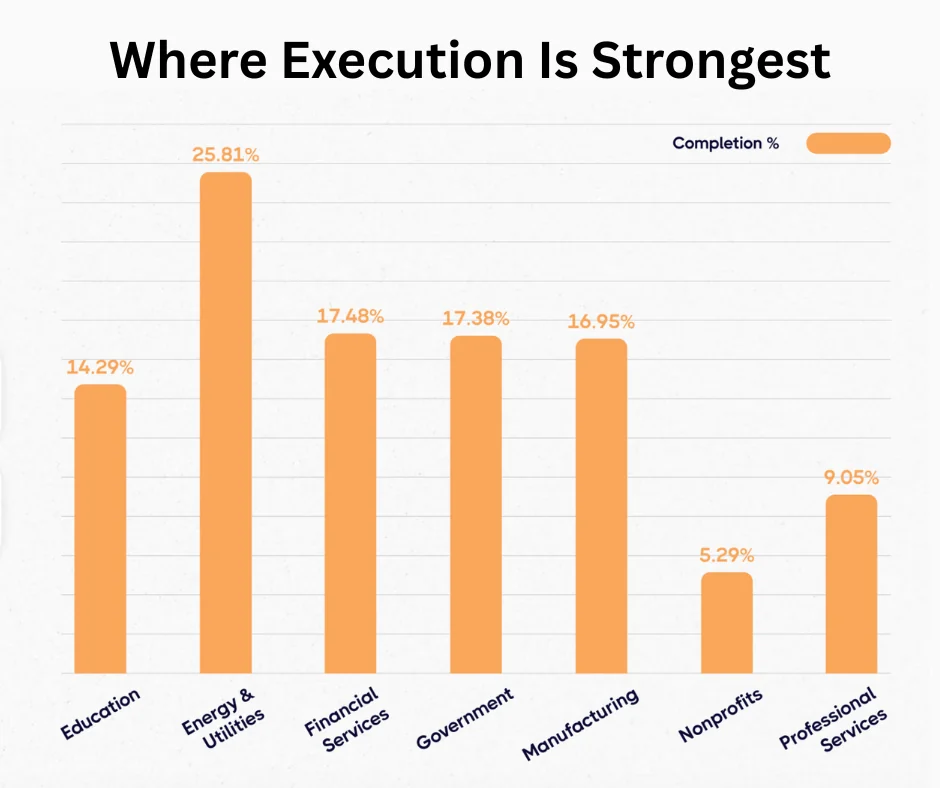
When we looked at completion rates by industry, Healthcare wasn't at the top. Energy & Utilities companies beat Healthcare, with a completion rate of 25.81%. (Yes, even they're only finishing about a quarter of their strategic projects.)
Organizations tend to confuse comprehensive measurement with effective management. They think if they track everything, they'll control everything.
But what actually happens is they track so much that they can't act on anything.
<div class="index-cards"><div class="index-card"><div class="index-card-title"><h3><img src="https://cdn.prod.website-files.com/637e14518f6e3b2a5c392294/676e013b384c32b910aeb21f_676dfb021364aad3469d54bf_city-of-fort-collins-framed%2520(1).webp" alt="Fort Collins, Colorado" width="200" height="86" align="right" /><strong>Real-life Metric Overload</strong></h3></div><div class="index-card-content">
<p>When strategy leaders for the city of Fort Collins, Colorado, first started tracking performance, they thought about metrics in three distinct layers, like a pyramid: At the top were 38 metrics demonstrating progress toward seven strategic outcomes. The middle layer contained metrics for budget requests. The bottom layer held departmental operational metrics.</p>
<p>👉They started with quarterly reviews of the top layer — 38 metrics with the full executive team and all department heads. But meetings were expensive and didn't hold everyone's interest because most metrics fell outside each attendee's department.</p>
<p>👉They adjusted to focus on Service Areas. Each Service Area Director met quarterly with the City Manager, Deputy City Manager, and Chief Financial Officer to review all metrics contributing to budget requests. Total metric count: over 400.</p>
<blockquote><p><em>"It quickly became apparent that it was not possible to review so many metrics in the time allotted."</em></p>
<p><em>—Lawrence Pollack, Fort Collins' Budget Director</em></p></blockquote>
<p>👉The next adjustment: They focused on the 3–5 most important metrics for each department, reducing the number to less than 200 "primary" metrics. Discussions improved but there still wasn't enough context about why these metrics mattered.</p>
<p>💡<strong>The breakthrough came when they shifted focus away from the metrics themselves toward the outcomes they were trying to achieve.</strong> For each key outcome, they reviewed 3–4 strategic metrics. They called these reviews "Strategy Maps" — Metrics, Analysis, and Performance.</p>
<p>That final number — 3–4 metrics per strategic outcome — is where Fort Collins found their sweet spot.</p>
<p>That's not the magic number for everyone, but it forced them to be ruthlessly selective about what mattered strategically versus what was just operationally interesting.</p>
</div><div></div>
The Data Says: 9–11 Measures Per Strategic Plan
After analyzing tens of thousands of strategic plans, the pattern is clear:
Median: 9 measures per plan
Optimal range: 9 to 11 measures
Standard formula: About 2 measures per goal
Organizations that stay within this range aren't just tracking less — they're executing more. This isn't an arbitrary range; it reflects a certain relationship between measurement and action.
Think about it: If you have five strategic goals and you're tracking 50 measures, that's 10 measures per goal. Can you really act on 10 different data points for a single strategic priority? Can your team hold 10 different metrics in their head when making decisions?
The answer, consistently, is no.
Germantown, Tennessee figured this out early in their journey to the Malcolm Baldrige National Quality Award. When they developed "Germantown Forward 2030" — their 15-year strategic plan — they didn't just create a comprehensive list of everything they could measure.
Germantown focuses its measurement on customer satisfaction (they refer to citizens as "customers") and strategic outcomes. They track a Net Promoter Score of 72 — an excellent score indicating how likely residents are to recommend Germantown to others. They monitor whether city services are responsive to customer needs. They measure progress on each strategic objective.
But they don't track everything. They track what matters for decision-making.
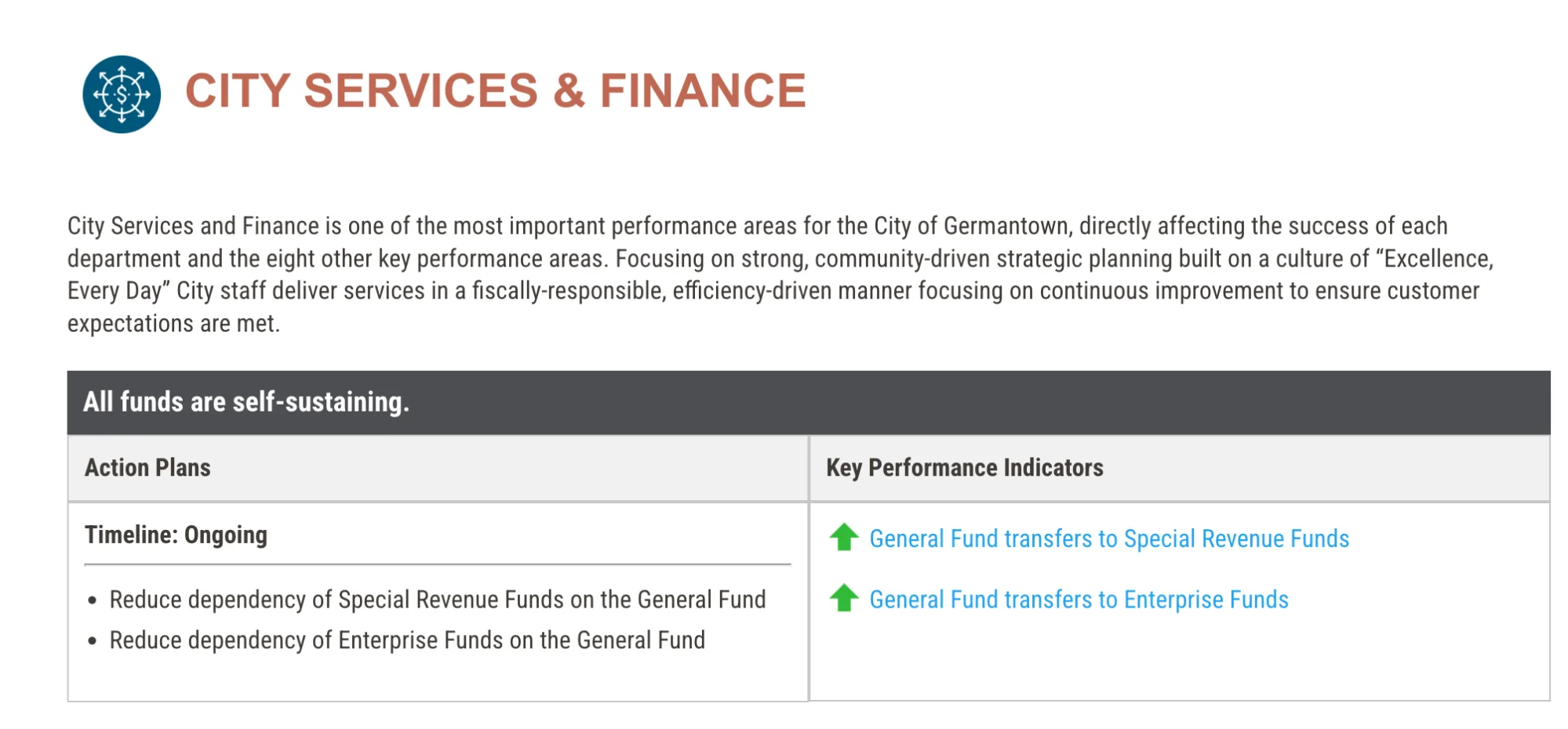
The result? In 2019, Germantown won the Malcolm Baldrige National Quality Award — the highest presidential honor for performance excellence.
According to Budget Director Lawrence P., "I believe the framework we were able to build with strategy and performance metrics and using ClearPoint to visualize that data was a feather in our cap in achieving Baldrige designation."
The framework wasn't comprehensive measurement. It was selective measurement with a clear line of sight from metrics to strategic outcomes.
Here's what the optimal range looks like in practice:
5 strategic goals × 2 measures per goal = 10 measures total
Some goals might have three measures and others might have just one. But the average hovers around two. And the total rarely exceeds 11 without causing execution problems.
The 2-Per-Goal Rule (And When To Break It)
The standard of two measures per strategic goal comes with two important qualifications.
1) First, earn the right to add a third measure.
The data shows that elite performers only add a third measure to a goal after two consecutive quarters of on-time reporting on the first two.
If you can't reliably update two measures per goal for six months straight, you don't have a measurement problem. You have an execution problem. Adding more measures won't fix it.
2) Second, some goals genuinely need just one measure.
In particular, this applies to outcome-oriented goals with clear success metrics. If your goal is "reduce homelessness," you might track just one number: people experiencing homelessness. You don't need to track five related metrics to know if you're succeeding.
<div class="index-cards"><div class="index-card"><div class="index-card-title">
<h3><strong>Two Measurement Successes</strong></h3></div><div class="index-card-content">
<h4><strong>Fort Collins, Colorado</strong></h4>
<p>Fort Collins demonstrates this principle in their Strategy Maps. For each of their seven strategic outcomes (like "Safe Community" or "Economic Health"), they track 3-4 metrics — carefully selected indicators that inform strategic decisions.</p>
<p>Their Community Dashboard makes this visible to the public. Residents can see exactly what the city is tracking and why. That transparency creates accountability — not just to hit the numbers but to track the <em>right</em> numbers.</p><p><em><img src="https://cdn.prod.website-files.com/637e14518f6e3b2a5c392294/6933513a546a54ae5627fdce_fort-collins-colorado-community-dashboard.webp" alt="Fort Collins, Colorado community dashboard" width="550" height="284" align="center" /></em></p>
<h4><strong>Carilion Clinic</strong></h4>
<p>Carilion Clinic in Virginia took a different approach when they expanded their performance management system, adding measures when they had clear owners and clear decision-making purposes.</p>
<p>For their clinic-wide scorecard, they track high-level metrics like "time from scheduling to service for new patients" — a clear indicator of access to care. For department scorecards, they track specific metrics relevant to that department's work, like "surgical site infection rate" for surgical departments.</p>
<p>They now manage around 300 scorecards through ClearPoint, with selective measurement appropriate to each level of the organization. A physician's individual scorecard might track 3–5 metrics directly tied to patient care. A department scorecard might track 8–10 metrics relevant to departmental operations. The clinic-wide strategic scorecard tracks the handful of metrics that matter for overall strategic direction.</p>
<p>This cascading measurement structure maintains the two per goal discipline at each level while allowing for appropriate depth where needed.</p>
</div><div></div>
What About Operational Metrics? The Great Separation
Here's where most organizations go wrong: They mix strategic metrics with operational metrics and call the whole mess a "strategic plan."
JEA, one of the nation's largest utilities serving 2,200 employees, solved this problem with a simple rule:
"Our day-to-day metrics live in internal systems, but anything related to our strategy lives in ClearPoint. It keeps things clean and eliminates confusion."
Kendra Cash, JEA's Enterprise Strategy Specialist, explains they use Power BI to house operational data, which they embed live into ClearPoint when strategic visibility is needed. This hybrid approach creates clear separation:
- Operational metrics are tracked in operational systems, reviewed by operational teams, and are updated frequently.
- Strategic metrics are tracked in the strategic plan, reviewed by leadership, and updated on strategic cycles.
The distinction matters because operational and strategic metrics serve different purposes.
Operational metrics tell you if processes are working. Strategic metrics tell you if you're achieving your strategic goals.
This separation also solves the "22% of measures never get started" problem.
When you mix operational and strategic metrics, it's easy to add measures that seem strategically important but are actually just operationally interesting. Then no one ever collects the data because it doesn't serve an operational purpose, and it doesn't get removed because it seems strategically valuable.
When you cleanly separate strategic from operational, this ambiguity disappears. Strategic metrics must inform strategic decisions. If they don't, they get archived. Operational metrics must inform operational improvements. If they don't, they get removed.
The practical application: Your strategic plan should track 9–11 strategic measures. Your operational systems can track hundreds of operational measures. Don't confuse the two.
The Ruthless Archiving Rule
Here's a discipline that separates elite performers from everyone else: They aggressively archive measures that aren't being used.
The rule is simple:
Any measure that shows "Not Started" for two consecutive quarters gets archived.
This feels harsh. When you archive a measure, someone inevitably says: "But we might need that data someday!" or "What if we want to track that next year?" or "Shouldn't we at least try to collect it before we give up?"
The answer is no.
If a measure has gone six months without anyone collecting data, it's not important. And keeping it in your active plan creates three problems:
- It clutters your dashboard with empty fields, making it harder to see what's actually happening.
- It creates the illusion of accountability. Someone's name might be attached to it but in reality, nobody's doing anything about it.
- It trains your organization to ignore metrics. When people regularly see measures that aren't being updated, they learn that measurement doesn't really matter.
Germantown implements this discipline systematically. As they evolved their performance management system from Excel and disparate software tools to ClearPoint, they didn't just migrate every metric they'd ever tracked. They asked: "Does this inform strategic decisions? Does it have an active owner? Are we actually using it?"
The result was a focused measurement system that employees actually engage with.
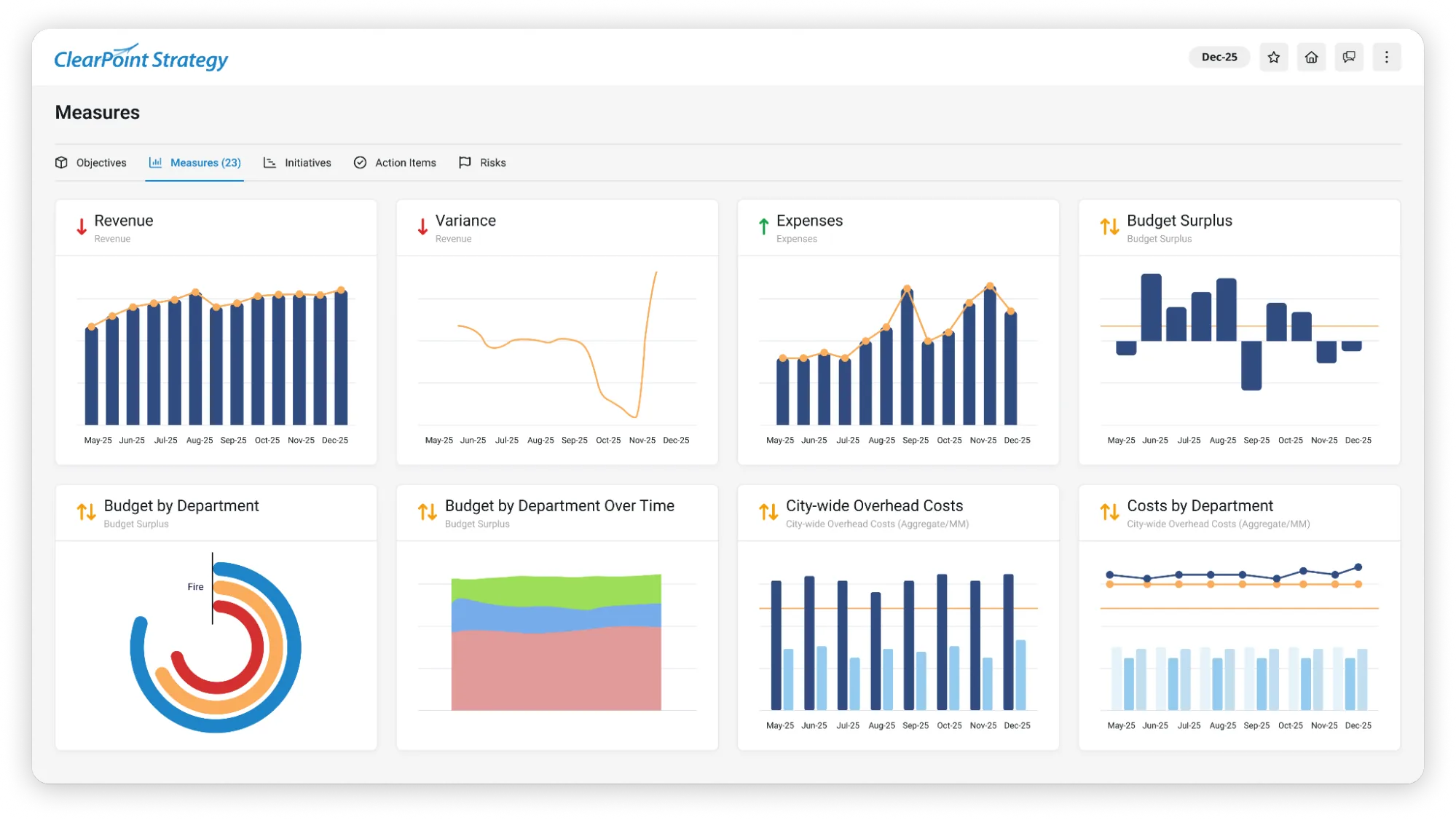
The shift from data entry to decision-making requires ruthless archiving. Every measure in the system should be there because someone is actively using it to make decisions, not because someone once thought it might be interesting.
The practical implementation:
- Month 1: Audit your current measures.
- Month 2: Mark any that haven't been updated in 90 days.
- Month 3: If still not updated, archive them.
- Repeat quarterly.
This isn't a one-time cleanup. It's an ongoing discipline that prevents measurement proliferation from creeping back in.
<div class="index-cards"><div class="index-card"><div class="index-card-title">
<h2><strong>The Industry Illusion: Why Your Sector Doesn't Determine Your Number</strong></h2></div><div class="index-card-content">
<p>Industry matters less than you think for determining the right number of measures. Here’s what we found:</p>
<ul>
<li>Healthcare: 22.92 measures per plan (median)</li>
<li>Education: 16 measures per plan</li>
<li>Financial Services: 11 measures per plan</li>
<li>Government: Varies widely but tends toward 9-11 range</li>
</ul><p><img src="https://cdn.prod.website-files.com/637e14518f6e3b2a5c392294/693352bb93ea8316e6ad143c_right-number-of-kpis-to-track-active-measures.webp" alt="Right number of KPIs to track - active measures" width="550" height="461" /></p>
<p>These differences don't predict execution success. Energy & Utilities leads completion rates at 25.81% despite not having the most measures. Healthcare tracks the most measures on average but doesn't lead in execution.</p>
<p>The point: your industry might influence your starting point, but what determines your optimal number is your organizational capacity to act on measurement.</p>
<ul>
<li>Fort Collins operates in <strong>local government</strong> with all its constraints and regulations. They could easily justify tracking hundreds of strategic metrics. Instead, they focus on 3-4 metrics per strategic outcome. They track more operationally, but strategically, they maintain discipline.</li>
<li>Carilion Clinic operates in <strong>healthcare</strong> — arguably the most heavily regulated, most complex measurement environment of any industry we analyzed. They could justify tracking 50 measures per scorecard. Instead, they maintain 2–3 key metrics per scorecard level, cascading appropriately through the organization.</li>
<li>JEA operates in <strong>utilities</strong> — another heavily regulated, infrastructure-intensive industry with complex operational and strategic requirements. They track hundreds of operational metrics in their internal systems. But strategically they focus on what matters for enterprise direction, and keep strategic measurement separate from operational measurement.</li>
</ul>
<p>The pattern across all these organizations: They use their industry's complexity as a reason to be more selective about strategic measurement, not less.</p>
<p>If anything, complex industries need simpler strategic measurement. When operations are already complicated, strategic clarity becomes even more important.</p>
</div><div></div>
The Real Answer: It Depends On What You're Measuring
After analyzing more than 300,000 measures across 20,582 strategic plans, here's what I can tell you about the right number of KPIs:
For a strategic plan: 9–11 measures total
For a strategic goal: 2 measures
For a strategic outcome: 3–4 measures
For operational management: as many as you need
These numbers aren't rules — they're patterns observed in organizations that actually execute their strategy.
The real question isn't "how many?" The real question is "how many can we act on?" This is shown time and again in real life:
- Fort Collins discovered they couldn't act on 400+ metrics. They couldn't even act on 200 "primary" metrics. They could act on 3-4 metrics per strategic outcome.
- Germantown discovered they could achieve Baldrige-level excellence by focusing measurement on customer satisfaction and strategic outcomes rather than comprehensive coverage of every possible indicator.
- Carilion discovered they could manage 300 scorecards across a 13,000-employee organization by maintaining discipline about what each scorecard measured and why.
- JEA discovered they could track hundreds of operational metrics while keeping strategic leadership focused by maintaining clean separation between operational and strategic measurement.
None of these organizations asked "what's the right number?" They asked "what do we need to know to make strategic decisions?" The number followed from the question.
<blockquote>
<p>So here's my answer to "how many KPIs should we track?":</p>
<p>Enough to inform strategic decisions. Not so many that you can't act on them.</p>
</blockquote>
Probably 9-11 for your overall strategic plan, about 2 per strategic goal, and 3-4 per strategic outcome.
But if you're asking "how many?" you're probably asking the wrong question.
The right question is: "Which metrics will change our decisions?"
Answer that question honestly and the number will be obvious.
The Diagnostic: Are You Tracking The Right Number?
Here's how to tell if you're tracking too many, too few, or just right:
You’re tracking too many indicators if:
- More than 20% of your measures show "Not Started."
- More than 30% of measures have no owner.
- You can't remember most of your metrics without looking at your dashboard.
- Leadership meetings spend more time reviewing data than discussing decisions.
- People regularly say "we track that?" when looking at your strategic plan.
You’re tracking too few indicators if:
- Leadership regularly makes strategic decisions based on data you don't have.
- You can't tell if you're making progress on strategic goals.
- Board members or executives regularly ask for metrics you aren't tracking.
- Departments are tracking strategic data informally because it's not in the official plan.
You’re tracking the right amount if:
- Every measure has an active owner who updates it regularly
- Leadership can recall your key metrics without looking at the dashboard
- Strategic discussions focus on "What should we do?" not "What does this number mean?"
- Less than 10% of measures ever show "Not Started"
- You regularly make strategic decisions informed by your metrics
Run this diagnostic on your current measurement approach. Be honest about which category you're in. Then make the adjustments needed to get to "just right.”
Implementation: Moving From Where You Are To Where You Should Be
If you're tracking too many metrics — and statistically, you probably are — here's how to get to the optimal range:
👉Week 1: Audit and categorize
- List all current measures
- Mark those which have active owners
- Mark those which were updated in the last 90 days
- Mark those which have shown "Not Started" for 2+ quarters
- Categorize: Strategic vs. Operational
👉Week 2: Archive the obvious problems
- Archive anything showing "Not Started" for 2+ quarters
- Remove phantom owners (inactive for 90+ days)
- Move operational metrics out of the strategic plan
👉Week 3: Calculate your ratio
- Count remaining strategic measures
- Count strategic goals
- Calculate: measures per goal
- Target: 2 per goal, 9-11 total
👉Week 4: Make the hard choices
- If you're still over the target, rank measures by decision impact
- Keep the ones that most directly inform strategic decisions
- Archive the rest (don't delete, just remove from active strategic tracking)
👉Week 5: Implement the discipline
- Set the 2-quarters-not-started rule
- Set the 90-day inactive owner rule
- Make these visible metrics: "% measures without owners" and "% measures not started"
- Review monthly
This is an ongoing discipline. Fort Collins didn't go from 400+ metrics to Strategy Maps overnight. They iterated, learned, adjusted. But they kept moving toward more focused, more useful measurement.
How To Handle Resistance
The hardest part isn't the technical work of removing metrics from your system. The hardest part is the political work of telling stakeholders that their favorite metric isn't strategic anymore.
Here's how to handle that conversation:
"This metric is important for operational excellence. We're going to keep tracking it in [operational system]. But for strategic reviews, we're focusing only on the 3-4 metrics that most directly inform strategic decisions about this goal. This metric will still be available; it just won't be in strategic leadership reviews."
Most resistance comes from fear of losing visibility. When you assure people that the metric isn't disappearing entirely — it's just moving to its proper home in operational management — resistance usually decreases.
And if someone insists a metric must stay in strategic reviews, ask: "What strategic decision would we make differently based on this metric?" If they can't answer clearly, archive it.
The Number Isn't The Point
After all this analysis, here's what matters: the right number of KPIs isn't about the number. It's about the relationship between measurement and action.
Track too many, and you'll spend all your time collecting data and none of your time acting on it. Track too few, and you'll make strategic decisions based on intuition rather than evidence.
The sweet spot — 9-11 strategic measures, about 2 per goal, 3-4 per outcome — is the range where most organizations can maintain the discipline to collect data regularly and the focus to act on it strategically.
Fort Collins found their sweet spot through iteration: 400+ metrics → 200 metrics → 3-4 per outcome. Germantown found theirs by asking what matters for customer satisfaction and strategic outcomes, not what's comprehensive.
You'll find yours by asking: "Which metrics change our decisions?"
Then track those. Just those. And ruthlessly archive everything else.
That's the answer to "what's the exact right number of KPIs to track?" It's not a number. It's a discipline.

%20OKRs%20vs%20KPIs%20Breaking%20Down%20the%20Difference.jpg)




%20Strategy%20vs%20Tactics%20Differences%2C%20Examples%20%26%20How%20to%20Track%20Both.jpg)
