
.svg)

Google AI answers
Better answers, right in Google.
Google lets you choose the sites its answers come from. Choose ClearPoint, and you’ll see ours first.
One click. Only changes what you see — undo it anytime.

You already have a strategic plan—now you need an execution system. Here’s the data-backed formula (Focus × Ownership × Measurement × Flow × Team), a 10-minute diagnost
- Strategy execution is multiplicative: Success = Focus × Ownership × Measurement × Flow × Team, so your weakest lever caps results.
- Score each lever 1 to 5 based on what you actually do today; your lowest score is the constraint to fix first.
- Plan size strongly predicts success: portfolios under 20 elements outperform those with 60 or more by a wide margin.
- Give every goal, measure, project, and milestone one owner; if no update in 90 days, reassign or remove.
- Keep strategic measures lean at roughly two per goal, and smooth the calendar so work avoids fiscal-boundary bottlenecks.
If you already have a strategic plan, your next problem isn’t planning. It’s operating the plan—month after month—through budget season, council scrutiny, competing priorities, and staff turnover.
That’s where most cities and counties get burned: accountability that disappears in a council meeting, last-minute reporting scrambles, and priorities that drift because the plan was never designed to run like a management system.
So here’s the practical question we set out to answer:
What do high-performing organizations do differently once the plan is written?
This post shares a simple execution model—the Strategy Success Formula—and translates it into a local government operating system you can run this quarter.
Executive Summary: What You Can Use Right Now
The Formula
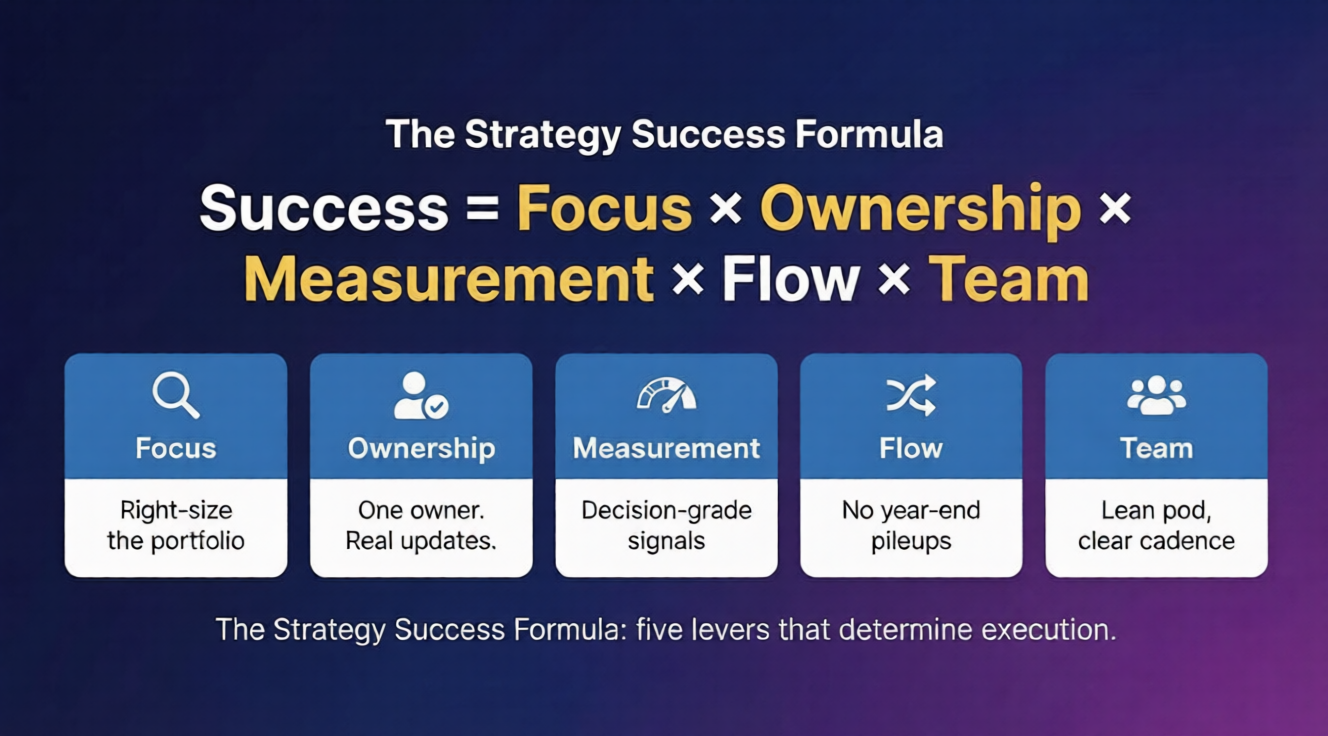
Success = Focus × Ownership × Measurement × Flow × Team
The Diagnostic
Score each lever 1–5. Your lowest score is your constraint.
The Play
Fix that constraint first using the 30-day rollout plan at the end of this post.
Download the full 2026 Strategic Planning Report (benchmarks + methodology + examples).
The Strategy Success Formula: What Actually Drives Execution
Type image caption here (optional)
Most strategic planning advice is framework-heavy and execution-light. This is the opposite. It’s built to help you run a plan.
It’s intentionally multiplicative: execution usually fails at the weakest link. Strong measures don’t matter if ownership is symbolic. Clear ownership won’t save an overloaded portfolio. A well-built plan still collapses if the calendar creates year-end bottlenecks.
The goal isn’t to “fix everything.” It’s to find your limiting factor—and pull that lever first.
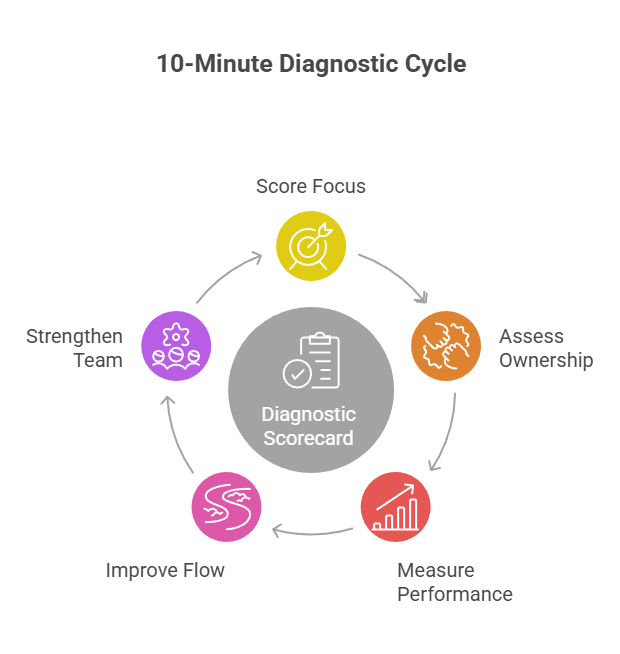
A 10-Minute Diagnostic: Find Your Constraint Fast
Rate each lever 1 (weak) to 5 (strong) based on what you actually do today—not what your plan says you do.
Focus
- Is the plan small enough to execute without becoming a second job?
- Can leaders name priorities without reading a list?
Ownership
- Does every strategic element have one named owner (a person, not a committee)?
- Do owners update on a predictable cadence?
Measurement
- Are measures used for decisions (budget/CIP/resource tradeoffs)?
- Do you keep measures lean—or create tracking theater?
Flow
- Are finish dates spread across the year—or stacked at fiscal boundaries?
- Do you have a mid-quarter finish window?
Team
- Do you have a small strategy pod that meets, decides, and follows up?
- Is collaboration intentional—or committee-shaped?
Your lowest score is your constraint. Start there.
Lever 1: Focus — Right-Size the Portfolio
Local government planning sessions reward comprehensiveness. Execution rewards focus.
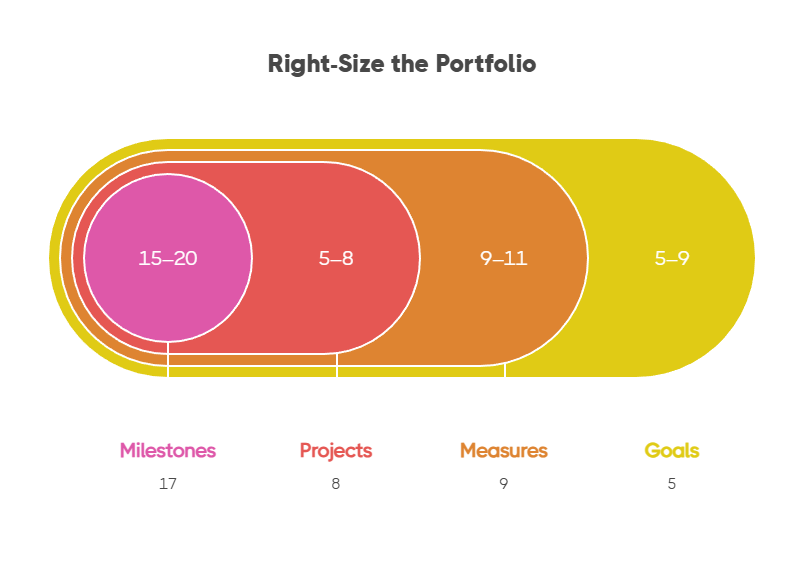
The data-backed guardrail: plan size strongly correlates with success
Across thousands of plans, performance drops as complexity increases: plans with fewer than 20 total elements succeed far more often than plans with 60+ elements.
What to do this quarter
1) Count your elements
Count total elements (goals + measures + projects + milestones).
2) Cut before you “improve reporting”
If you’re far above an executable range, reduce scope first. Don’t build reporting on top of an unmanageable portfolio.
3) Create a “parking lot”
Keep important initiatives—but move them out of the strategic portfolio until capacity exists.
4) Add a hard rule for new work
Every new strategic project must answer: What will we stop doing?
Want examples? Here are 4 Local Government Strategic Planning Examples.
Lever 2: Ownership — Make Names Real
You don’t have a shortage of stakeholders. You suffer from diffused accountability.
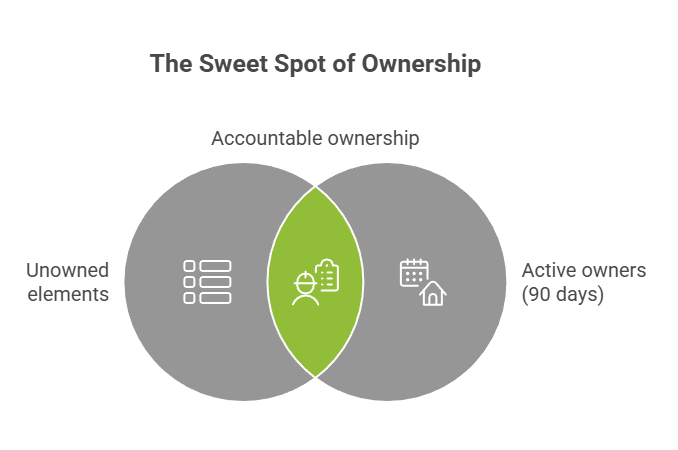
Even when plans assign owners, the data shows a massive accountability gap: most elements lack clear ownership, and only a small fraction of assigned owners actively update work on a 90-day basis.
The rule that changes execution
- Every goal, measure, project, and milestone needs one owner.
- If an owner hasn’t updated in 90 days, reassign or remove.
- Track two indicators on page one: Unowned elements (%) and Active owners (% updated in last 90 days).
What to do this quarter
1) Replace committees with one accountable owner
One person accountable, helpers optional.
2) Make ownership visible
Add two governance KPIs to your monthly scorecard:
- % unowned elements
- % owners active in last 90 days
We explain here why accountability matters.
Lever 3: Measurement — Select Fewer, Decision-Grade Signals
In local government, a measure isn’t “good” because it exists. It’s good because it helps you decide.
The report shows most organizations operate near a median of ~9 strategic measures, and that measurement volume varies by sector—reinforcing the need to keep strategic measures intentionally lean and decision-grade.
A practical measurement discipline
- Keep strategic measures lean (default: ~2 per goal).
- Add a third only after you’ve proven you can update consistently.
- Archive measures that sit “Not Started” across multiple reporting cycles.
What to do this quarter
1) Keep only measures that pass the “council test”
For each strategic goal, keep measures that:
- are understandable to council and the public,
- can be updated reliably,
- trigger a decision (resources, scope, timing).
2) Create a one-page measure standard (for every strategic metric)
Include:
- definition,
- source,
- update frequency,
- owner,
- what action it triggers.
Lever 4: Flow — Smooth the Calendar
Cities and counties have predictable calendar pressure (budget, audits, council cycles, grants). Execution fails when the plan schedules work in a way that guarantees bottlenecks.
The report shows strategic work often piles into fiscal boundary months (with a heavy concentration of project end dates in December and June).
A simple flow rule
- Don’t allow a single month to hold an oversized share of planned finishes.
- Create a mid-quarter finish window so delivery happens continuously—not in year-end heroics.
What to do this quarter
1) Build a 12-month delivery map
Plot every project finish and milestone due date across the year.
2) Rebalance overloaded months
If fiscal year-end months are overloaded, move due dates now—before the fire drill becomes inevitable.
3) Establish finish windows
Set one “finish window” per quarter (mid-March / mid-June / mid-September / mid-December) and run delivery through that cadence.
Lever 5: Team — Build a Lean Operating System
Strategy execution doesn’t need a bigger committee. It needs a smaller operating system.
A workable local government model
- A core strategy pod that can meet, decide, and follow up.
- Collaboration that’s added intentionally—only when it unblocks delivery.
What to do this quarter
1) Name your strategy pod (10–16 people)
Small enough to move, senior enough to decide.
2) Give it a clear charter
“Own cadence, remove blockers, publish a council-ready snapshot monthly.”
3) Make attendance and updates non-negotiable
Because execution is the product.
A Council-Ready Reporting Snapshot: What to Show Every Month
If you want to reduce “front page risk,” your plan needs a monthly view that answers three questions fast:
- What changed since last month?
- What is at risk—and what decision is needed?
- Who owns the fix, and what’s the next action?
You can find Local Government Strategic Planning Examples here.
The one-page snapshot template
Include:
- Top 5 strategic priorities (with RAG)
- Top 5 risks / blockers (with owner + decision needed)
- Delivery calendar (what’s due before next council cycle)
- Two governance metrics:
- % unowned elements
- % active owners (last 90 days)
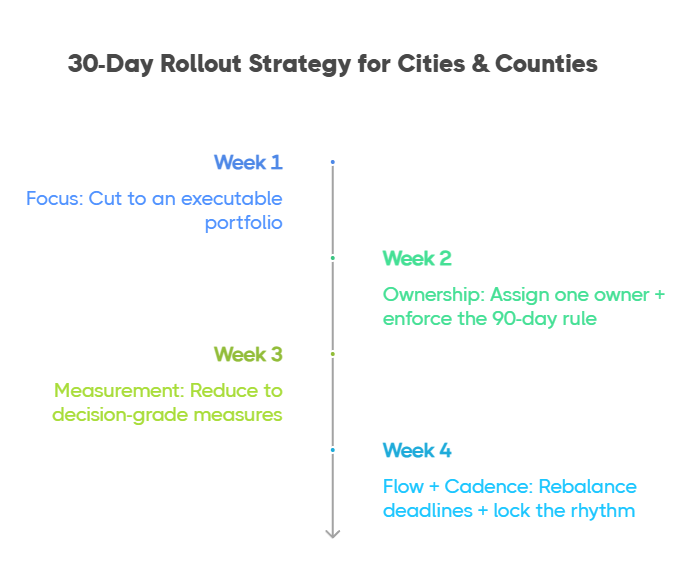
A 30-Day Rollout Plan for Cities and Counties
Week 1: Focus
- Inventory plan elements and cut to an executable portfolio.
- Create a parking lot/backlog for non-strategic work.
Week 2: Ownership
- Assign one owner to every element.
- Apply the 90-day rule.
- Publish “unowned” and “active owners” on page one.
Week 3: Measurement
- Reduce to decision-grade measures (~2 per goal).
- Publish measure standards (definition, source, cadence, owner, decision trigger).
Week 4: Flow + Cadence
- Rebalance deadlines; establish mid-quarter finish windows.
- Lock the pod meetings and the monthly one-page snapshot.

%20Strategy%20vs%20Tactics%20Differences%2C%20Examples%20%26%20How%20to%20Track%20Both.jpg)




%20OKRs%20vs%20KPIs%20Breaking%20Down%20the%20Difference.jpg)