.svg)
Google AI answers
Better answers, right in Google.
Google lets you choose the sites its answers come from. Choose ClearPoint, and you’ll see ours first.
One click. Only changes what you see — undo it anytime.

Most OKRs fail because teams track too many objectives. Learn how to simplify your OKR framework with focus, alignment, and strategic execution that actually works.
- OKR frameworks usually fail from overload — too many objectives, key results written as tasks, and teams setting goals with no vertical alignment.
- When everything is a priority, nothing is: strategic dilution spreads resources thin and quarterly reviews turn into project-status readouts.
- Enforce ruthless focus — cap the company level at three objectives per quarter and link every department objective to a company one.
- A key result should measure an outcome you can verify; if you can complete it with no business impact, it is a task, not a result.
- Every objective at every level needs a visible parent, and a quarterly prune keeps the system honest by auditing it, not just scoring performance.
Here's a scenario that plays out in thousands of organizations every quarter:
<p style="padding-left: 30px;"><em>Leadership sets 15 objectives with 45 key results.</em></p>
<p style="padding-left: 30px;"><em>Teams copy them into spreadsheets, dashboards, or dedicated OKR tools. For three weeks, everyone updates their progress.</em></p>
<p style="padding-left: 30px;"><em>By week six, half the key results are stale.</em></p>
<p style="padding-left: 30px;"><em>By quarter's end, the OKR review becomes a formality — a checkbox exercise disconnected from actual strategic work</em>.</p>
The OKR framework isn't the problem. The overload is.

When Andy Grove introduced OKRs at Intel and John Doerr later popularized them through Measure What Matters, the system was designed around a radical constraint: focus. The entire power of objectives and key results comes from forcing organizations to choose what matters most — and say no to everything else.
Most organizations do the opposite.
They use OKRs as an exhaustive inventory of everything they're working on, which strips the framework of its core function.
This article breaks down why overloaded OKRs fail and provides a practical path to simplifying your OKR framework so it actually drives strategic execution.
Give your OKR implementation the best chance of success with ClearPoint. Book a demo and see how it works using your own data!
The Three Ways Organizations Overload Their OKRs
1. Too Many Objectives
The most common failure mode is simply tracking too many things.
When a team has eight to 10 objectives per quarter, nothing is truly prioritized. Every objective competes for attention, and the framework becomes a project management list rather than a strategic focus tool.
The benchmark: Google's original OKR implementation recommended three to five objectives per team per quarter. Many successful organizations operate with even fewer — some limit themselves to three company-level objectives per quarter. (Here are 350+ OKR framework examples for inspiration.)
The discipline of choosing three objectives from a list of 20 possibilities is where the strategic value lives. That selection process forces leadership conversations about trade-offs, dependencies, and true priorities.
2. Creating Key Results That Are Actually Tasks
A key result should measure an outcome — a change in state that you can objectively verify. But in overloaded OKR frameworks, key results frequently devolve into task lists:
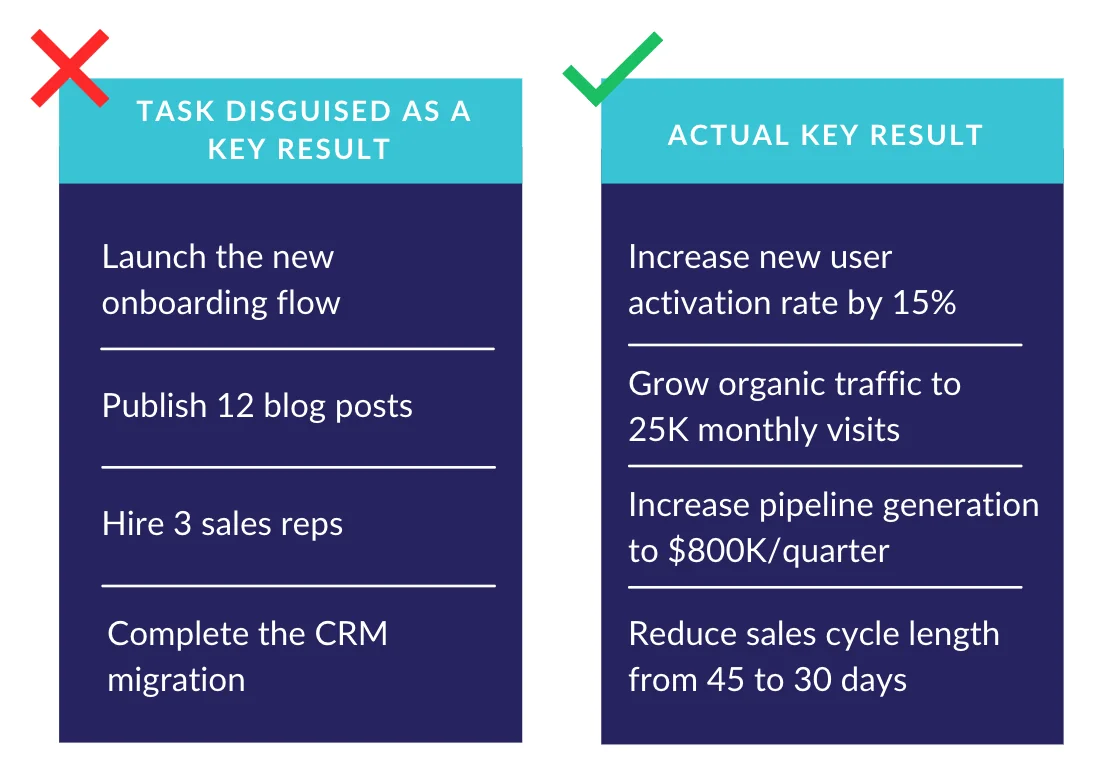
When key results are tasks, you end up with 40–60 items that are really a project plan — not a strategic framework. The OKR system collapses under this weight because there's no difference between "our strategy" and "everything we're doing."
3. No Vertical Alignment
In overloaded OKR frameworks, every team creates objectives independently. The engineering team writes their OKRs. Marketing writes theirs. Sales writes theirs.
Nobody maps these to a shared set of company-level objectives.
The result: 50+ objectives floating across the organization with no clear hierarchy. When leadership asks "Are we on track?", no one can answer because there's no unified view of what "on track" even means at the organizational level.
The OKR framework's design assumes a cascade structure: company objectives flow down to department objectives, which flow down to team objectives. Without this alignment, you have parallel OKR systems that create busywork without strategic coherence.
The Real Cost Of OKR Overload
Overloaded OKRs don't just waste time during quarterly reviews. They create deeper organizational problems:
Strategic dilution. When everything is a priority, nothing is. Resources get spread thin across too many initiatives, and the organization makes incremental progress on many things instead of breakthrough progress on the few things that matter.
Accountability erosion. With 50 objectives, who owns what? Shared ownership across too many items leads to diffused responsibility. When a key result goes red, it's easy to assume someone else is handling it.
Update fatigue. Asking teams to update 10+ objectives with 30+ key results every week or biweekly creates overhead that people start to resent. They fill in numbers without thinking, and the data quality degrades. The dashboard looks full but means nothing.
Loss of executive trust. When leadership sees green across 45 key results but the company is clearly underperforming, they stop trusting the system. Once an OKR framework loses executive buy-in, it's functionally dead.
How to Simplify Your OKR Framework
Principle 1: Enforce Ruthless Focus
The single most impactful change you can make is reducing the number of objectives. Here's a practical constraint:
- Company level: Three objectives per quarter, maximum
- Department level: Two to three objectives, each explicitly linked to a company objective
- Team level: One to three objectives, each linked to a department objective
Total key results per objective: three to five. If you need more, your objective is too broad — split it.
This constraint feels uncomfortable at first. Teams will argue that they're working on more than three things. They are. But the OKR framework isn't meant to capture everything — it's meant to capture what matters most right now.
Principle 2: Separate OKRs From Operational Metrics
One reason OKR frameworks get bloated is that organizations dump operational KPIs into the same system. But OKRs and KPIs serve different purposes: OKRs are intended to drive change and improvement, while KPIs serve as a way to monitor the ongoing health of some aspect of your business.
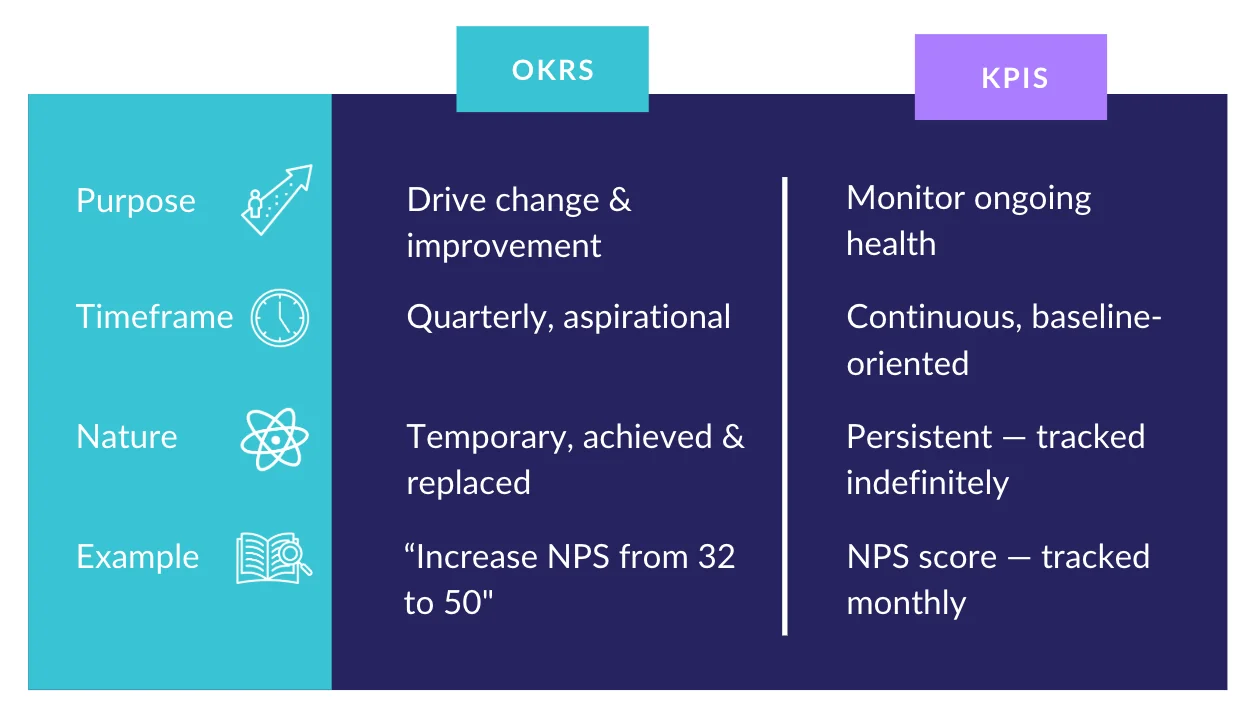
Your NPS score is a KPI you track forever. "Improve NPS by 18 points this quarter" is an OKR. Both belong in your strategic management system, but they shouldn't be mixed into one undifferentiated list.
Track KPIs in a separate section of your dashboard. Reserve OKRs for the specific changes you're trying to make this quarter.
Principle 3: Measure Outcomes, Not Activities
Revisit every key result and ask: "Does this describe a result or an activity?"
A simple test: if you can complete the key result without any business impact, it's a task, not a result. Publishing 12 blog posts is an activity. Growing organic traffic by 60% is a result. You can publish 12 terrible blog posts and hit the task-based KR while completely failing the business objective.
For each objective, define key results that describe the state change you want to see in the business. Then track the activities (initiatives, projects, tasks) separately as the inputs that drive those results.
Principle 4: Build A Clear Cascade
Every objective at every level should have a visible parent. When a team-level OKR doesn't connect to a department or company objective, it's either:
- Not strategically important enough to be an OKR (move it to project management)
- Revealing a gap in the company-level strategy (escalate and discuss)
A clean cascade means that at any level of the organization, you can answer two questions:
- "What company objective does this support?"
- "What team-level OKRs are driving progress on this?"
Principle 5: Review And Prune Quarterly
In addition to scoring your performance at the end of each quarter, OKR best practices also include a regular audit of the system itself. Ask the following questions to identify common OKR mistakes:
- Did we have too many objectives? (If nothing got to 100%, probably yes.)
- Were key results truly measurable? (If scoring was subjective, rewrite them.)
- Did every OKR have a clear owner? (If not, fix accountability.)
- Were all OKRs aligned to company priorities? (If orphaned OKRs existed, tighten the cascade.)
This meta-review prevents the framework from slowly expanding back to overload over successive quarters.
OKR Framework: Simplified Template
Here's a clean template for a simplified OKR framework:
Company Level (Q2 2026)
Objective 1: Accelerate product-led growth.
- KR1: Increase free-to-paid conversion rate from 4% to 7%.
- KR2: Reduce time-to-value for new users from 14 days to five days.
- KR3: Achieve 40% monthly active usage among paid accounts.
Objective 2: Expand into the mid-market segment.
- KR1: Close 15 new mid-market deals (50-500 employees).
- KR2: Achieve $200K in new mid-market ARR.
- KR3: Reach 60+ NPS among mid-market accounts.
Objective 3: Build a world-class customer success function.
- KR1: Reduce net churn from 8% to 4% annually.
- KR2: Increase expansion revenue from 15% to 25% of total ARR.
- KR3: Achieve 90% customer health score across the book of business.
Notice: three objectives, three key results each, all outcome-focused, all measurable. No task lists. No operational metrics. Just the strategic bets for the quarter.
How ClearPoint Supports a Simplified OKR Framework
ClearPoint Strategy is designed to prevent the exact overload problems described above:
- Cascade alignment: Link team OKRs to department OKRs to company objectives with explicit parent-child relationships visible in a single view.
- Separated KPIs and OKRs: Track ongoing operational metrics alongside quarterly OKRs without mixing them into one list.
- Status automation: Color-coded indicators update based on data, so you see real performance instead of manually-entered optimism.
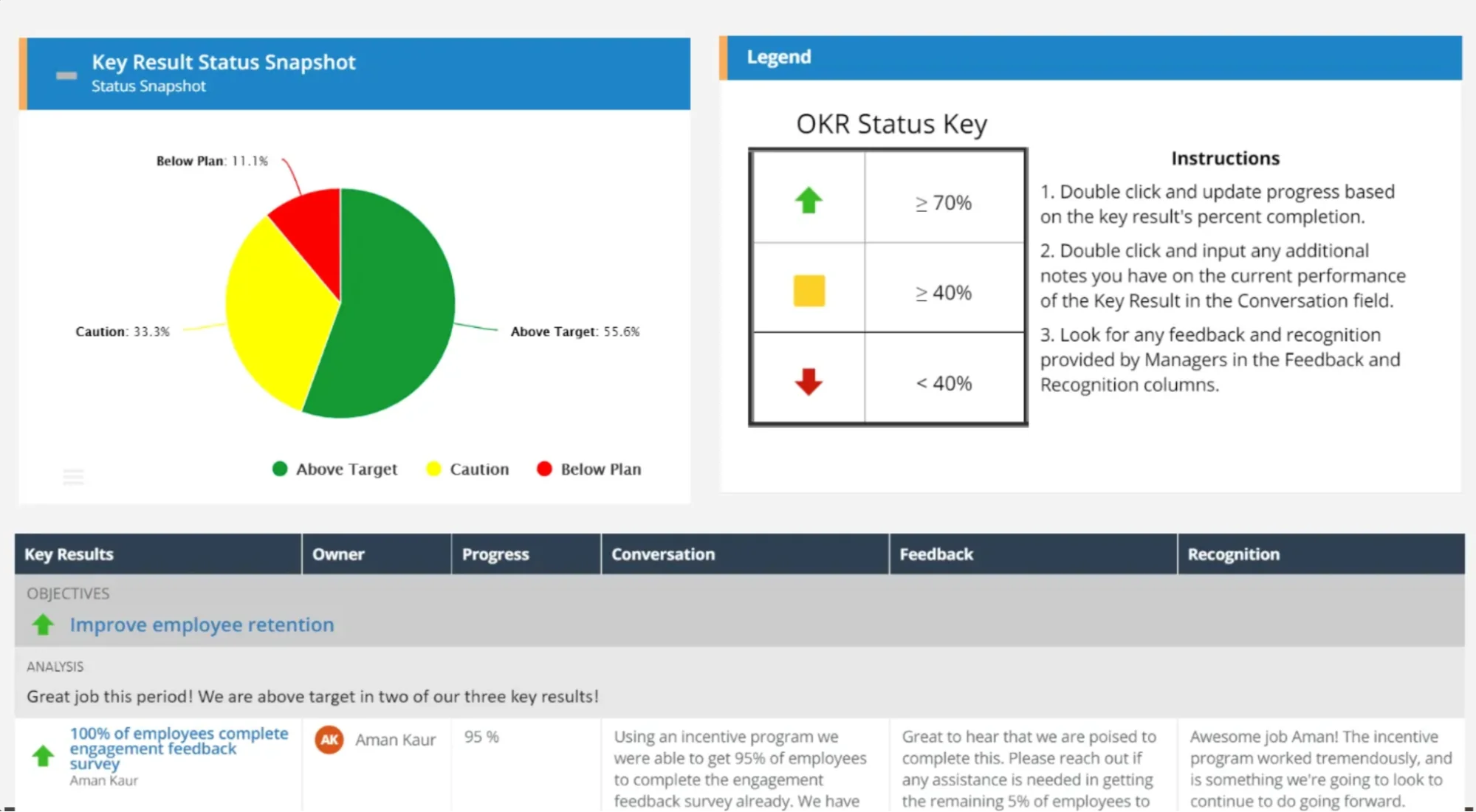
- Initiative linking: Connect projects and tasks to the key results they support, keeping activities separate from outcomes.
- Executive dashboards: Leadership sees three to five company objectives and their status — not 50 items across 12 teams.
Plus, ClearPoint’s new AI Assistants can guide you through the foundational steps of creating a strategic plan. By answering a few simple questions, even novices can develop a robust and effective plan.
<p style="text-align: center;"><img src="https://blog.clearpointstrategy.com/hubfs/OKR.gif" alt="ClearPoint’s OKR" width="750" height="457" /></p>
The bottom line: ClearPoint enforces the structure that makes OKRs work. Without structural enforcement, even well-intentioned teams drift back toward overload within two to three quarters.
FAQ: OKR Framework
What is an OKR framework?
An OKR (Objectives and Key Results) framework is a goal-setting methodology where organizations define qualitative objectives (what they want to achieve) and measurable key results (how they'll know they've achieved it). The idea of using OKRs for strategy execution was developed at Intel by Andy Grove and popularized by John Doerr, the framework is designed to create focus and alignment across an organization.
How many OKRs should a team have?
Best practice is three to five objectives per team per quarter, with three to five key results per objective. At the company level, many organizations limit themselves to three objectives. The constraint is intentional — OKRs derive their power from forcing prioritization.
What's the difference between OKRs and KPIs?
OKRs are time-bound goals designed to drive change (e.g., "Increase conversion rate from 4% to 7% this quarter"). KPIs are ongoing metrics that monitor business health (e.g., "Monthly conversion rate"). OKRs are aspirational and temporary; KPIs are persistent and baseline-oriented. Both are valuable but should be tracked separately.
Why do OKR implementations fail?
The most common failure modes are: tracking too many objectives (loss of focus), writing key results as tasks instead of outcomes (no measurable impact), lacking vertical alignment between team and company goals (strategic disconnection), and not separating OKRs from operational KPIs (framework overload).
How do OKRs cascade through an organization?
In a well-implemented OKR framework, company-level objectives cascade to department objectives, which cascade to team objectives. Each level's OKRs should explicitly link to the level above, creating a clear line of sight from individual team work to organizational strategy. This alignment is what makes the framework strategic rather than just administrative.
Can you use OKRs alongside other strategic frameworks?
Yes. OKRs pair well with frameworks like the Balanced Scorecard, Baldrige Performance Excellence, and strategic planning methodologies. The key is to use OKRs for quarterly focus and execution, while the broader framework provides the long-term strategic architecture. ClearPoint supports both approaches in a single platform.
Stop Overloading. Start Executing.
The OKR framework is powerful precisely because it's simple. Three to five objectives. Three to five key results each. Outcomes, not tasks. Aligned from top to bottom.
If your current OKR implementation has dozens of objectives, key results that read like to-do lists, and no clear connection between team goals and company strategy — you don't need a better tool.
You need fewer, better OKRs.
Start next quarter with three company objectives. Cascade them cleanly. Measure outcomes. And watch what happens when your entire organization focuses on the same priorities.





%20OKRs%20vs%20KPIs%20Breaking%20Down%20the%20Difference.jpg)