

A Community Committed to Excellence
Bartlett, Tennessee, is a suburban community of more than 60,000 residents that has grown from a small town into a city.
ClearPoint Strategy co-founder Ted Jackson hosted Chief Administration Officer Steve Sones – who has been with the city for 22 years – for a customer interview about how city leaders use ClearPoint to keep Bartlett a premier community in Tennessee through change.
Watch the full video here!
About the City of Bartlett
Bartlett, Tennessee, is a city in Shelby County. It lies in the heart of the county and borders Memphis on the west. At the 2020 census it had a population of 57,786 and was the 11th largest city in Tennessee. Bartlett is a residential community that keeps a small town spirit. Its official site provides information on city government. The city publishes Bartlett Vision 2030, a plan with a public community dashboard, under the tagline "A great place to live, work, play, raise a family, and retire!"
Bartlett overhauled its strategic planning process after the retirement of a long-serving mayor and CAO. The new administration wanted to improve strategic direction, and the city needed a new plan.
The city had hired a consultant to draft a strategy before COVID, but the process paused when COVID hit. The city was able to reuse the earlier template, but the processes in place proved unpopular.
The main challenge was the lack of a unified strategic vision across city departments, which led to disjointed efforts and inefficiencies. The plan had no comprehensive metric system, and the administration wanted a way to align departmental activities with the city’s goals.
Previously, you had everybody doing all these great things, but in their own separate entities. What ClearPoint and the strategic plan helped us do is bring all that together. We’re not working in silos.
Strategy and Implementation
Bartlett’s city-wide strategic plan included:
- Academic Partnership: The city partnered with the University of Memphis to help gather public data (for free!).
- A Community Dashboard: The city developed a public-facing dashboard that displays real-time progress on city objectives, building trust and transparency.
- Regular Strategic Reviews: The city implemented weekly meetings with department directors and quarterly strategic reviews using ClearPoint to automate updates and maintain strategic alignment.
See inside Bartlett’s ClearPoint account in our webinar (10:07)
The city built a new strategic plan in 13 months. Leaders also met with an adjacent community using ClearPoint, the City of Germantown, to talk through best practices.
Click to read about the City of Germantown’s journey to Baldrige excellence with ClearPoint
This guidance, along with input from directors, the board of Aldermen, and public survey data, was used to build the city dashboard to present to the public. Bartlett Vision 2030 consists of an overall agenda, available online, with each piece of the plan owned by its 11 departments. Each department has several objectives and measures that link to one of five focus areas:
- Economic Vitality
- Growth & Infrastructure
- Vibrant Workforce
- Health & Public Safety
- Community Engagement
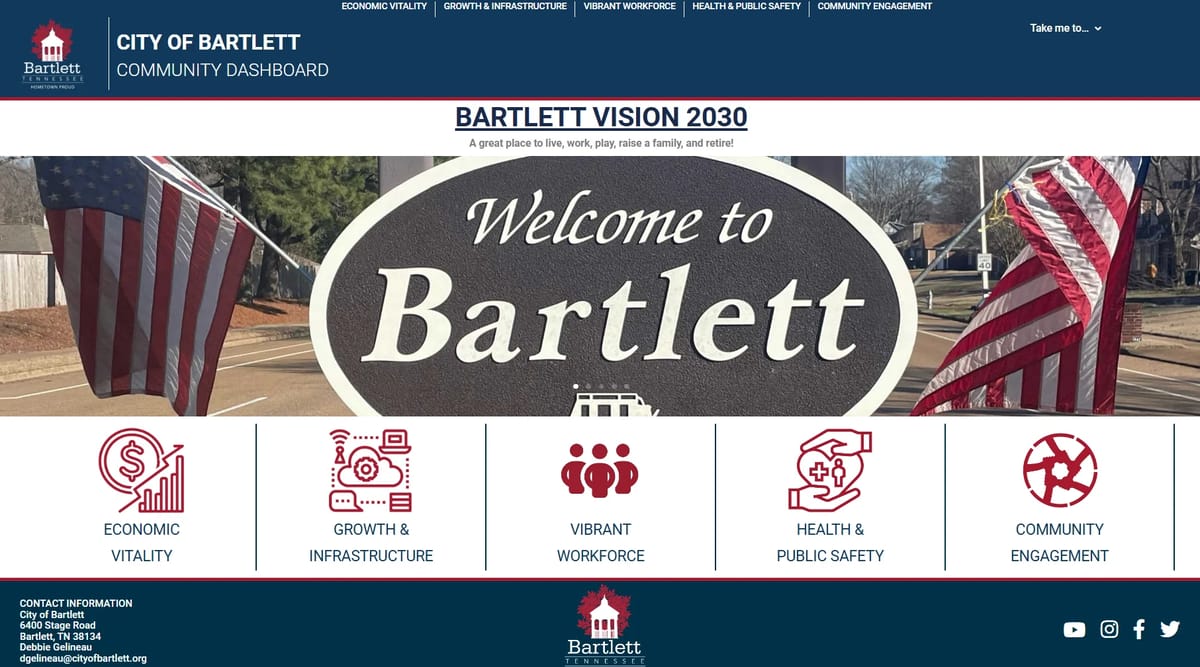
The externally accessible dashboard allows citizens and other stakeholders to track the city’s progress with better visibility.
A Hard Year’s Work
Bartlett got it done with clear direction, strong relationships, and a platform like ClearPoint.
The ClearPoint Strategy team pushed us. They’re setting dates and goals for you, just like you are with your team, and that’s what brought it together. Their prompting and support help – I’m happy with the way it worked out.
The city also leaned on the aldermen, holding several work sessions to share survey results and get feedback on the direction. Their only question was why the city hadn’t done things this way already.
According to Sones, the selling’s already been done. City Council members can see what is on the horizon and have the information laid out. That supports better decisions, better resource allocation, and more efficient governing.
The new approach brought a cultural shift toward accountability and improved cooperation between departments. Sones says ClearPoint helps him answer: “What’s going well?” “What’s not going well?” “What can we do to help get there?” and most importantly, “Is there anything that we need to be tracking that we’re not?”
With ClearPoint, it’s easy to have groups of information the most current as possible to see what we can do to help complete objectives and keep moving forward.
Best Practices
Sones sees the new strategic plan as a living document. Because plans change, he stresses collaboration and following best practices.
Simplicity
Keep strategic processes simple and flexible. That is how you gain and keep stakeholder support.
Continuous Feedback
Ongoing feedback helps refine strategies, meet new requirements, and adapt to changing needs. Ask for it regularly through employee surveys and other means to keep the feedback loop open.
Organizational Buy-In
Show stakeholders the overall mission and keep strategy in front of everyone as they work through their day-to-day, and you create a culture that supports it. Sones even jokes about the coining of the phrase, “Sounds like something that should go in ClearPoint,” among his colleagues.
Strategic Advice
For other municipalities looking to replicate Bartlett’s success, Sones offers this advice:
Strategic Planning
Be open and inclusive. In Bartlett’s case, the mayor, aldermen (three of which were newly elected), and department directors all brought fresh voices to speak for the community, alongside university survey results that checked what the representatives said. These insights made sure the plan covered what the community needs.
Strategy with ClearPoint
As for ClearPoint, be persistent, be fluid, and lead from the front. Show stakeholders what the system can do and let it bring everything together into a cohesive team.
The Future with ClearPoint
As Bartlett grows, its leaders remain focused on future-oriented strategies for areas such as public safety, environmental health, education, and more. Future initiatives included linking a GIS map through ClearPoint so residents can track infrastructure progress, and using the platform’s artificial intelligence (AI) features to streamline tasks and build even more buy-in.
Bartlett has kept its small-town charm through this work. With a clear vision and the right methodologies, other municipalities can get similar results.
See what ClearPoint could do for your community. Schedule a free demo to see the software in action.
Additional Case Studies
City of St. Cloud, Florida

City of Bartlett, Tennessee


City of Coral Springs, Florida
