We analyzed 20,582 strategic plans. Get a copy of the full report.
Free tool ·
All
Measure, target, direction, one caution band. The tool assigns Green, Amber or Red and writes the status policy sentence for each measure — it rewrites itself when you change a target. Free to use; email only to export.
Free to use. No account. Email only to export.
85.7%
of the time, an amber KPI stays amber the next period · 11.0% back to green · 3.3% to red · Aug 2026
30.1%
of 602 distinct status labels clients wrote cannot be resolved to red, amber or green · Aug 2026
83.7% vs 44.0%
milestones green vs. objectives red — same three colors, different altitude · Aug 2026
10.1% vs 42.5%
share of red readings, municipal vs. healthcare · Aug 2026
ClearPoint platform data · status records · August 25, 2026 extraction
RAG status is a red-amber-green reading of a measure against its target: green at or better than target, amber within an agreed caution band, red beyond it. The reading is only as useful as the threshold rule and the escalation behind it — on the ClearPoint platform, an amber KPI stays amber 85.7% of the time and escalates to red only 3.3% (August 2026).
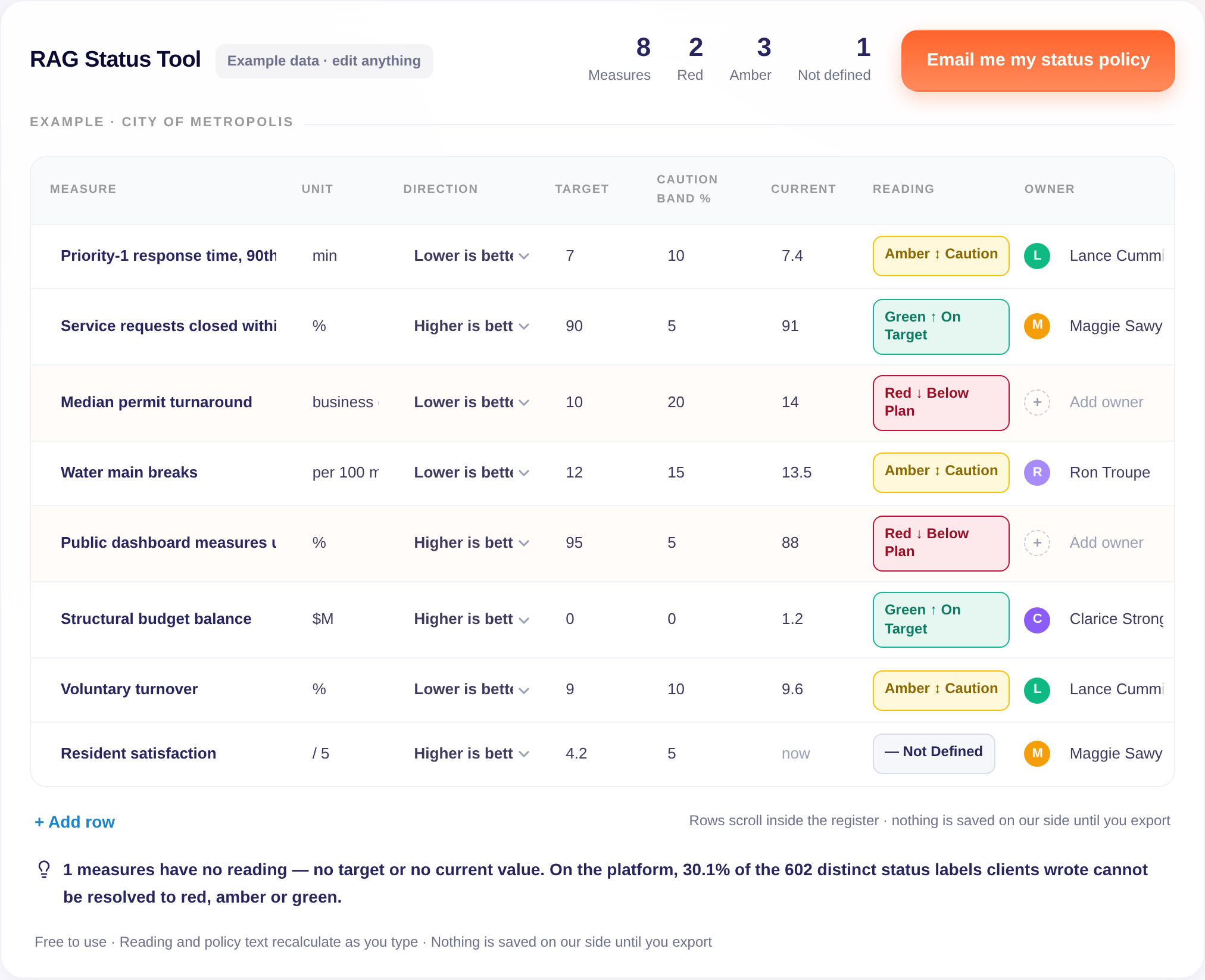
Example thresholds — City of Metropolis (illustrative). Eight measures with a target, a direction and a single caution band; in the tool, the reading and the policy sentence are generated from these columns.
| Measure | Unit | Direction | Target | Caution band % | Current | Owner |
|---|---|---|---|---|---|---|
| Priority-1 response time, 90th pct | min | Lower is better | 7 | 10 | 7.4 | Lance Cummins |
| Service requests closed within SLA | % | Higher is better | 90 | 5 | 91 | Maggie Sawyer |
| Median permit turnaround | business days | Lower is better | 10 | 20 | 14 | — |
| Water main breaks | per 100 miles | Lower is better | 12 | 15 | 13.5 | Ron Troupe |
| Public dashboard measures updated on time | % | Higher is better | 95 | 5 | 88 | — |
| Structural budget balance | $M | Higher is better | 0 | 0 | 1.2 | Clarice Strong |
| Voluntary turnover | % | Lower is better | 9 | 10 | 9.6 | Lance Cummins |
| Resident satisfaction | / 5 | Higher is better | 4.2 | 5 | — | Maggie Sawyer |
Every status is rendered as text plus an arrow, never as color alone (WCAG 1.4.1).
Reuse freely with attribution. Canonical source: https://www.clearpointstrategy.com/free-tools/rag-status
| Measure | Unit | Direction | Target | Caution band % | Current | Reading (calculated) | Owner | Policy text (auto · click to expand) (calculated) |
|---|---|---|---|---|---|---|---|---|
|  |  |  |  |  |  |  |  |  |
|  |  |  |  |  |  |  |  |  |
|  |  |  |  |  |  |  |  |  |
Source: ClearPoint Strategy — https://www.clearpointstrategy.com/free-tools/rag-statusWe’ll email a CSV of your measures — target, band, reading, owner and the policy sentence — plus a printable one-page status policy. Nothing else, unless you ask.
Nothing is saved on our side until you export.
On its way to your inbox
Amber is where measures park: on the platform an amber KPI stays amber 85.7% of the time. In a 30-minute session we show how thresholds like yours run live — the reading changes when the owner updates, the escalation fires on the second amber, the council packet shows the policy text. On your measures, not ours.
Why amber is a parking space
Red, Amber, Green: a three-state reading of a measure against its target. Green is at or better than target; Amber is worse than target but inside an agreed caution band; Red is beyond the band. That is the whole definition — everything else is the thresholds, and the thresholds are what most RAG templates leave to a colored cell.
A parking space. In the ClearPoint status records, a KPI that is amber stays amber 85.7% of the time in the next period, returns to green 11.0% of the time and escalates to red 3.3% (August 2026). Amber is not functioning as an alert stage; it is where uncomfortable measures wait. The policy sentence the tool writes includes an escalation rule for that reason.
An amber KPI stays amber 85.7% of the time. Amber is not an alert. It is a parking space.
Because altitude changes the rate. Milestones read green 83.7% of the time; objectives read red 44.0% of the time — a factor of twelve on the red rate with identical colors. And by sector, municipal measures read red 10.1% of the time against 42.5% in healthcare. A threshold policy has to say which level and which sector it was written for.
A template is a grid with a Status column you color by hand. This tool computes the reading from your target, direction and band, and generates the policy sentence that goes into your performance framework — then regenerates it when the target is renegotiated in the meeting.
| RAG status template | This tool | |
|---|---|---|
| Thresholds | Typed or colored by hand | Target + direction + one band |
| Reading | Chosen | Computed, text + arrow |
| Policy sentence | Written separately | Generated, rewrites on change |
| Escalation rule | Missing | In every sentence |
| Accessibility | Color only | Text + arrow (WCAG 1.4.1) |
| Email required | To download | Only to export |
Trusted by the teams whose plans are public
“We had six shades of yellow and nobody could say what any of them triggered. One band, one sentence per measure, and the review got shorter.”
[Cleared client quote — same vertical only] — name, title, organization
City of Fort Lauderdale · Durham County · City of Coral Springs · City of Goldsboro · JEA
Red, Amber, Green — a three-state reading of a measure against its target. Green is at or better than target, Amber is within an agreed caution band, Red is beyond it. The reading is only as good as the thresholds behind it.
Pick a target, a direction (higher or lower is better) and one caution band as a percentage of target. Green at or better than target; Amber within the band; Red beyond. The tool applies this to each measure and writes the policy sentence.
In practice, a parking space. On the ClearPoint platform a KPI that is amber stays amber 85.7% of the time, returns to green 11.0% and escalates to red 3.3%. A useful amber has an escalation rule — the policy text includes one.
Because the sentence is what goes into the performance-management framework, and it has to change when a target is renegotiated. The tool rewrites it when you change a number.
It exports to one. The difference is that the thresholds, the reading and the policy text are computed from your target and band, not colored by hand.
ClearPoint platform data: status records and normalized statuses, August 25, 2026 extraction — 602 distinct client status labels; amber transition matrix on consecutive status periods.
All answers ship as text in the DOM — the accordion only hides them visually.
Method
ClearPoint platform status records and normalized statuses, extracted August 25, 2026. Label resolvability: 602 distinct client-written status labels, 181 (30.1%) not resolvable to red, amber or green. Amber transition matrix: consecutive status periods of the same measure. Altitude and sector cuts: share of readings by element type and by organization sector.
Green at or better than target; Amber worse than target but within margin% of target; Red beyond; Not Defined when target or current is empty. One band, not two — a range mode with two margins was tested and dropped as inconsistent with its own example.
Transition rates describe what organizations record, not what the measures did. The two-period escalation rule in the policy text is a practice recommendation, not a measured optimum.
Thirty minutes, your measures, a status that updates when owners do.
Book a 30-min demo
.svg)
