

Mailing address: 399 Boylston Street, Suite 650
Boston, MA 02116
866-568-0590
support@clearpointstrategy.com
Both platforms run strategic plans for local government. They differ on one question: who sets the structure of your plan, the vendor or you.
Envisio’s strongest asset is a prescribed structure on day one.
No two cities on ClearPoint are built alike. The median local government runs 19 plans, and plan size ranges from a handful of measures to more than 50. Onboarding starts with your org chart and your reporting calendar, and our customer success team learns how your city works before building anything. See the data
ClearPoint platform data, snapshot September 2026. Review scores checked on G2 and Capterra on September 28, 2026.
If you read nothing else.
Public sector is a core practice at ClearPoint. 161 local governments run their strategy here, the median one on 19 plans, alongside state agencies and special districts.
The structure is yours. Multiple concurrent plans, a hierarchy you name, any framework, and roll-up from any level. All native. Ask to see each one in the first ten minutes of a demo.
Security is held by ClearPoint, as an organization: SOC 2 Type 2, WCAG 2.2 AA native with the VPAT in our Trust Center, and AI that never trains on your data.
ClearPoint Next launched in 2025 and has shipped ten releases since June 2026, every one public and dated.
Envisio’s approach is prescribed: quick setup, coaching-led implementation and careful public dashboards. The decision comes down to structure.
All 27 rows are shown first, grouped by theme. Filter by theme above the table. A green check means the capability is documented; a red cross on the Envisio side means it does not appear in their public material, and the row is highlighted. Totals at the bottom follow the filter, with a partial counted as half.
Envisio column based on Envisio’s public website and help center, checked September 28, 2026.
Owners update measures by replying to an email or a Teams message, without opening the platform.
Your strategy data readable by the AI tools your organization already approved.
Tone and behavior controls, admin-only configuration, a global off switch, transcript oversight.
ClearPoint AI works on your actual portfolio and draws on a research archive of 31.2 million rows from over 20,000 strategic plans.
Held by ClearPoint Strategy as an organization. Report available on request from the Trust Center. Ask each vendor whether the report is issued to the vendor or to its hosting provider.
SOC 2 stated for their hosting data centre. No Envisio-issued report found.
No training on your data. Opt-in per account, scoped per role, logged per request, formal AI subprocessor agreement.
No public statement found on training, per-role scoping or request logging.
Native in the application, no overlay and no plugin. VPAT in the Trust Center. Ask each vendor for its VPAT and read both against your requirements.
Stated for their public dashboards.
SAML and Microsoft Entra ID, with permissions scoped per scorecard and per element.
REST API and webhooks, Data Loader (Excel/SQL/ODBC), Zapier. API access is one of the integration options you pick when you build a quote.
No webhooks, Zapier or SQL/ODBC loader found.
ArcGIS, Tyler Munis and Oracle.
No Oracle integration found.
Power BI, Tableau and SQL sources feeding measures directly.
No direct SQL source connection found.
Recurring imports mapped once, then left alone.
One click, brand-applied, with charts as native objects.
No native PowerPoint or Word export found.
Owners are reminded, then nudged, then escalated, by email and in Microsoft Teams.
No automatic escalation found.
Calculations, aggregations and status counts. Roll-ups across element types and measure data types, with custom weighting. Stoplight rules you set per measure.
No weighted roll-ups of measures found.
Briefing books assembled on a schedule, per committee, with the commentary attached to each element.
Balanced Scorecard, OKRs, V2MOM, Hoshin Kanri, Theory of Change and hybrids, with a guided assistant for each.
No guided assistant per framework found.
Strategic plan, departmental plans, grant and CIP plans in one account, each with its own structure and owners.
Goal, objective, measure, initiative, milestone, or your own five levels with your own names.
Department results roll into strategic goals at any depth. Both vendors state native roll-up. Ask each to change one departmental measure and show the city goal move, live.
Council view, resident view and department view built from the same data.
No separate dashboard views per audience from the same data found.
Your own domain, a branded ClearPoint subdomain, or live elements embedded in the CMS you already run.
Live elements dropped into the site you already run.
Hero photos, focus areas, measures and capital projects already wired to your scorecard, on day one.
A person who knows your plan, through implementation and after it.
G2: 4.6★ across 179 reviews. Capterra: 4.8★ across 53.
G2: 4.7★ across 14. Capterra: 4.7★ across 28.
161 local governments, alongside hospital systems, universities and utilities.
ClearPoint column reflects ClearPoint Next as shipped on 8 September 2026. Envisio column reflects their public website and help center, checked September 28, 2026. In the totals, a partial counts as half. Send us a correction and we will change the row and date it.
161 local governments run their strategy in ClearPoint, alongside state agencies and special districts. On top of that practice, ClearPoint runs plans for hospital systems, utilities, universities and Fortune companies, and every government customer benefits from what those sectors have already built.
Two caveats, stated rather than buried: these are organizations that chose ClearPoint, so read this as a picture of local governments that run a real performance system — and the 161 are identified by keywords in the organization name, so treat the boundary as approximate. The median holds either way: half of these local governments run 19 plans or more. Full benchmark
The three shapes we are asked to hold most often — none of them a question of population size.

A county where every department needs its own scorecard, and the county plan has to stay a single source of truth. One measure, linked into every plan it belongs to, updated once.

The council sees one view, the executive team another, residents a third — from the same data, published where the city wants it.

A multi-year capital program where schedule, spend and outcome measures live together, and the quarterly report writes itself from what project managers already updated.
A city plan, three department plans rolling up into it, and one measure shared across all of them. No form, no sales call.
 Start the tour
Start from the Community Dashboard template: hero photos, focus areas, measures and capital projects already wired to your scorecard. Then open what five cities built on the same platform. None of them look alike, and each one carries its city’s name, colors and photography.
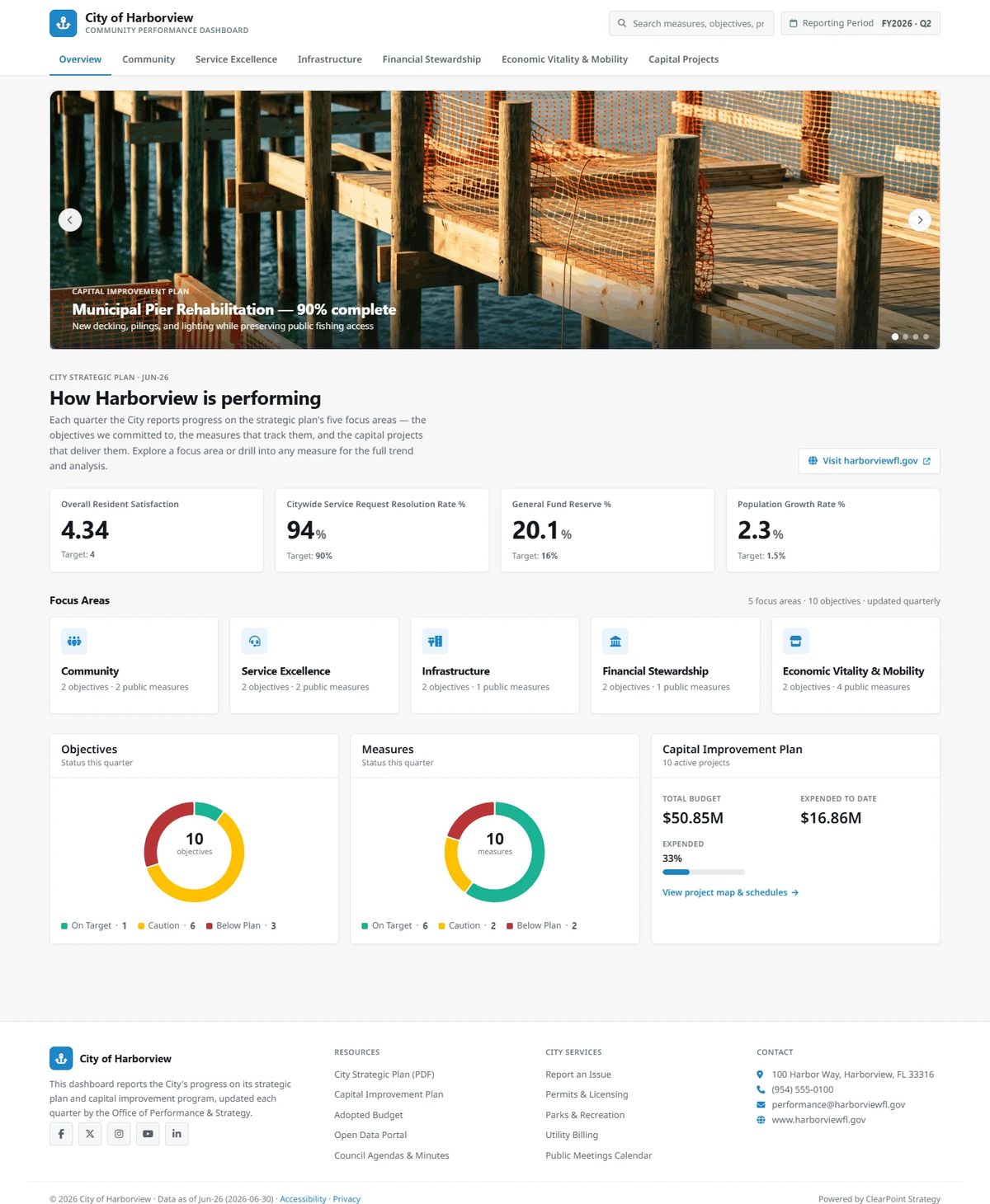


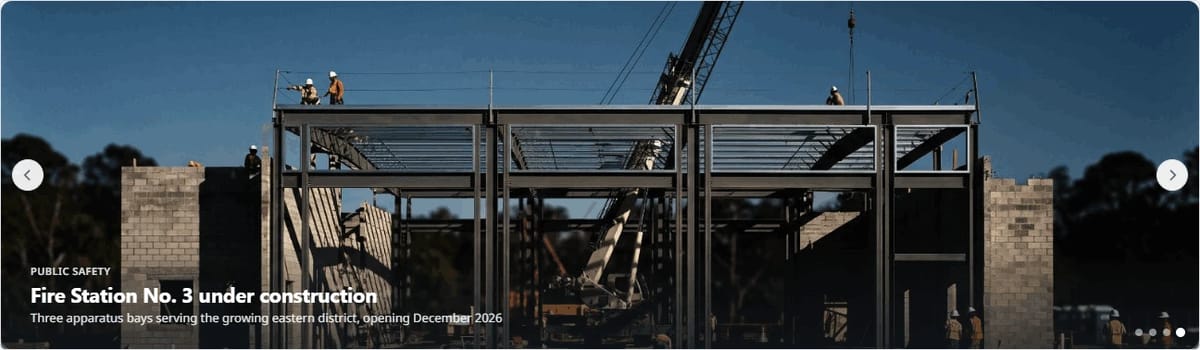
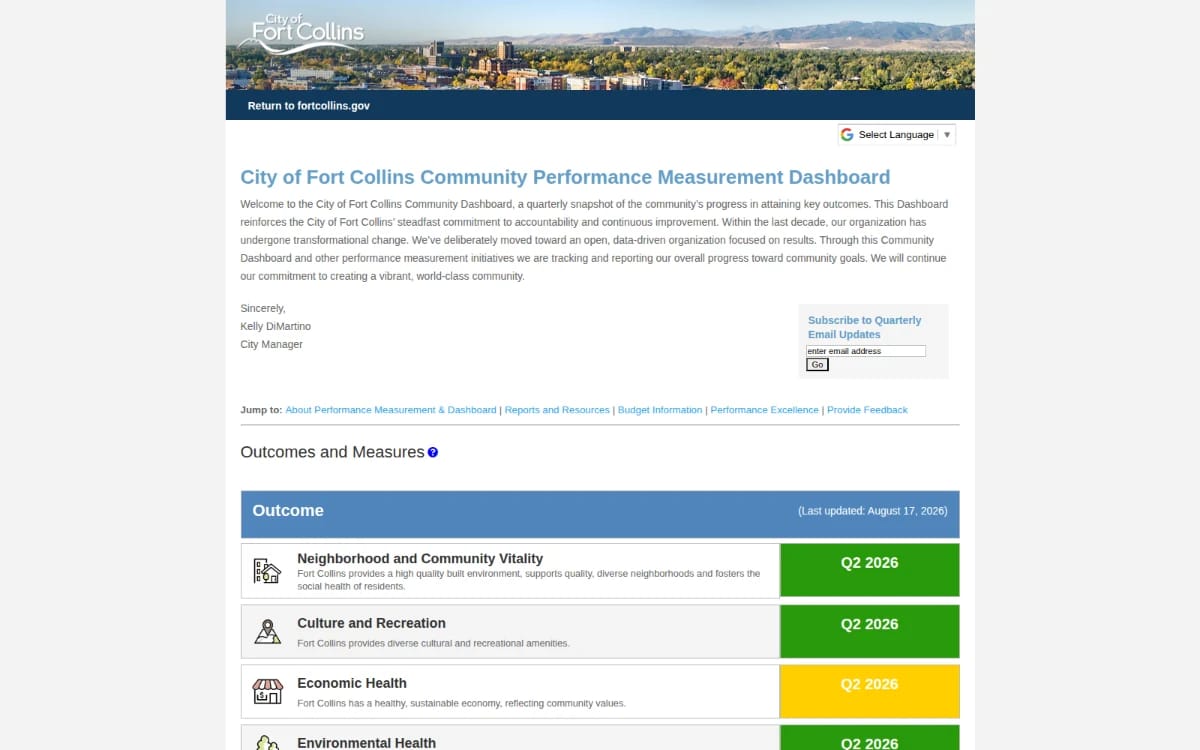
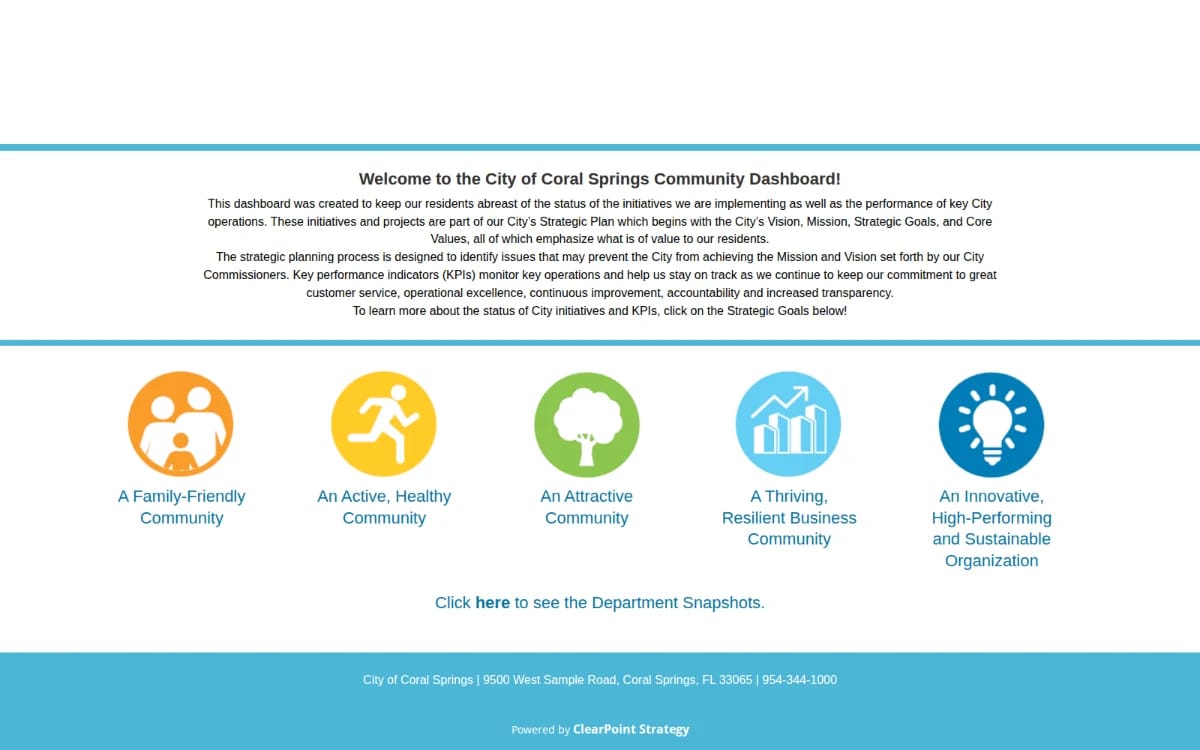
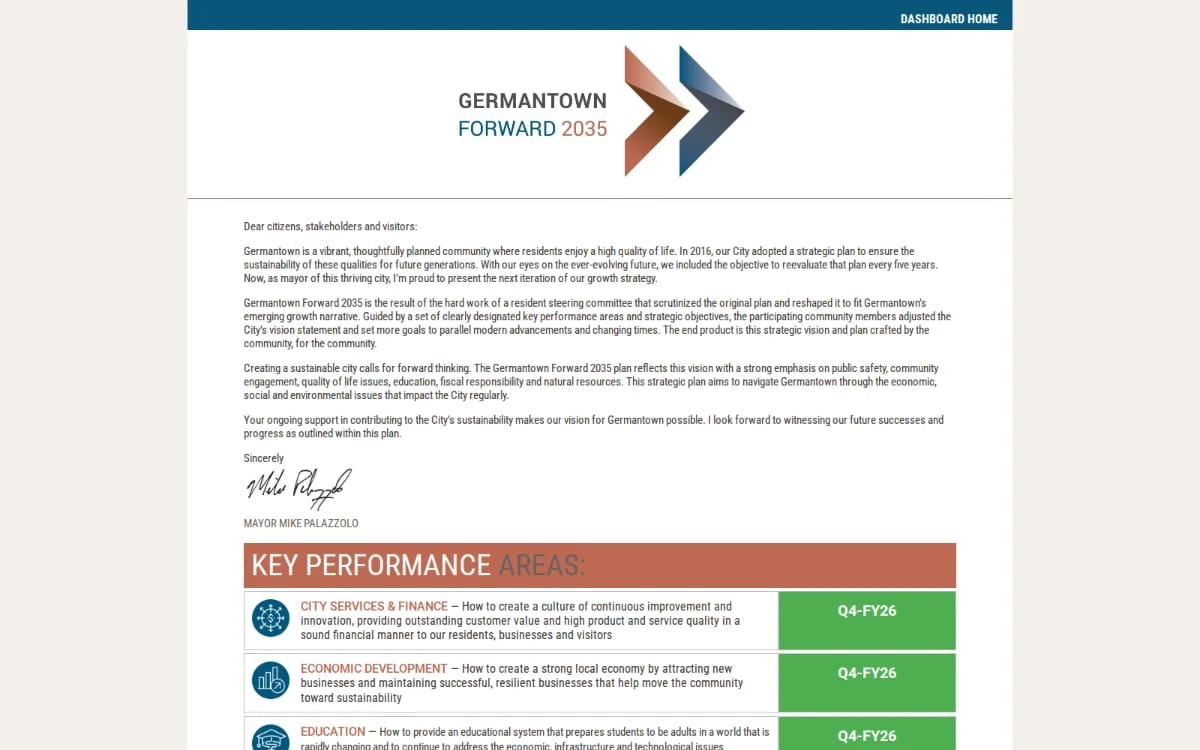
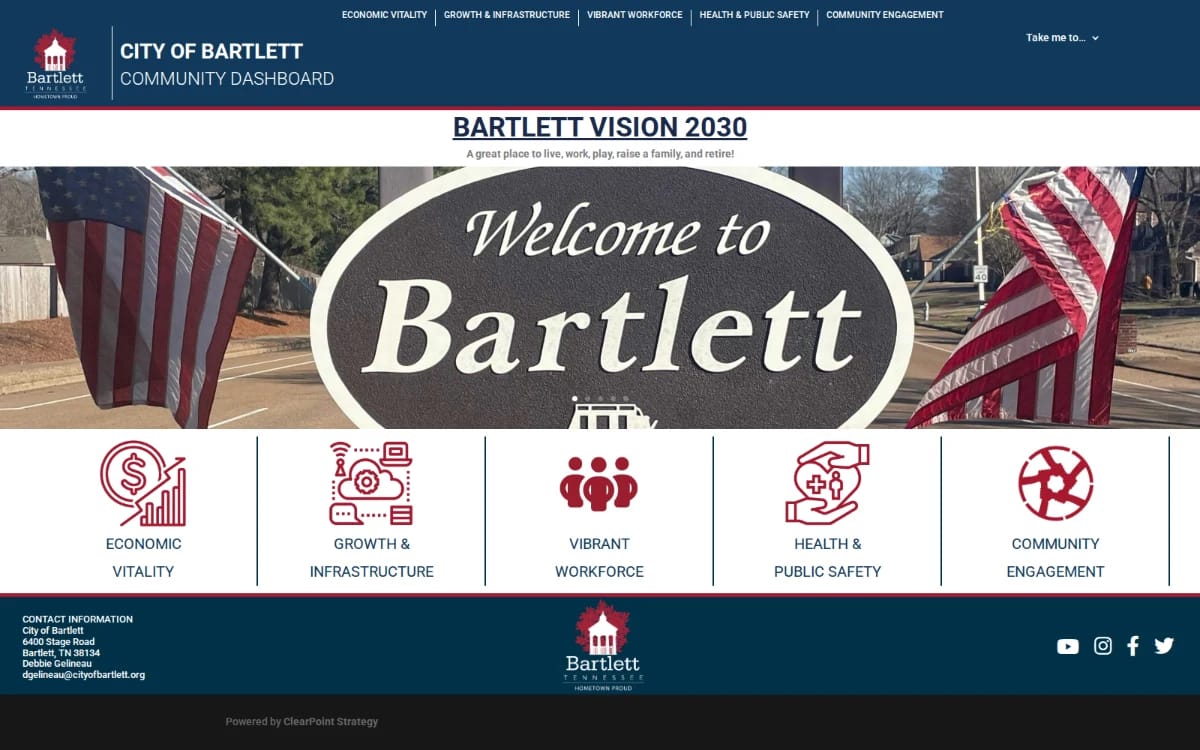
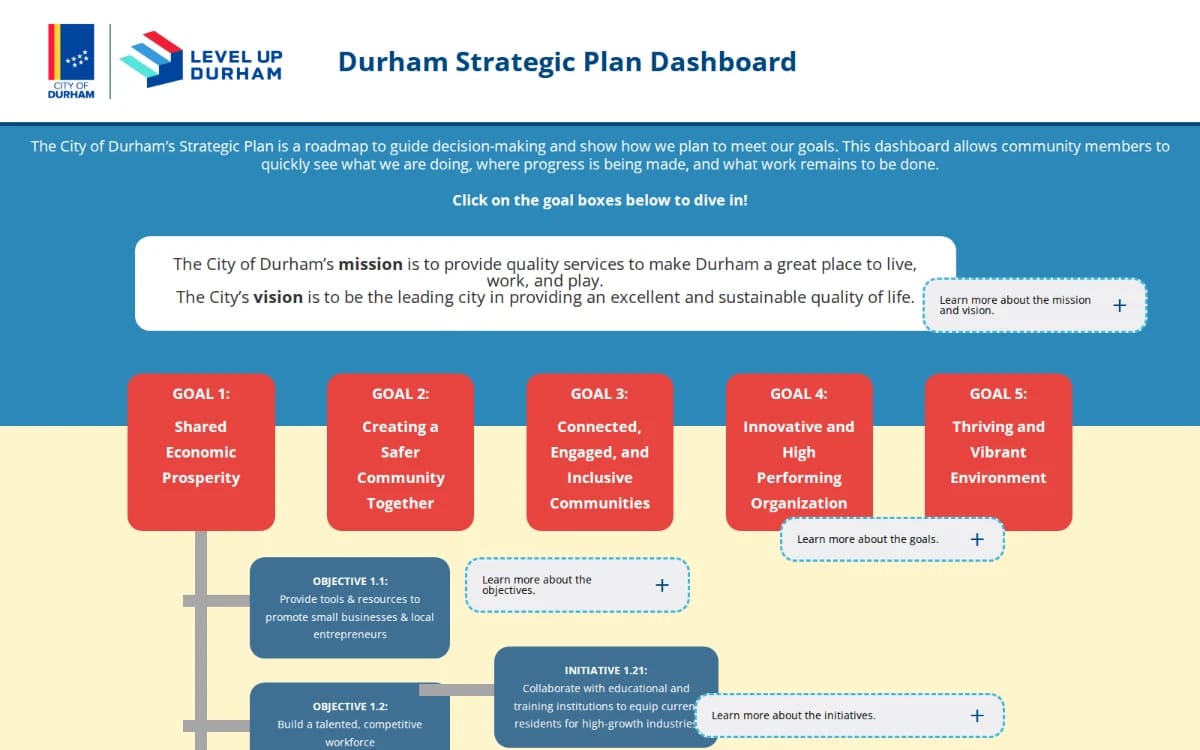

Every city above chose its own layout, colors and photos. Yours will too.
Strategy updated from an email reply. A briefing built for each role. AI that works inside Teams, Outlook and the assistants your organization already approved. These are the biggest steps of the last twelve months, each with its version number and a dated note at news.clearpointstrategy.com.
Reply in plain English to any ClearPoint report email. AI reads the export, answers your questions, and writes the update back into the scorecard.
A role-aware homepage that rebuilds from live account data on every open — a materially different page for an executive, an administrator and a contributor.
Plus a personal Outlook connection, so AI is calendar-aware and can draft and send meeting follow-ups on your behalf.
Connect your own AI assistant to your ClearPoint data over a secure, OAuth-authenticated connection: read your strategy, ask questions, update it.
Guided, multi-step workflows for SWOT, risk assessment, department and enterprise planning, and onboarding — structured conversations that guide each step.
Upload your own documents so AI answers from your organization's context, with citations back to the source.
Tone and response-length controls, supportive or challenging recommendations, custom guidelines, admin-only configuration, a global off switch, transcript oversight, and a formal AI subprocessor agreement.
License utilization, weekly active users, team activity, and an AI-generated ROI narrative that updates itself.
Four surfaces from the current product.
The homepage rebuilds from live account data on every open, and shows a materially different page to an executive, an administrator and a contributor.
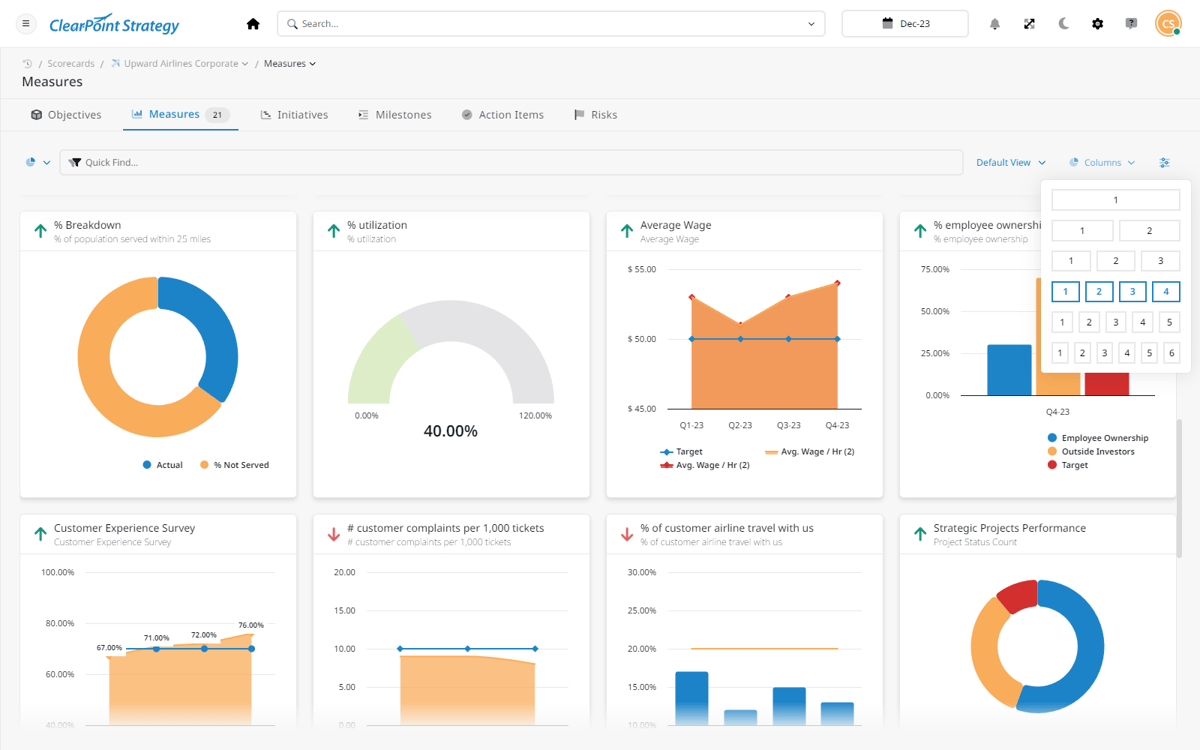
One measure, linked into every plan it belongs to. Update it once and every scorecard, report and dashboard that uses it moves with it.
ClearPoint AI reads each linked measure’s status, owner and history — then turns a recommendation into an action item with an owner and a date.
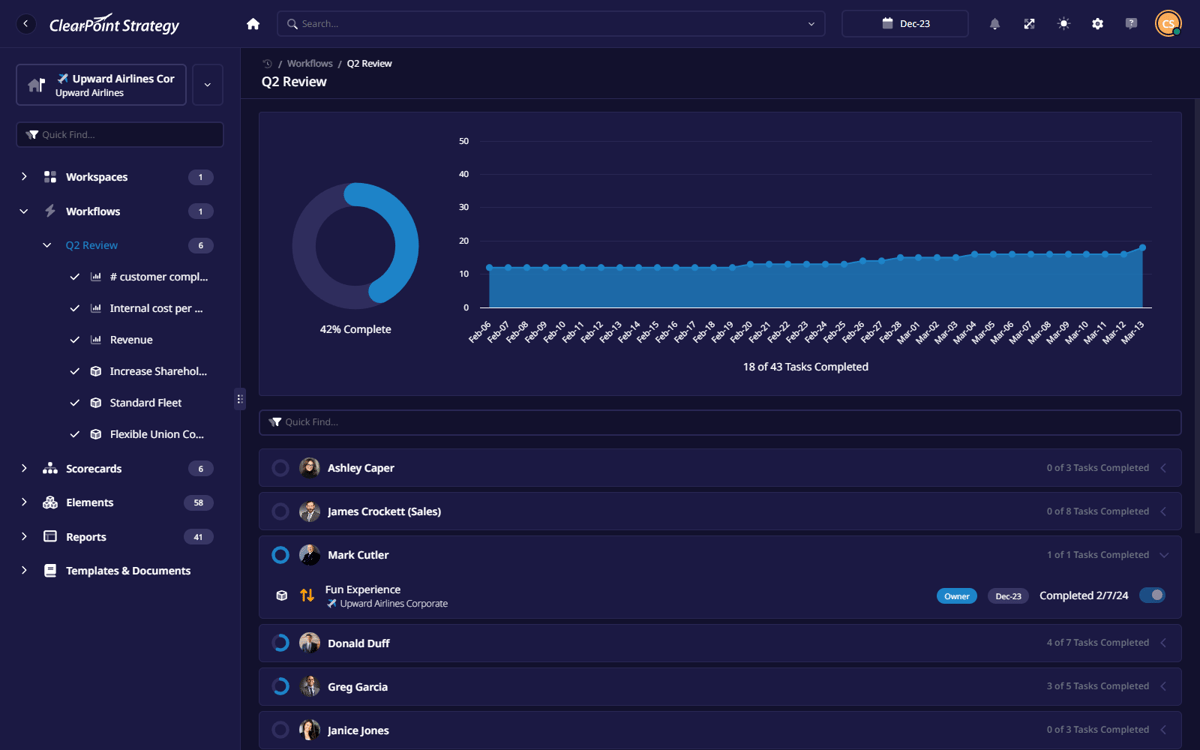
Who owes what, by when, chased automatically. The reporting cycle stops being a person with a spreadsheet and a calendar reminder.
Some organizations want the method decided for them. Envisio hands you a structure, a standard reporting shape and a clean public dashboard. ClearPoint builds around the structure you already have and the one you will have in three years.
Their implementation is coaching-led; one customer says they “didn’t just give us the keys to the car, they taught us how to drive it.”
Next to 161 local governments sit hospital systems, universities, utilities and Fortune companies, on the same platform and the same roadmap.
Teams rarely switch because something broke. They switch when the plan grows past the structure it started in.
Council wants PowerPoint or Word, and someone reformats an Excel or PDF export every cycle.
Finance, GIS or HR figures get copied into the plan by hand instead of flowing in from where they live.
Reminders go out, but when an owner misses the deadline, someone still escalates it by hand.
Council, residents and departments each need their own view, so you maintain copies to get there.
Goals roll up with weights, and the math happens outside the tool before it reaches the plan.
Your organization approved an AI assistant, and owners still log in to update every measure.
IT wants a SOC 2 Type 2 report issued to the vendor itself, not to its hosting provider.
You are adding OKRs or a hybrid next to the scorecard, with no guided way to run both.
Ask both vendors. Have them show you, live. Then ask every reference the same four things.
Walk through the checklist on a demoClearPoint: once. One measure, linked into every plan it belongs to. Watch it happen live.
ClearPoint: yes, from any level of the hierarchy.
ClearPoint: open Coral Springs, Fort Collins and Durham side by side. Three cities, three dashboards, one platform.
ClearPoint: automated collection plus integrations with Power BI, Tableau, Oracle, ArcGIS and Tyler Munis, a REST API with webhooks, and an MCP server.
ClearPoint: analysis on any element that reads each linked measure’s status, owner and history, then turns a recommendation into an action item with an owner and a date.
ClearPoint: the report is issued to ClearPoint Strategy as an organization. Accessibility is native in the application, with the VPAT in our Trust Center. Ask each vendor for both documents.
ClearPoint: tone and behavior controls, admin-only configuration, a global off switch, permission-aware answers, a named audit trail, transcript oversight, and a signed subprocessor agreement.
ClearPoint: Balanced Scorecard, OKRs, V2MOM, Hoshin Kanri, Theory of Change, or your own hybrid, in the same account, without a migration.
It depends on how your plans are structured. Envisio’s plan structure comes built for you. ClearPoint lets your structure be your own (multiple scorecards, different reporting calendars, several frameworks) and rolls it all up into one view.
Envisio can be the better fit if a prescribed structure suits you: stable plans on one reporting calendar, no automated system integrations, standard dashboard templates, or a procurement rule that requires in-country hosting in Canada or Australia.
Yes, as an organization. The report is issued to ClearPoint Strategy, and it is available on request from our Trust Center along with our other security documents. When you compare vendors, ask whether the report you are shown is the vendor’s own or its hosting provider’s.
ClearPoint conforms to WCAG 2.2 AA natively, in the application, without an overlay or plugin. Our VPAT is in the Trust Center. Ask every vendor in your evaluation for its VPAT and read them against your requirements.
A role-aware AI homepage, AI updates by email and Microsoft Teams, an official MCP server, AI Playbooks, a grounded Knowledge Base, and a full AI governance layer. Each release is listed on this page with its version number.
No. Publish on your own domain, embed in your existing CMS, or export accessible HTML.
Balanced Scorecard, OKRs, V2MOM, Hoshin Kanri, Theory of Change and custom hybrids, with guided assistants for each, in one account, without migrating when your approach changes.
Pay for what you need, as published in Clearing the Air, and ask about the Government Unlimited plan with unlimited users. API and MCP access is one of the integration options you pick when you build a quote. We make no claim about any competitor’s pricing. Ask every vendor on your shortlist for written pricing, including what year-three renewal looks like.
It depends on how many scorecards you are moving and how clean the measure history is. ClearPoint Next is self-service, and our team loads your data before training. Ask any vendor, including us, for a written migration plan with named owners and dates, and treat a number given without seeing your data as a guess.
Thirty minutes, your data, your dashboard. Bring the hardest thing in your portfolio and we will build it on the call.


Don't want to schedule a demo yet? No worries. Just enter your contact info below to get instant access to an interactive tour of ClearPoint.


