.svg)

1911 N Fort Myer Drive, Suite 1100
Arlington, VA 22209
866-568-0590
info@clearpointstrategy.com
ClearPoint is where cities, counties, health systems and universities build their strategic plan and run it after approval.
Every objective gets an owner. Updates come in on their own. The board report takes one click.
Southern Ohio Medical Center cut monthly reporting from 40 hours to 15–20 minutes.














Strategic planning software is where an organization builds its strategic plan and runs it: objectives, the measures and initiatives under each, a named owner for every element, regular progress updates, and reports for leadership. Unlike a document or a spreadsheet, it keeps the plan current and shows what is on track and what is slipping.
Plan already approved? See the strategy execution platform ›Bring your plan in as it is. Every element gets an owner, updates arrive on their own, reports build themselves, and what slips shows up before the review.
Across 52,247 objectives in 318 organizations, 77.6% have no named owner. Initiatives with a named owner are completed 2.5× as often.
See the data ›The plan is approved. Then the work of running it lands on one person and a spreadsheet. Four things break, in this order.
01 · Owners. Objectives sit in a document nobody opens, with no owner and no measure attached.
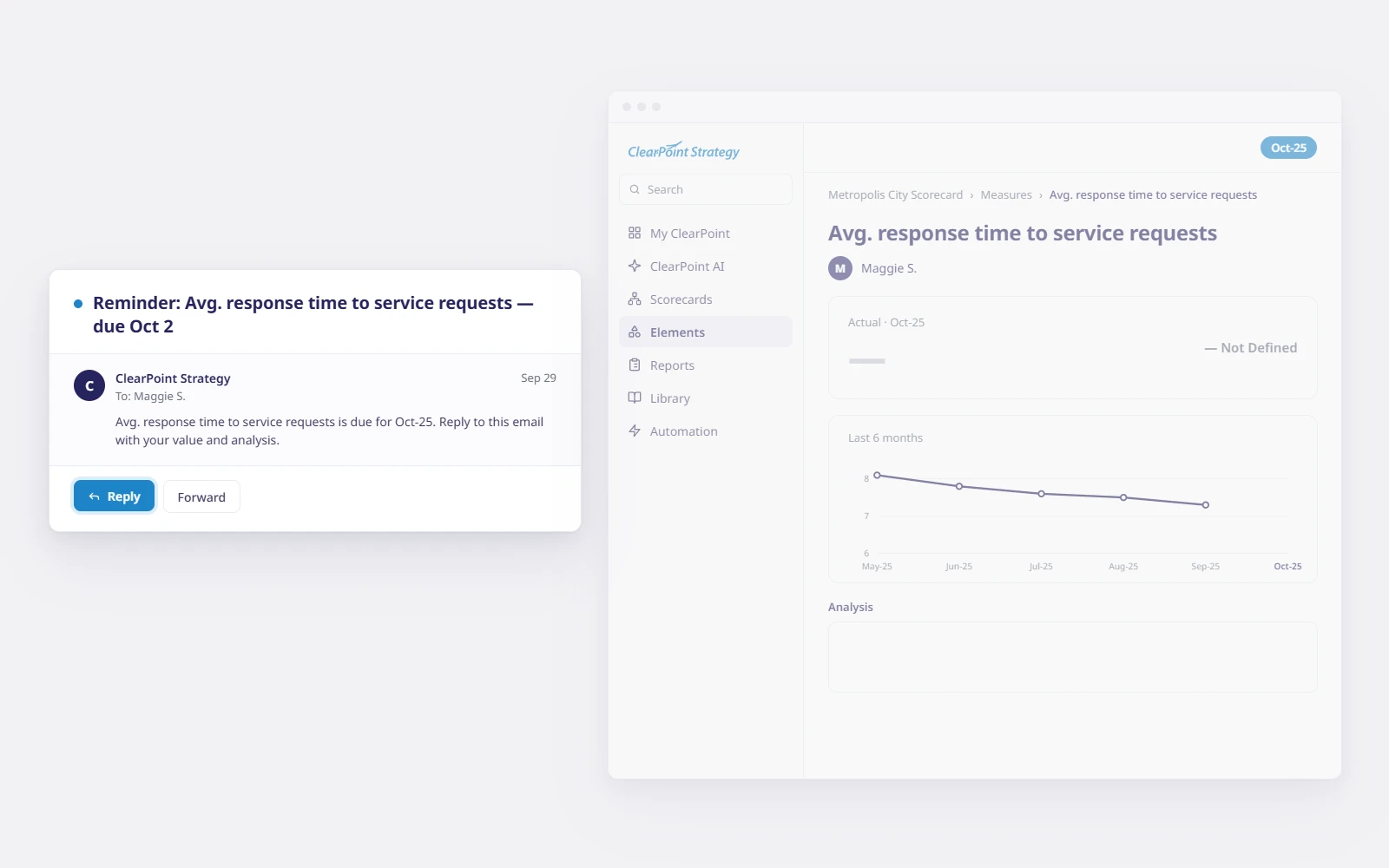
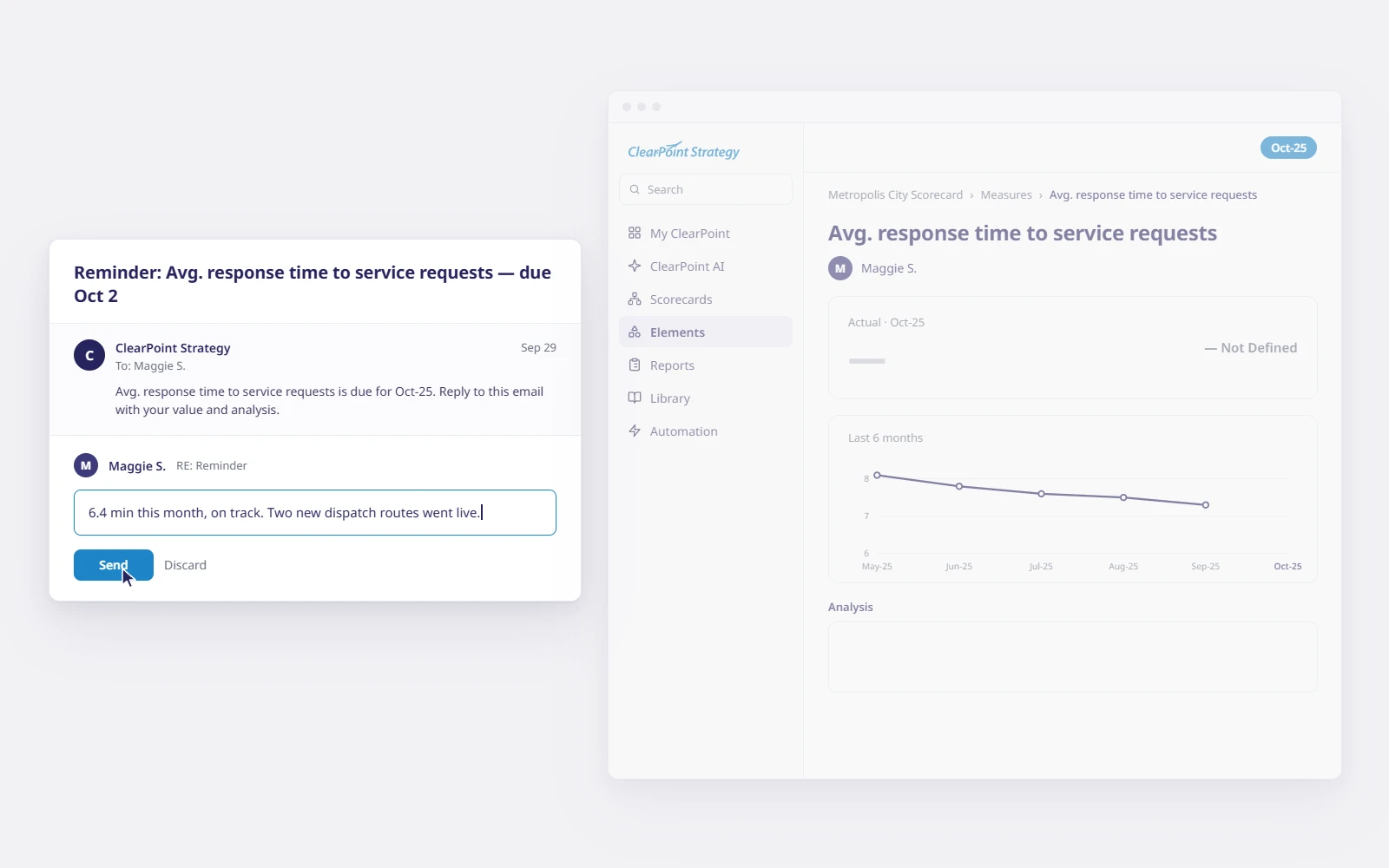
02 · Updates. One person chases six departments every quarter and re-keys the numbers by hand. What you see: an email reply becomes the month’s value, with its status, in the scorecard. Also on a schedule from Excel, Power BI, Snowflake, SQL Server, Tableau and Jira.
03 · Reporting. Council packets and board decks are rebuilt from scratch every period.
04 · Early warning. A red measure surfaces after the quarter closes, when the decision is already late.
Every objective gets a named owner. Anything unowned is flagged.
The plan lives in a PDF.
Bring your plan in as it is. ClearPoint turns it into objectives, measures and initiatives, and gives each one a named owner. Anything left unowned is flagged on the scorecard.
Owners reply to an email or in Teams. The scorecard updates itself.
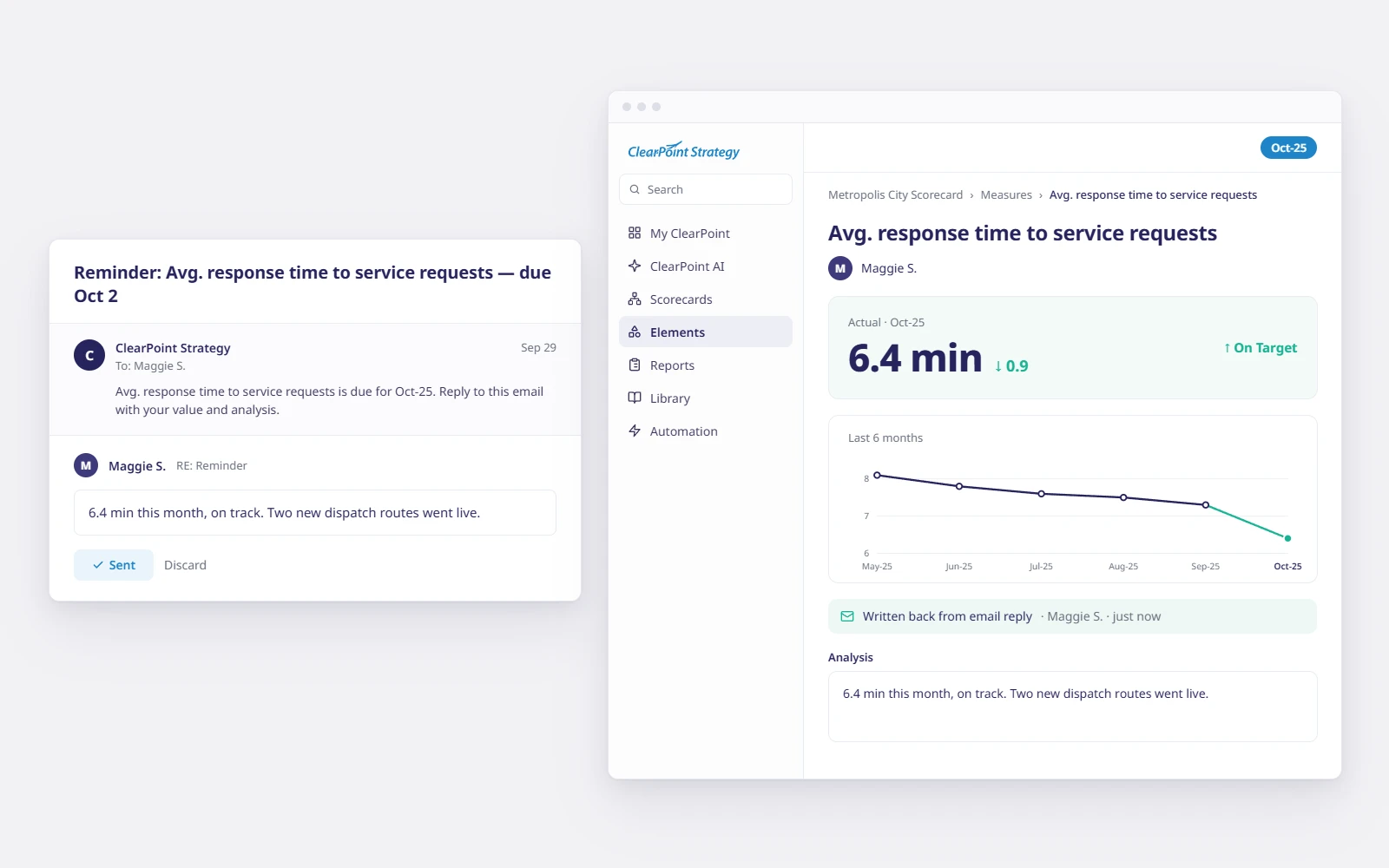
Updates arrive by email, late.
Numbers arrive on a schedule from the systems you already use. People who do not live in dashboards reply to a reminder email or answer ClearBot in Microsoft Teams.
Board and council reports come out of the live plan in one click.
The board report takes weeks.
Board packets, council presentations, department reviews and public dashboards come out of the same plan, in your branding. Design each template once. Every period after that is one click, on schedule.

Status rules flag what is slipping while there is still time to act.
You learn what slipped at the review.
Status rules and trends flag what is slipping while there is still time to act. Each element has an owner and a cadence, so a change in the data becomes a decision.
How ClearPoint AI is governed ›The method comes from 30 years of helping organizations execute strategy, alongside the creators of the Balanced Scorecard. It is built into the Playbooks, the setup and the people who do it with you.
Guided, step-by-step conversations with ClearPoint AI: build a strategic plan by department, organization type or industry; run a SWOT or a risk assessment; onboard a new department.
You answer questions in your own words. ClearPoint drafts the objectives, measures and initiatives, in your terminology, for you to review before anything is published.
A library of ready-made Playbooks is included. Custom Playbooks built with the ClearPoint team are available in beta.
ClearPoint's team sets up your plan with you, whether you start from scratch or bring an existing document.
Most organizations have their first scorecard live in 3 weeks.
On-demand strategy sessions with ClearPoint’s team, live sessions on how other organizations run their plans, and an open drop-in demo where you can ask anything.
Founded by Ted Jackson and Dylan Miyake, who worked with Robert Kaplan and David Norton — the creators of the Balanced Scorecard — and have spent 30 years helping organizations execute strategy. Our methodology
Everything the plan needs to be built, owned, updated and reported, in one place.
ClearPoint does each of these; the cards below show how.
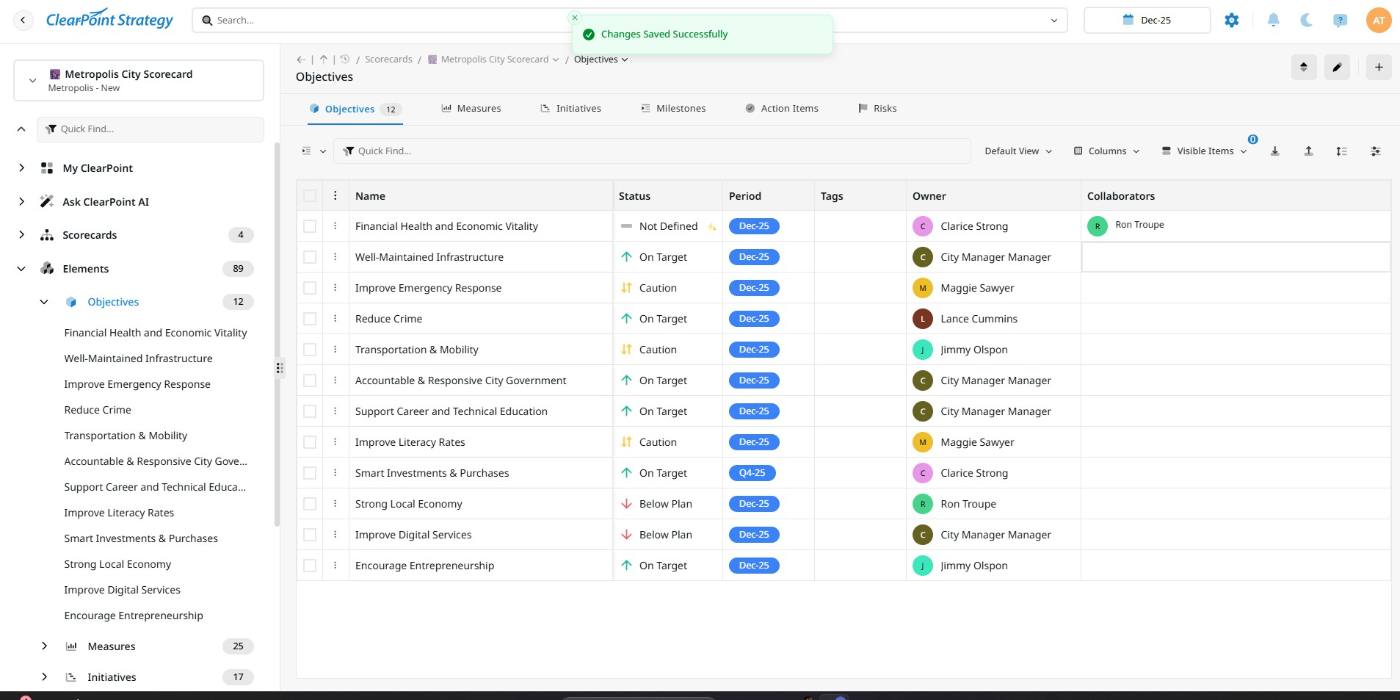
Every objective, measure and initiative in one structure, each with a named owner. Learn more ›
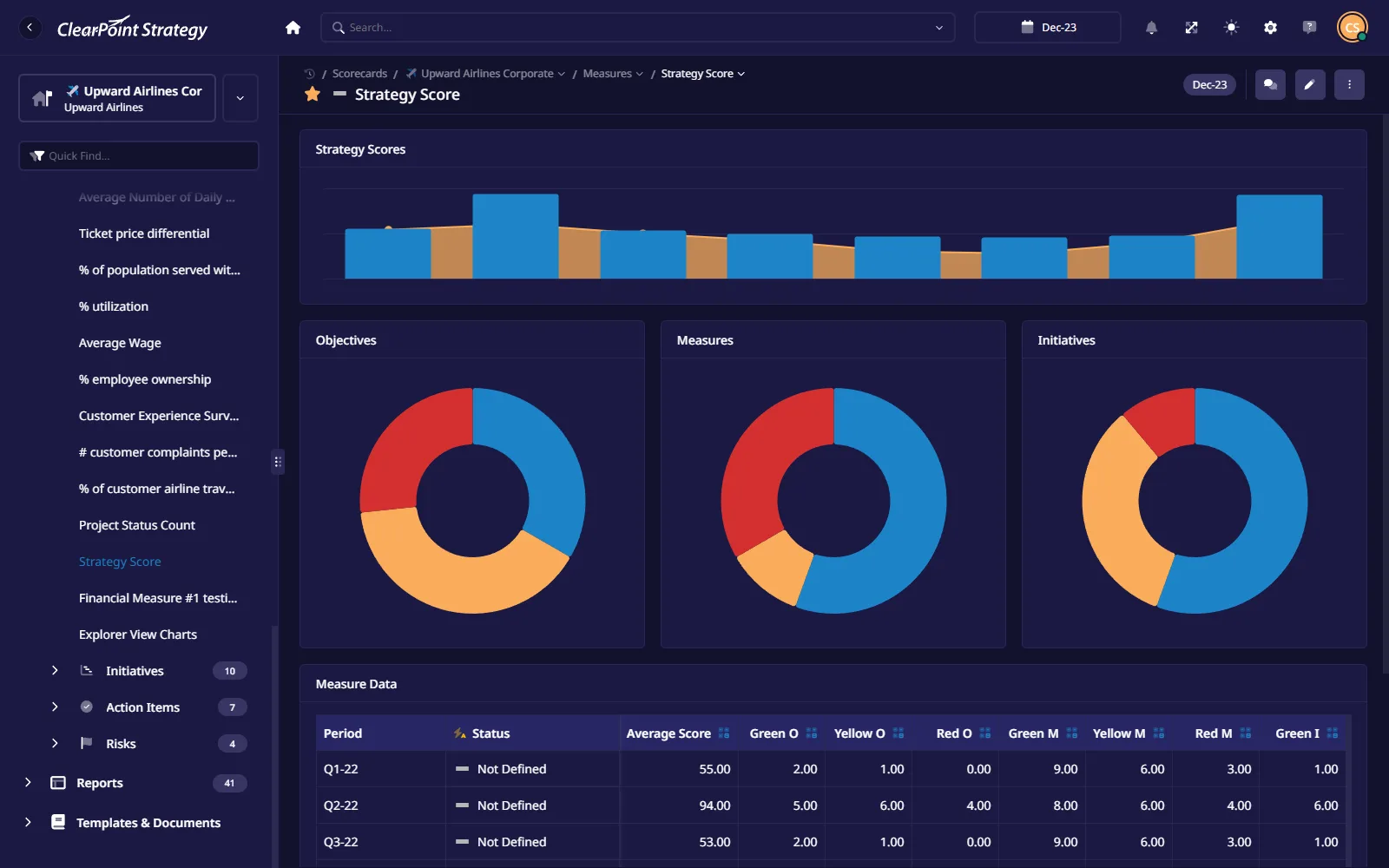
Briefing books, packets and presentations built from the live plan. Learn more ›
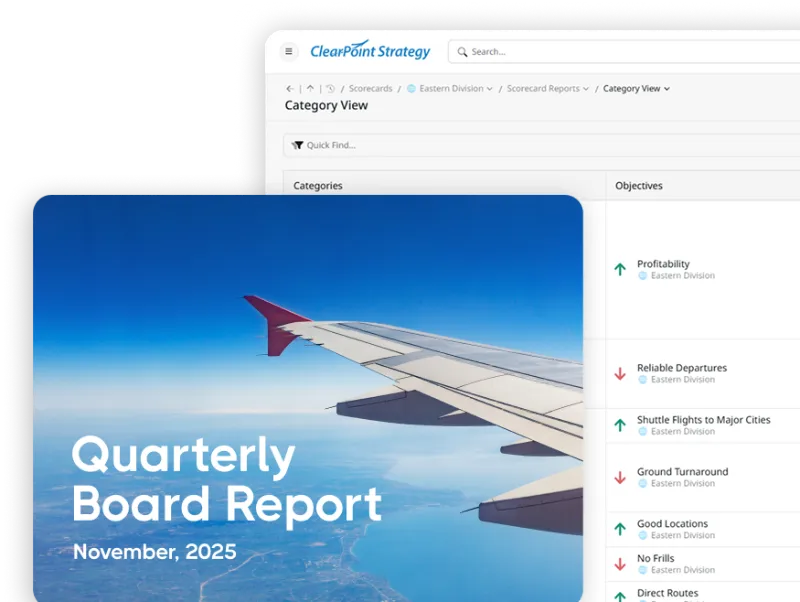
Guided workflows to build the plan, run a SWOT or a risk assessment, and onboard your team.
Learn more ›Targets, thresholds and red-yellow-green status set once and applied automatically.
Learn more ›Learn more ›
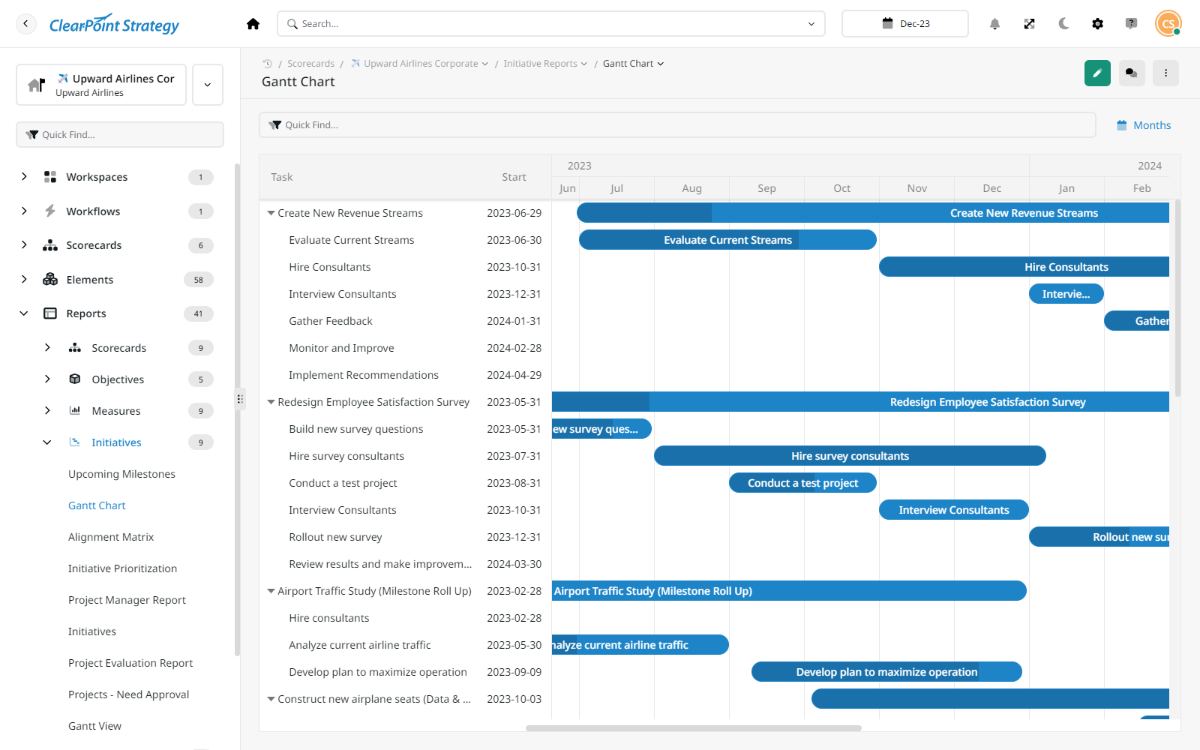
One home page for the whole strategy, and a public site your residents can read. Learn more ›
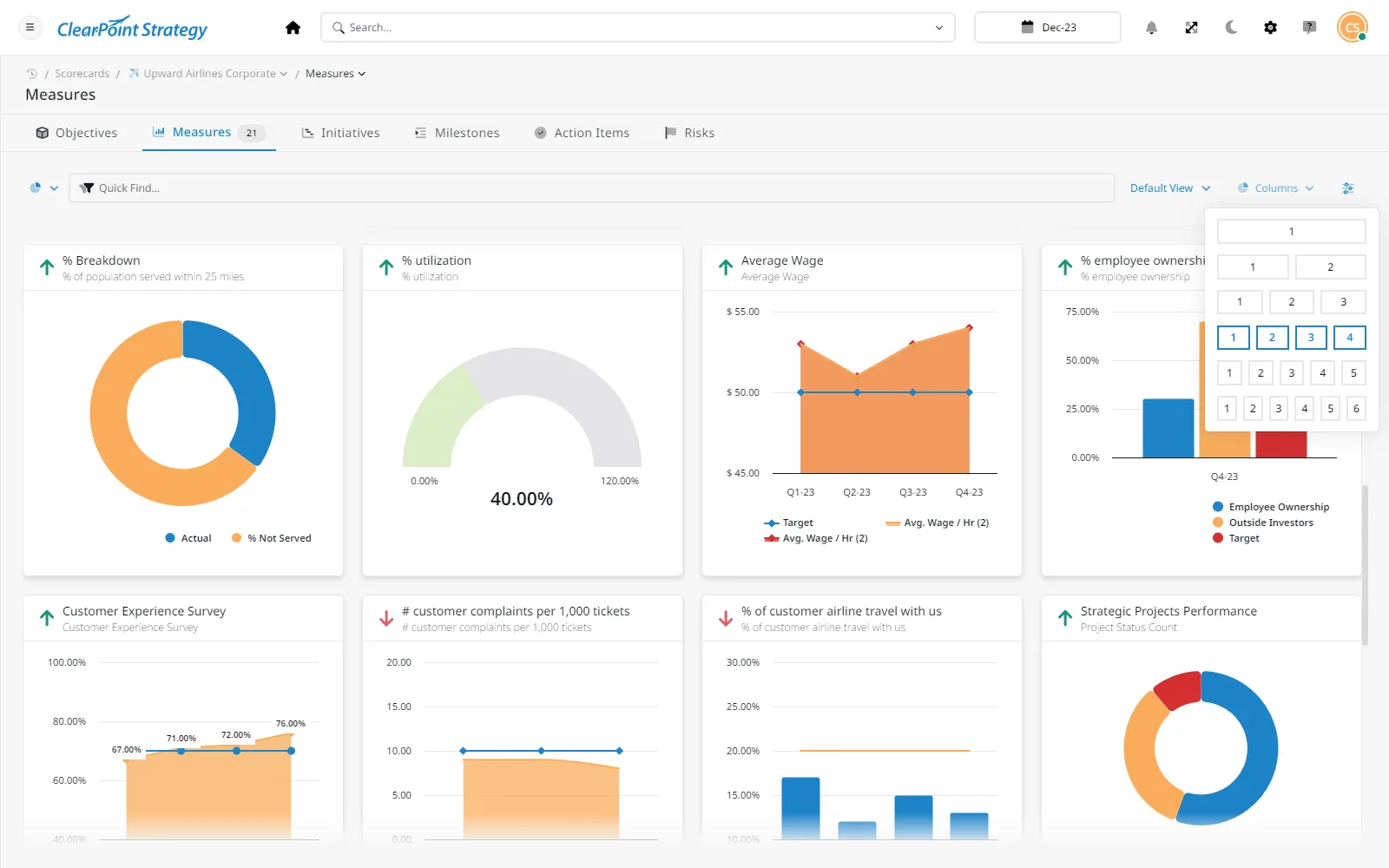
Excel, Power BI, Snowflake, SQL Server, Tableau, Jira, and anything else through the API or Zapier. All integrations ›
 Excel
Excel  Power BI
  Snowflake
  SQL Server
  Tableau
  Jira
JiraClearPoint has run 20,582 strategic plans. The patterns below come from anonymized plan structure. We see how a plan is built, never what it says.
ClearPoint platform data: 52,247 objectives in 318 organizations.
Those patterns shape how we set up your plan and what ClearPoint AI flags in it: too many objectives, too few measures, an element without an owner.
Source: ClearPoint anonymized platform data, extract of July 2025. Objectives: 52,247 in 318 organizations. Initiatives: 90,305 in 315 organizations. Plan structure: 4,184 plans with at least one objective and one initiative. We see how a plan is built, never what it says.
How we read the data →| Pattern | Group | Initiatives completed |
|---|---|---|
| Ownership | Named owner | 21.5% |
| Ownership | No named owner | 8.7% |
| Objectives per plan | 1–10 | 11.8% |
| Objectives per plan | 11–20 | 11.1% |
| Objectives per plan | 21 or more | 9.1% |
| Measures per objective | 3 or fewer | 10.1% |
| Measures per objective | More than 3, up to 8 | 15.1% |
| Measures per objective | More than 8 | 11.6% |
on G2
11 G2 badges · Fall 2026






G2 and the G2 logo are registered trademarks of G2.com, Inc.
A plan stalls when only the strategy office uses the tool. Each role gets its own view.
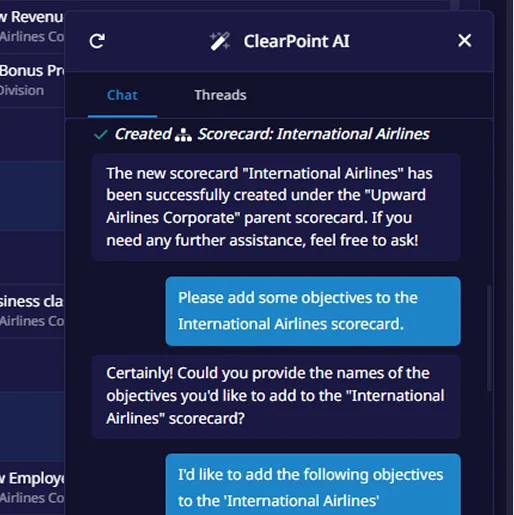
A briefing rebuilt from live data before each meeting: what moved, what is at risk, what to ask.
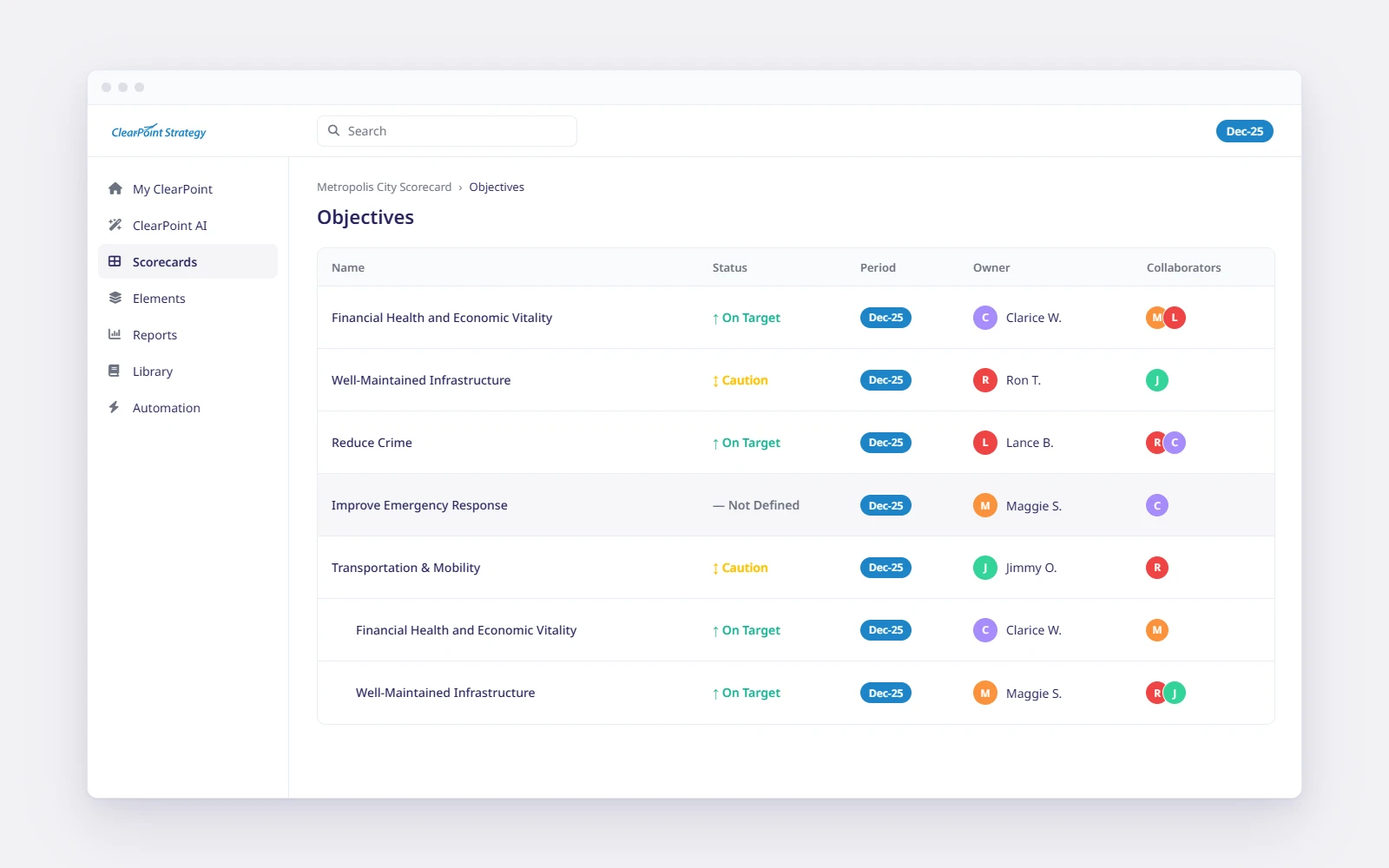
Ownership, cadence and status rules in one place. The chasing stops.
Their objectives, measures and projects, linked to the plan above them.
Update a measure by replying to an email or in Microsoft Teams. Most never log in.
Organizations that answer to a council, a board, an accreditor or a regulator, where the plan has to be reported on.
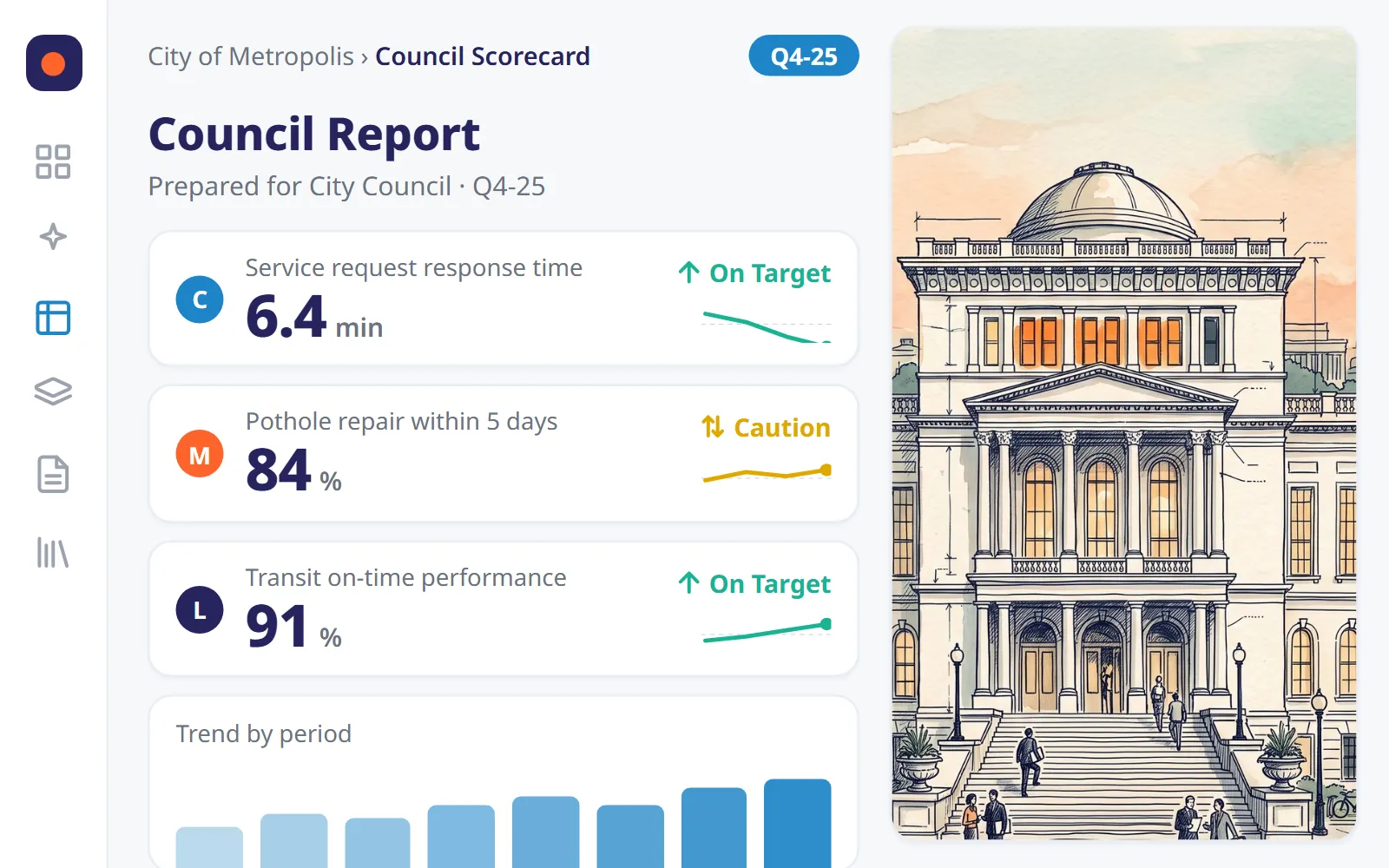
Cities, counties and districts that report to a council and publish progress to residents.
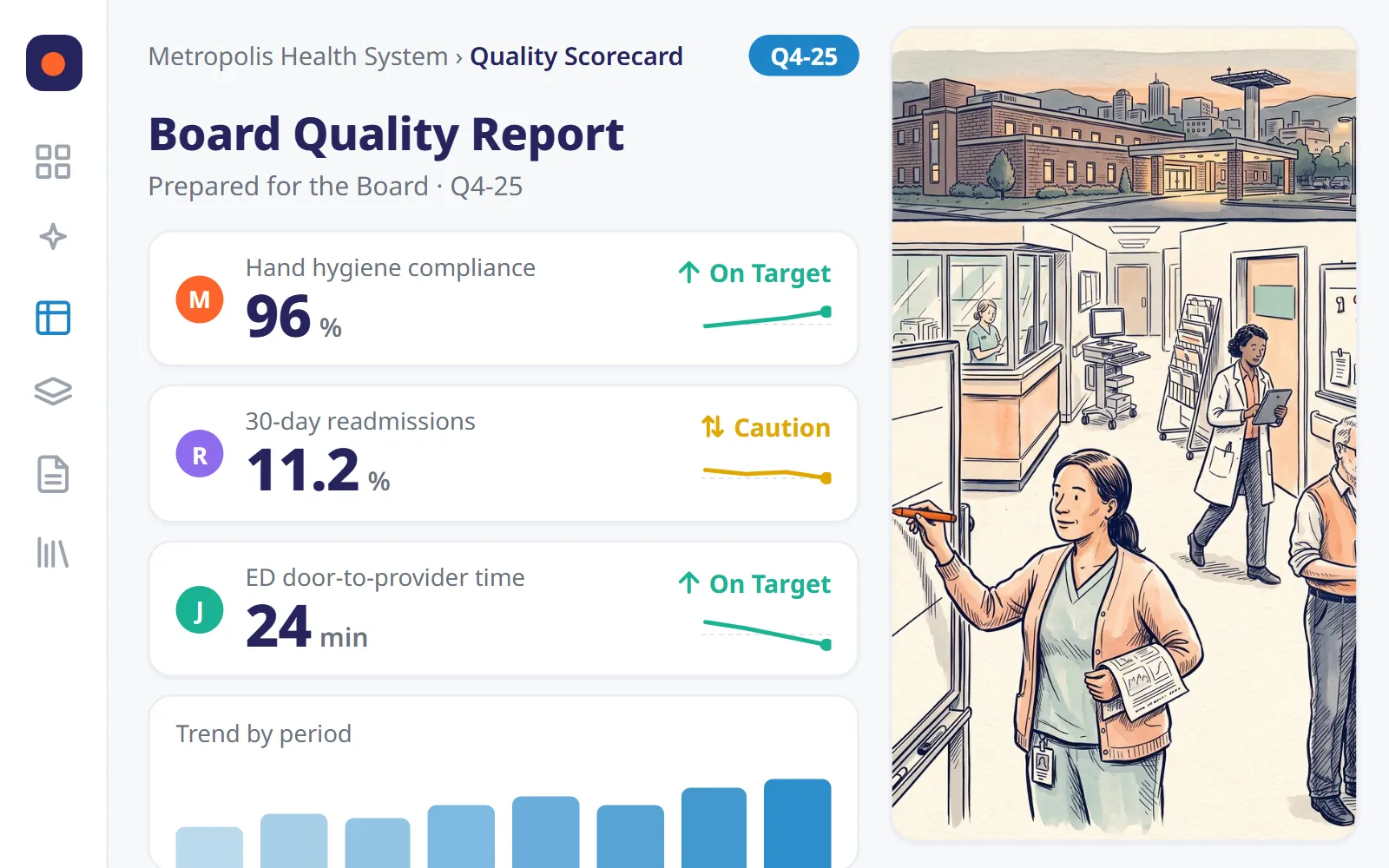
Health systems tying quality, safety, access and finance measures to one board-level plan.
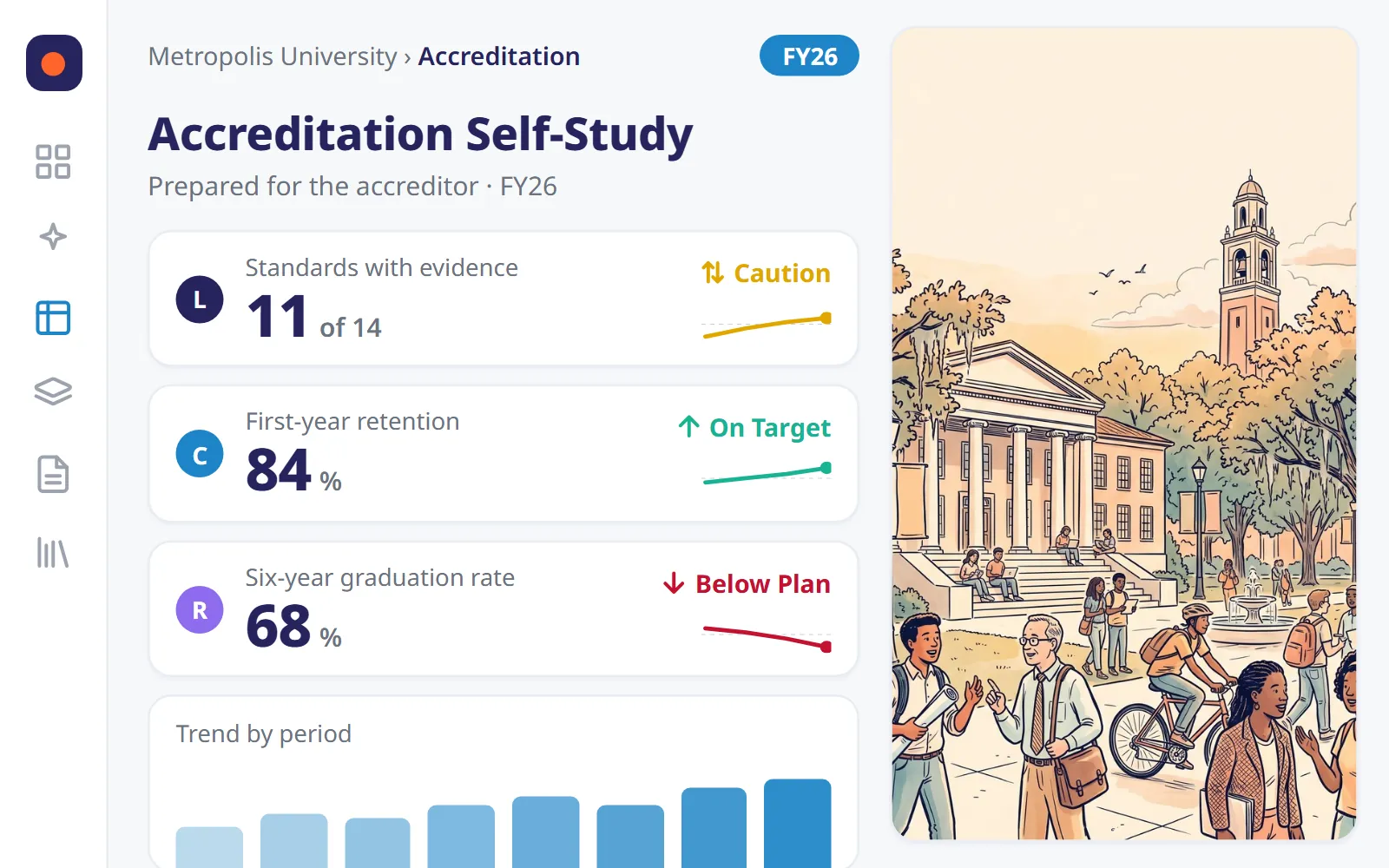
Universities running accreditation, enrollment and student-success plans across colleges.
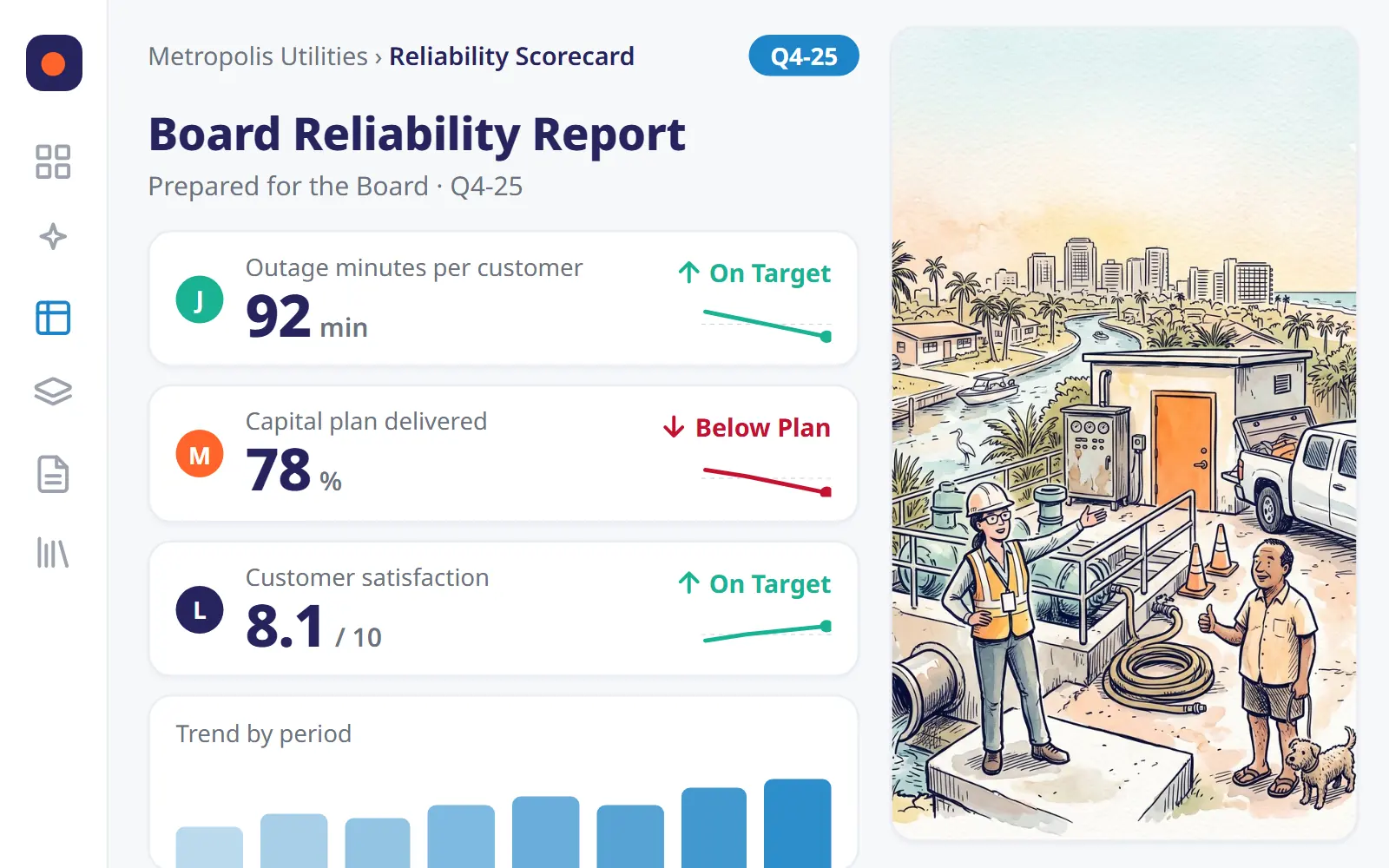
Utilities and enterprises with regulated targets, many departments and a demanding board.
Not listed? ClearPoint runs plans for 150+ organizations.
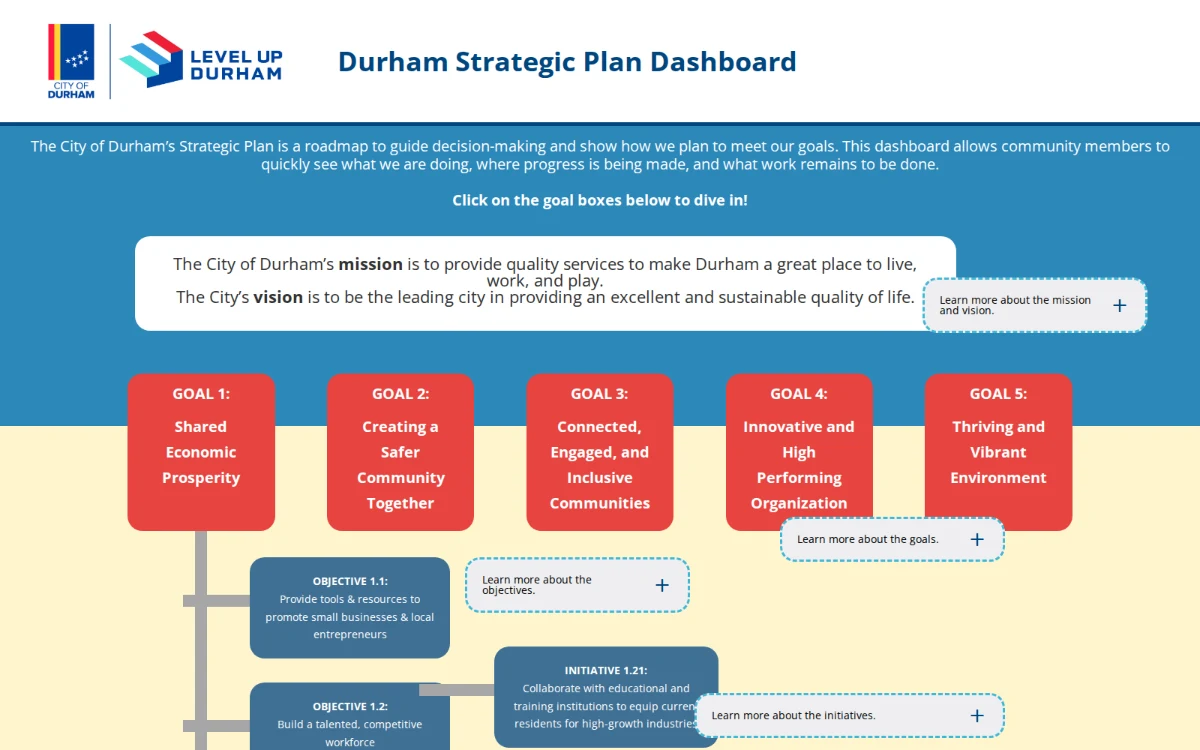
See customer stories ›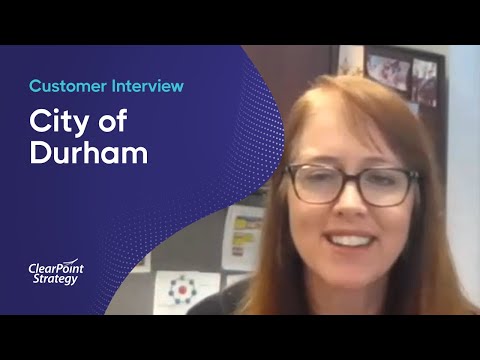 Performance Management in the City of Durham, NC | ClearPoint Strategy
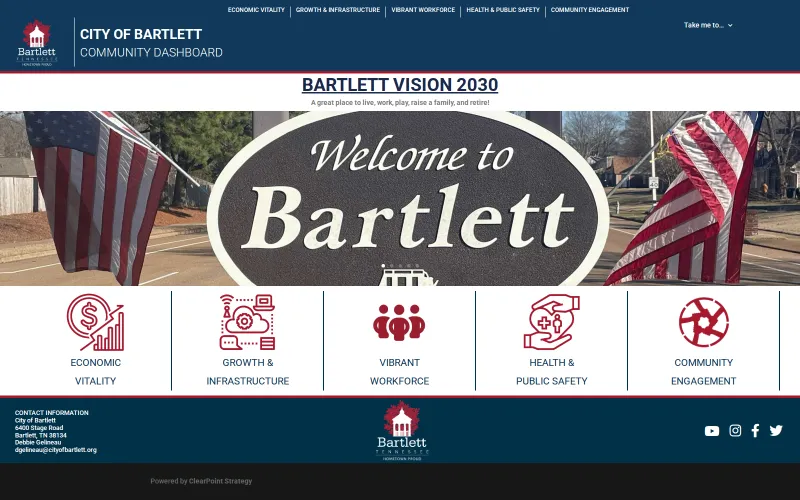
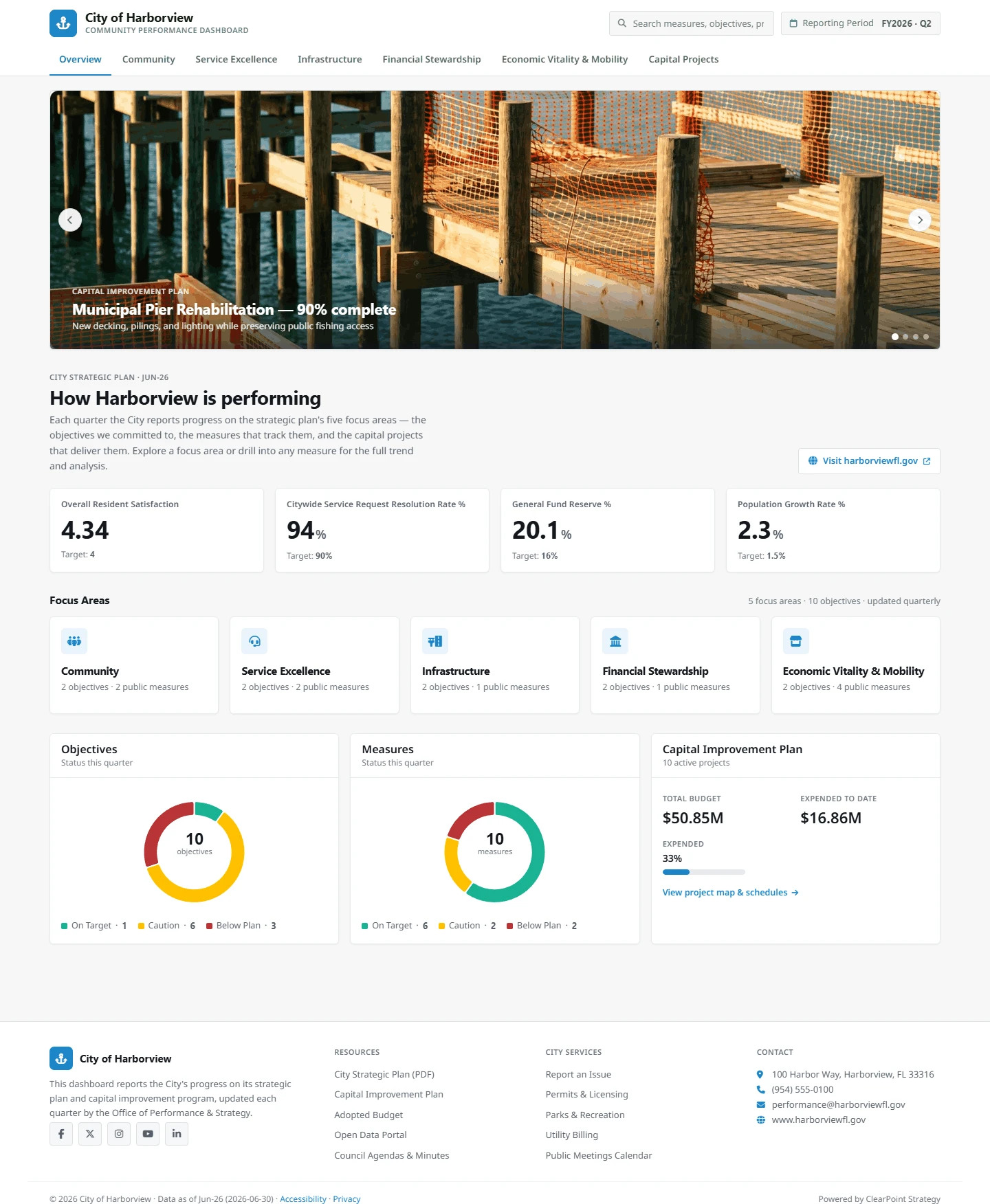
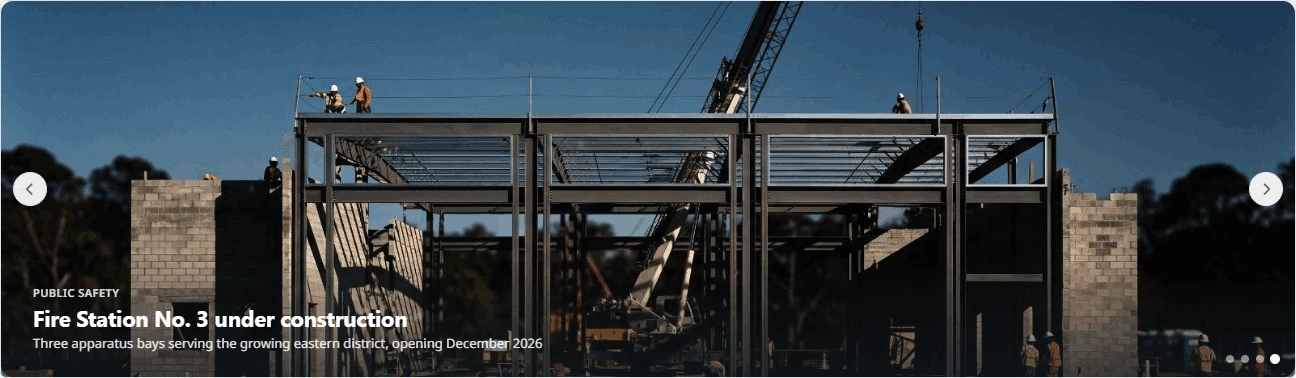
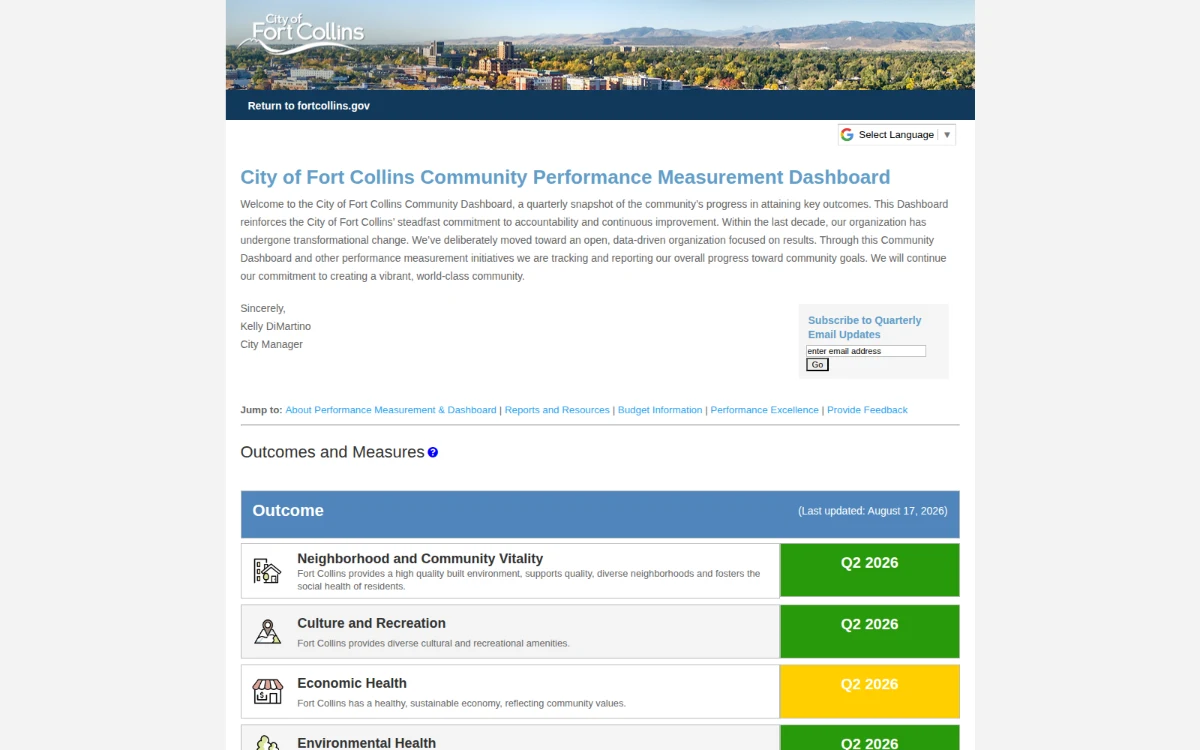
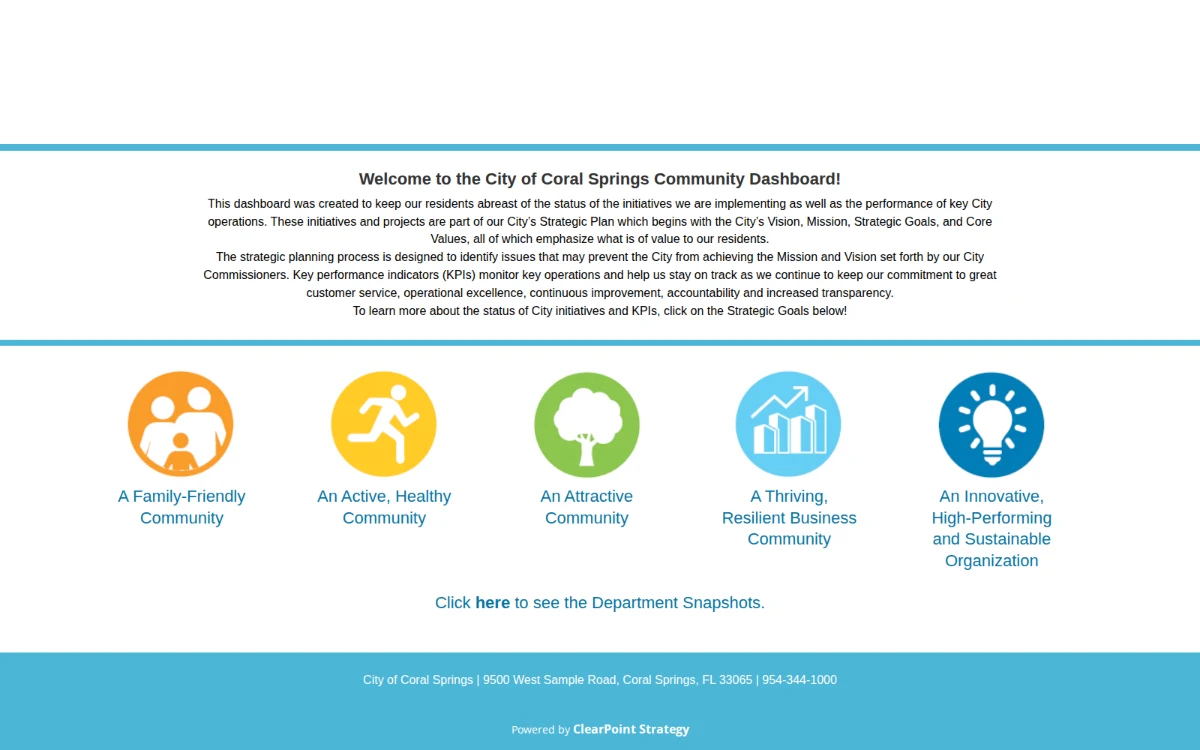
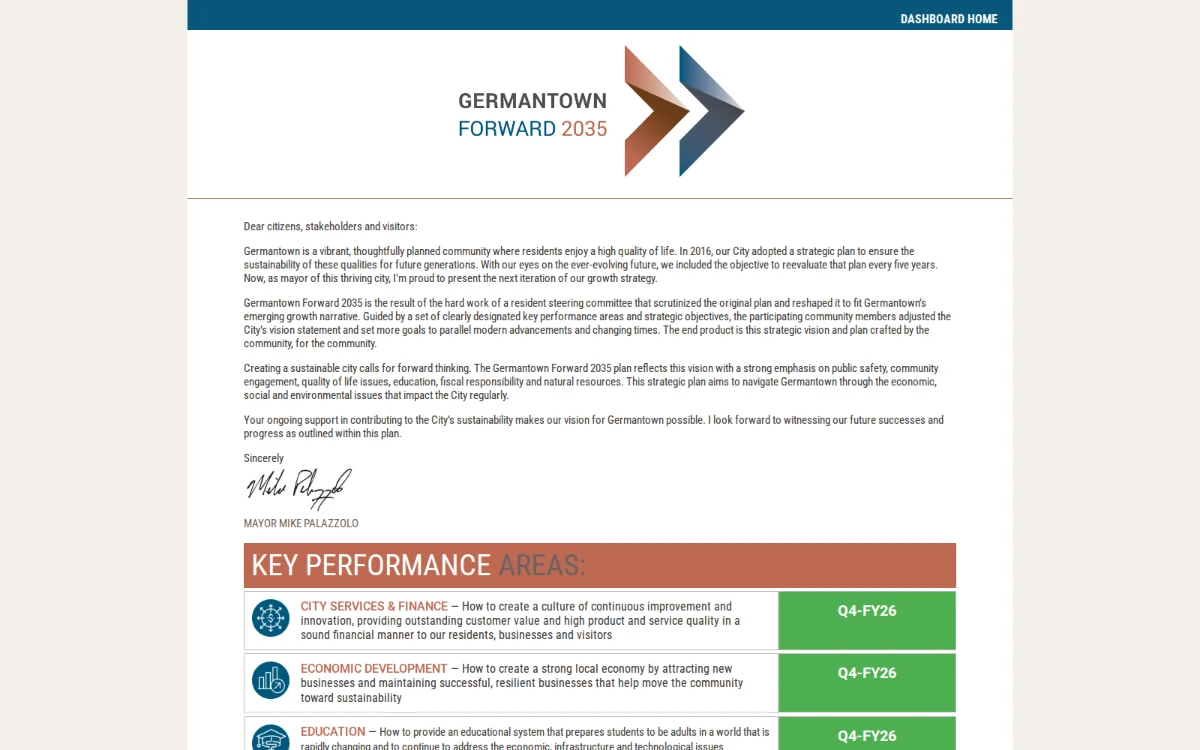
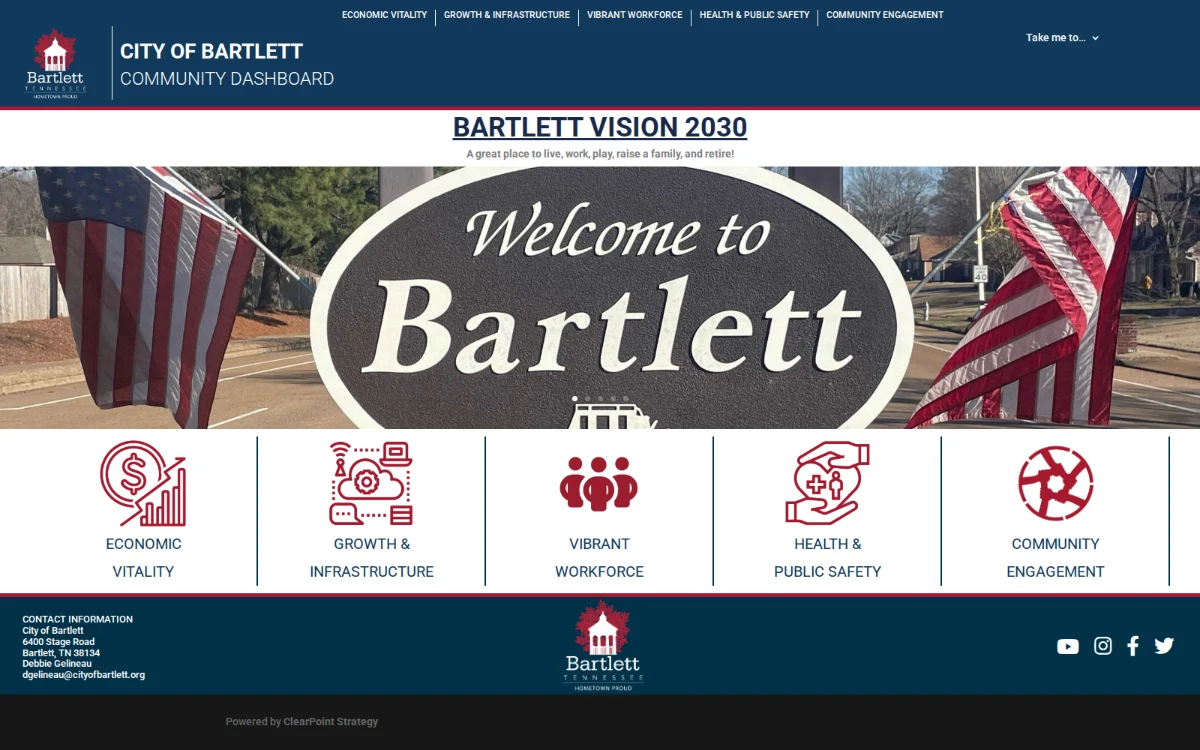
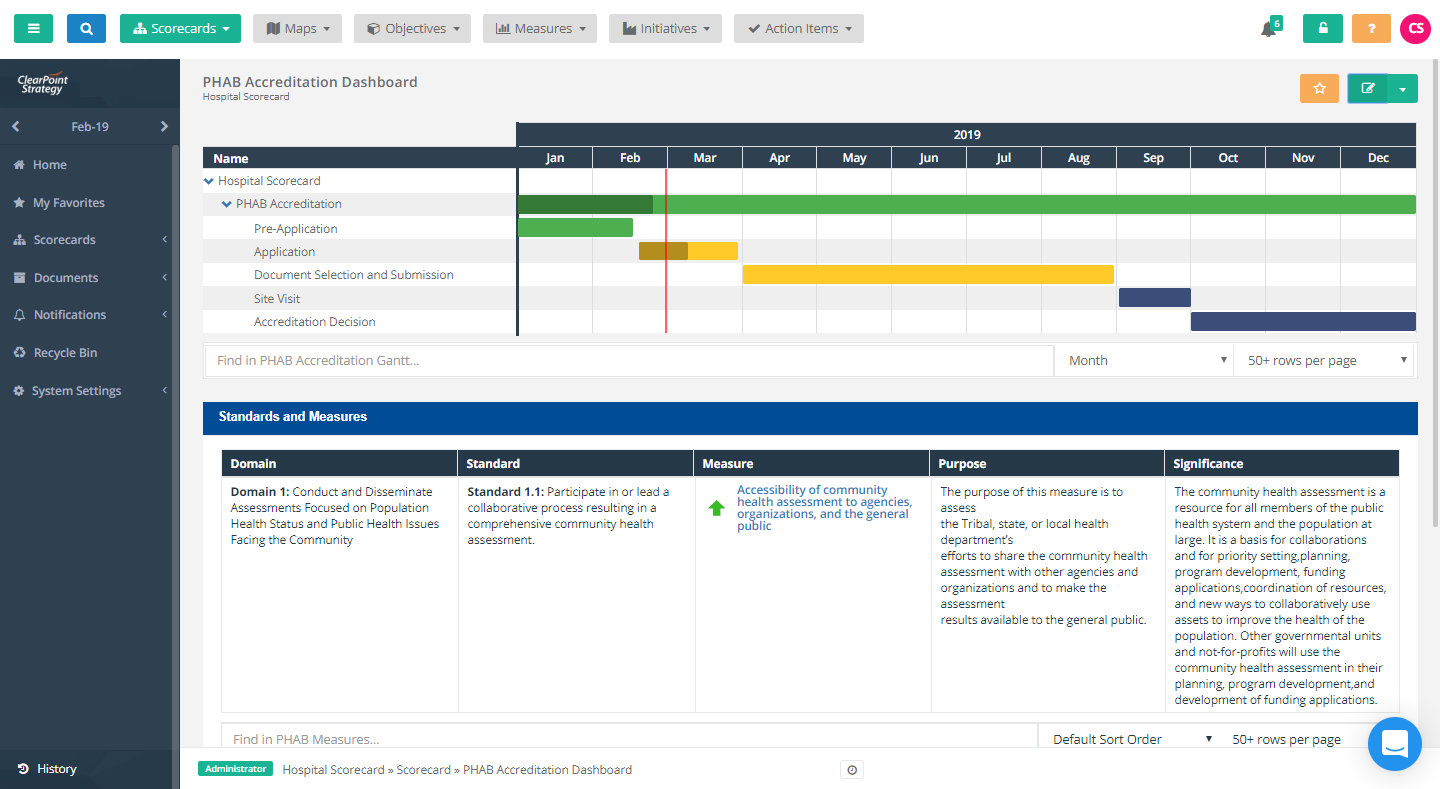
Start from the new Community Dashboard template: hero photos, focus areas, measures and capital projects already wired to your scorecard. Then look at what five cities did on the same platform. None of them look alike.
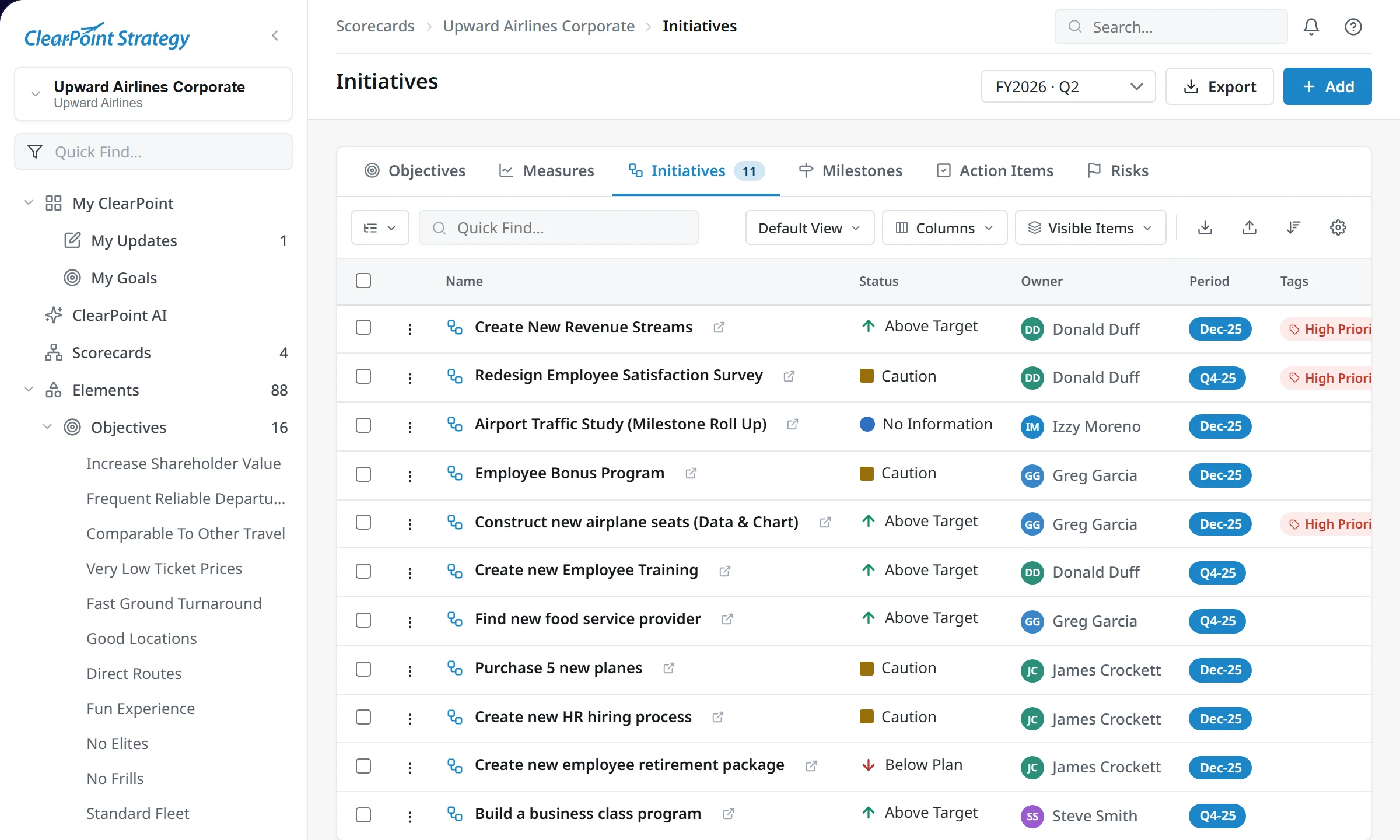
This is My ClearPoint, the page your team lands on: updates due, goals, measure health and the initiatives behind them. Only the people you invite see it.



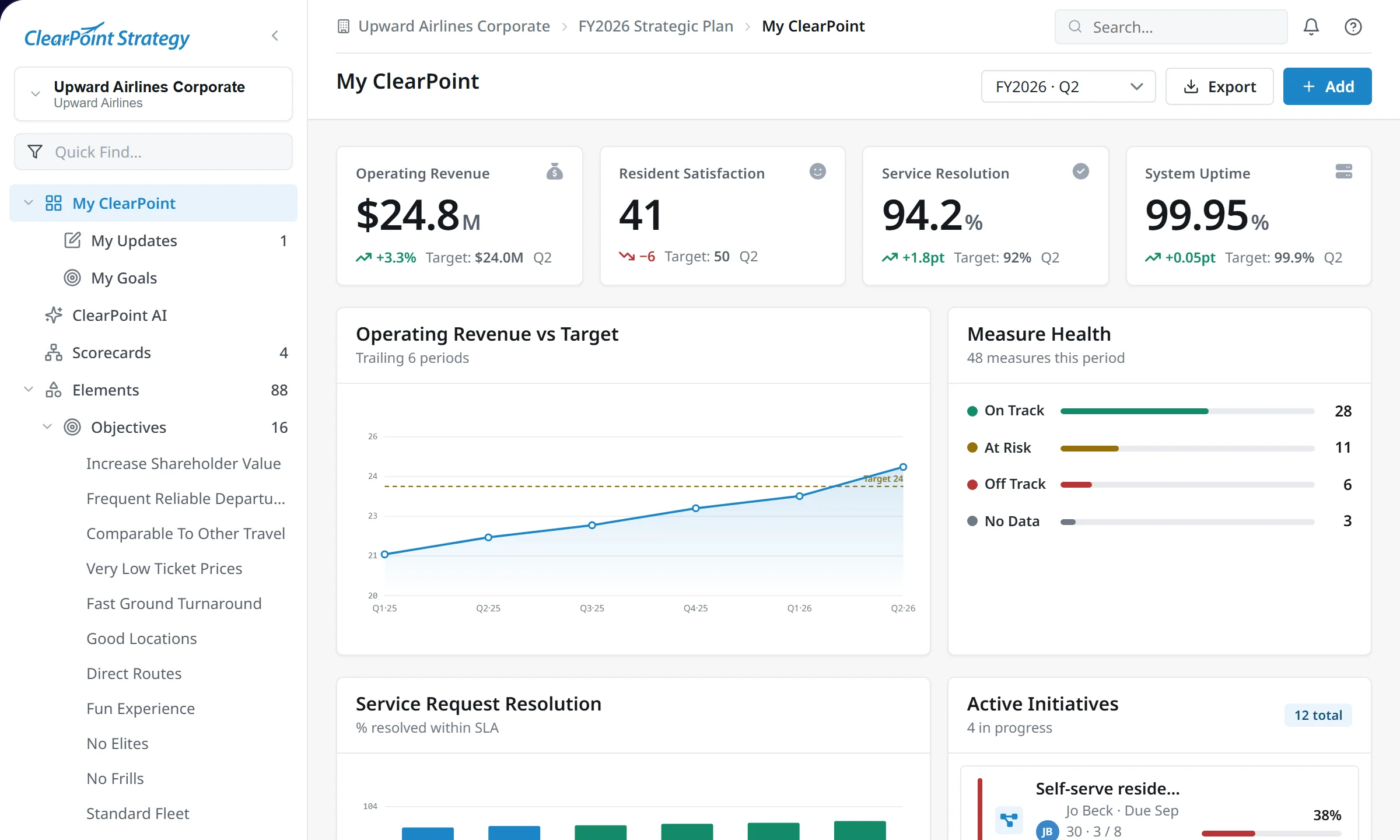
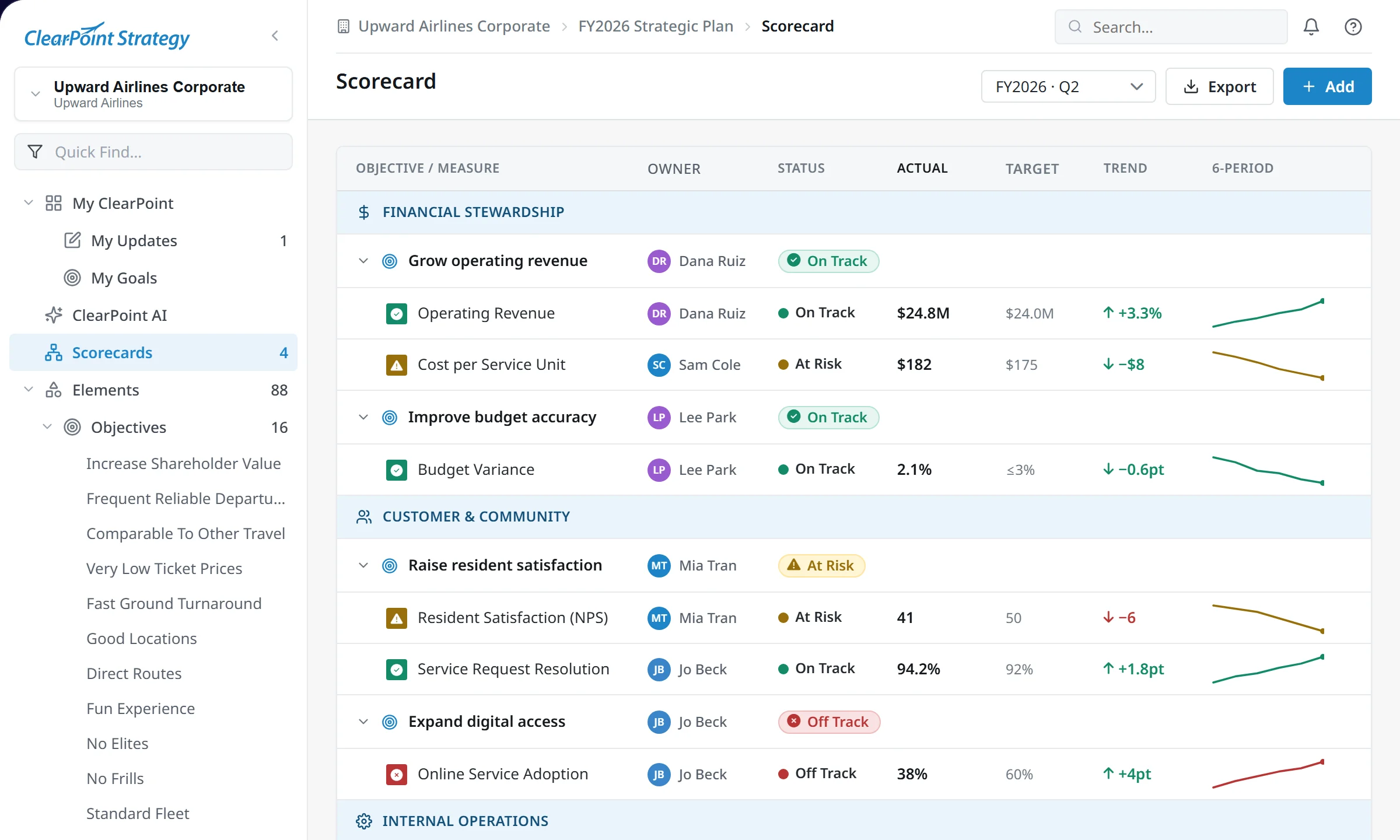
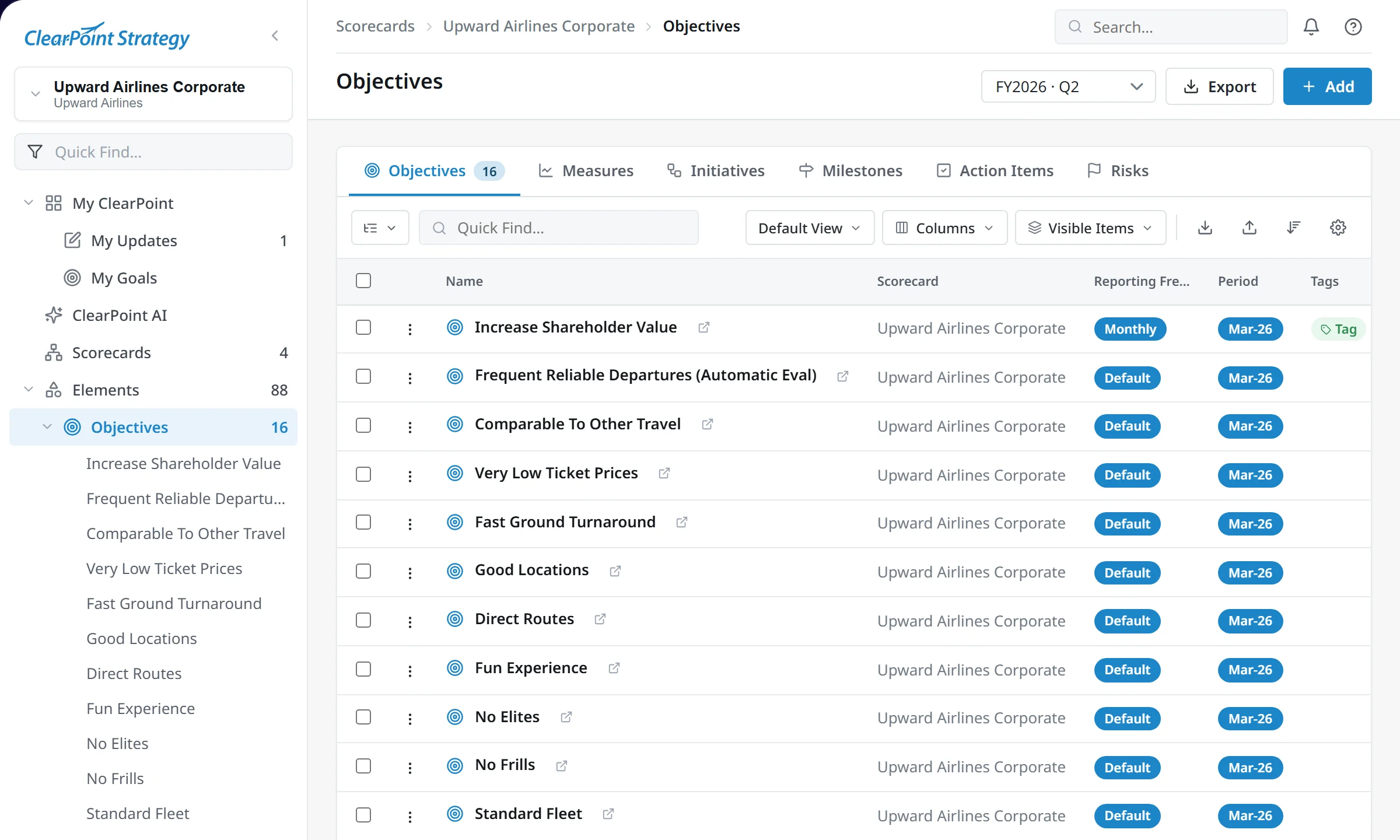
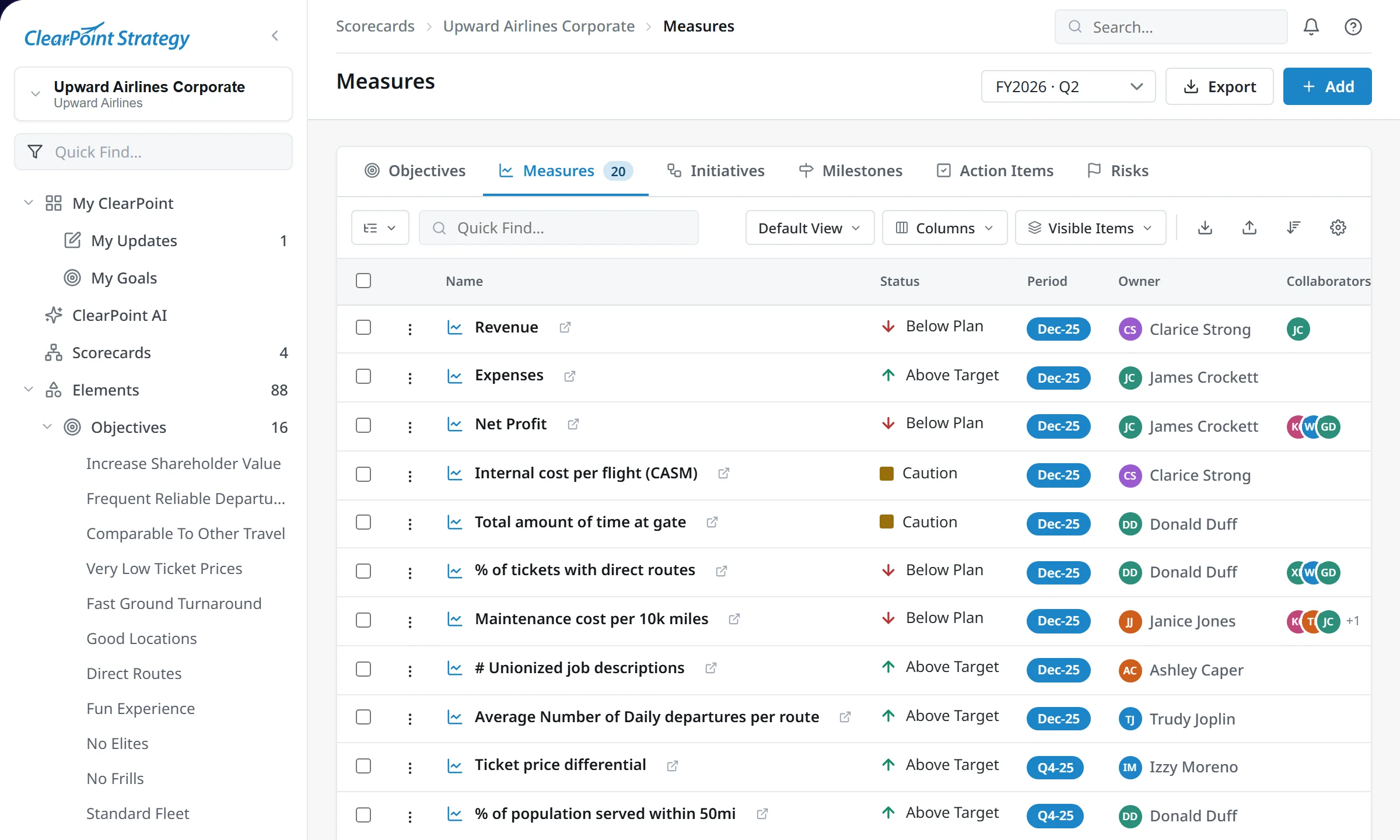
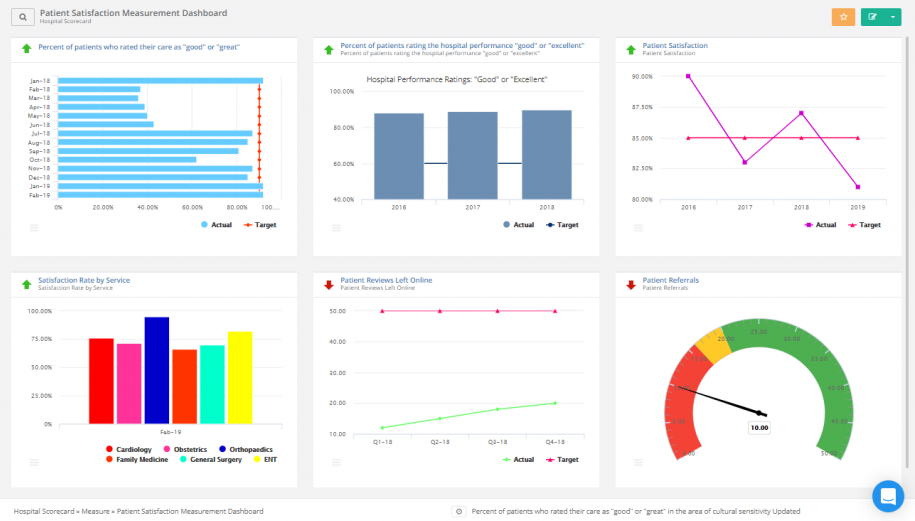
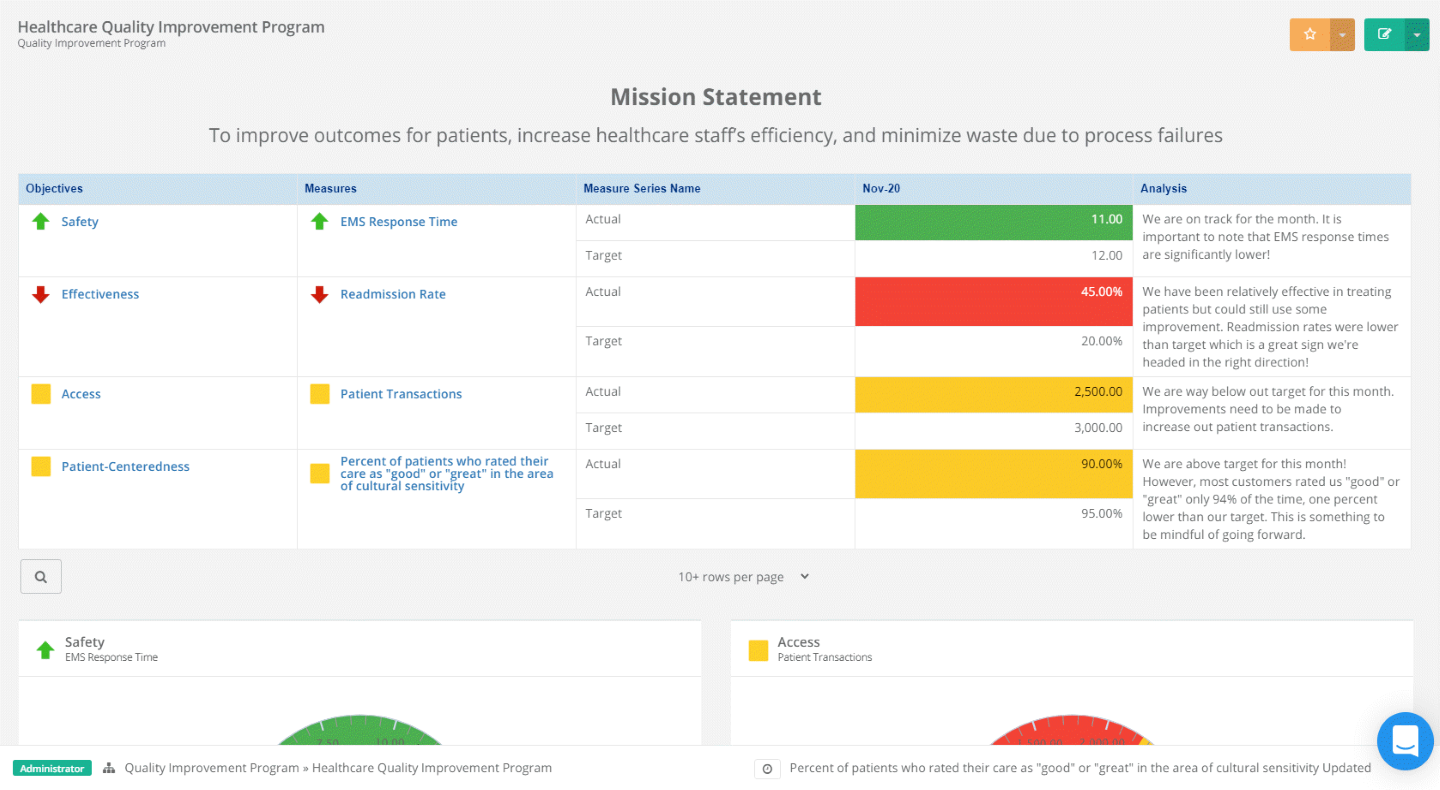
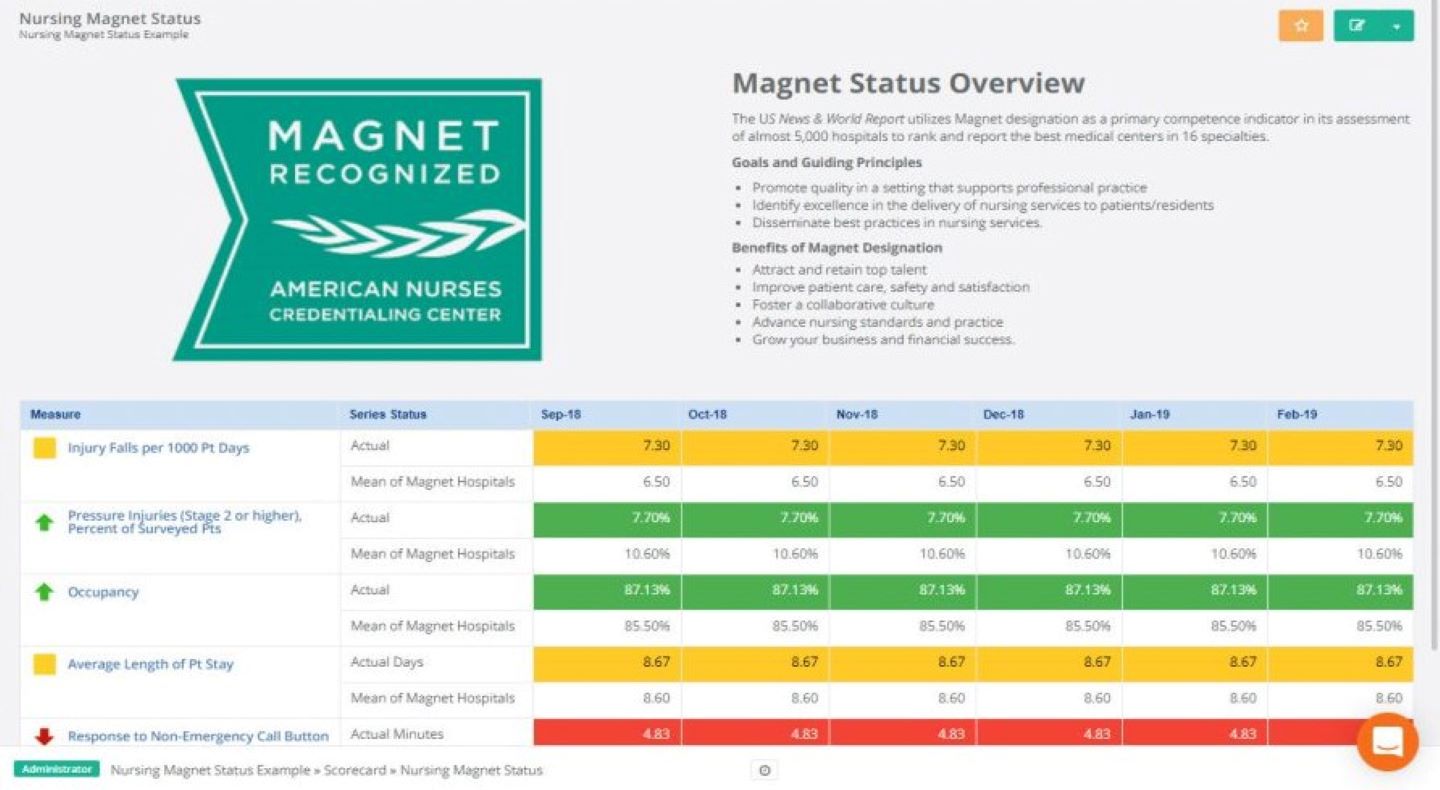
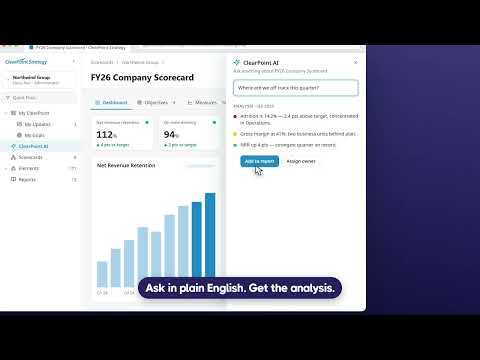
Three places on the same path: it helps build the plan, it collects the updates, and it points to what needs attention. Your administrators decide what it may do, and can switch it off.
Drop in a PDF, a spreadsheet or a slide deck. ClearPoint AI drafts the scorecard, objectives and measures in your terminology, for you to review before publishing. Guided Playbooks take a team through a SWOT, a risk assessment or a department plan. The questions a Playbook asks are the ones our team has asked in strategy sessions for 30 years.
Owners reply to the report email in plain English, answer ClearBot in Microsoft Teams, or ask from a connected Outlook calendar. The update is written back to the scorecard. Most contributors never log in.
My AI Briefing rebuilds each leader’s home page from live data: what moved, what is at risk, what to ask. On any element, ClearPoint AI explains the variance, drafts a recommendation, and turns it into an action item with an owner and a date. Exception reports list what is red, unowned or overdue before the review. It also drafts the PowerPoint for the meeting.
They choose what the AI may do, review transcripts, and can turn it off for the whole account. Answers respect each user’s permissions. Your data is never used to train AI models.
Also included: an AI Knowledge Base that answers with citations from your own documents, and an MCP server that connects ClearPoint to Claude, Cursor and Copilot.
See ClearPoint AI ›Every update travels encrypted, lands in a US region, and is only shown to someone allowed to see it.
Ted Jackson and Dylan Miyake worked alongside Robert Kaplan and David Norton, the creators of the Balanced Scorecard, and have spent three decades helping organizations execute strategy. ClearPoint is that experience turned into software.
Our methodology
Three weeks, with people. Here is what each week covers and what we hear most often before it starts.
Bring it as a PDF, a spreadsheet or a slide deck. ClearPoint’s team structures it into objectives, measures and initiatives with you.
Every element gets an owner. Data connections and reminder schedules are set.
Your team runs one update cycle in the tool and produces the first board or council report.
The same connectors as above, on a schedule. Anything else comes in by file or by the API.
It moves as it is. Nothing is rewritten unless you decide to.
Most contributors never log in. They reply to an email or answer ClearBot in Microsoft Teams.
The setup is done with you, and the people who update never see the admin side. The learning curve sits with the ClearPoint team, in the first three weeks.
Planning is the work of deciding: priorities, objectives, and how progress will be measured. Execution is everything after the retreat — owners updating measures, initiatives moving, leadership seeing what is slipping in time to act. ClearPoint holds both, so the plan you approve is the plan you report on. Read more about the strategy execution platform.
Each option solves part of the job. ClearPoint holds the whole plan, with an owner and a measure on every objective, and reports on it without manual assembly.
| The job to be done | Spreadsheets & slides | Project management tools | OKR tools | Strategy consultant alone | Strategic planning software (ClearPoint) |
|---|---|---|---|---|---|
| Helps you build the plan | Template only | Not designed for it | Goal-setting only | Yes, during the engagement | Guided Playbooks + setup support |
| Every objective has a named owner | Manual | Owners on tasks only | Yes, at goal level | Defined in the document | Built in; unowned items are flagged |
| Measures and history kept over time | Manual, versions multiply | Limited | Key results per cycle | Rarely after delivery | Yes, every update retained |
| Updates collected without chasing | No | Task status only | Check-ins | No | Reminders, reply-by-email, Teams |
| Board or council report | Assembled by hand | Not designed for it | Dashboards | Consultant-written | One-click report from live data |
| Public-sector security documentation | n/a | Varies | Varies | n/a | SOC 2 Type II, TX-RAMP Level 1, US-only hosting |
Comparing specific vendors? Read our guide to the best strategic planning software
Strategic planning software is where an organization builds its strategic plan and runs it: objectives, the measures and initiatives under each, a named owner for every element, regular progress updates, and reports for leadership. Unlike a document or a spreadsheet, it keeps the plan current and shows what is on track and what is slipping. It is also called strategic plan software or a strategic planning platform.
Planning software helps you build and structure the plan: objectives, measures, initiatives, framework. Execution software runs it after approval: ownership, cadence, status, reporting. ClearPoint does both in the same plan.
ClearPoint pricing depends on the number of users, the support level, integrations and single sign-on requirements, so it is quoted per organization. Training and onboarding are included. You get a firm price, plan and next steps in one 30-minute call.
Take the instant tour for an unguided look, or use the 30-minute demo to see your own plan in ClearPoint. You leave the call with a firm price and a three-week implementation plan.
No. Your data is never used to train AI models. Administrators can turn AI off account-wide.
Not necessarily. ClearPoint's Playbooks guide you through building the plan and our team sets it up with you. If you already work with a consultant, ClearPoint is where the plan they help you build gets owned, measured and reported.
Yes. Balanced Scorecard, OKRs, Hoshin Kanri, V2MOM or a framework of your own. Existing plans come in from Excel or PDF, and ClearPoint AI drafts the structure in your terminology.
Yes. Departments can use different frameworks in the same account: Balanced Scorecard perspectives in one, OKRs in another, Hoshin Kanri in a third. Everything still rolls up to one organizational view.
Each department gets its own scorecard, owners and cadence, linked to the organizational objectives it supports. Leadership sees the roll-up; departments see and edit only what belongs to them.
A spreadsheet stores the plan. It does not chase the update, recalculate status or build the board book. ClearPoint keeps one version, gives every objective an owner and a cadence, writes incoming values back automatically and generates the report.
Scheduled imports from Excel, Power BI, Snowflake, SQL Server, Tableau and Jira, plus owners replying to a reminder email or to ClearBot in Microsoft Teams. Updates are written back to the plan and status recalculates automatically.
Yes. The same live plan feeds a branded public dashboard, a scheduled email, a PDF and a PowerPoint briefing book. Publish only what you choose; everything else stays behind permissions.
Most organizations have their first scorecard live in 3 weeks, whether they start from scratch or import an existing plan.
Objectives, measures and targets can be re-scoped at any time, with history preserved so you can still show what was reported last quarter. Reports rebuild from the new structure automatically.
Mostly, yes. Both names describe software that holds the strategic plan with its objectives, measures and initiatives, and tracks progress against it. ClearPoint covers the plan and its execution in one system.
Project tools manage tasks and deadlines inside a project. Strategic planning software manages the plan above the projects: objectives, KPIs, the initiatives that serve them, ownership and board-level reporting. ClearPoint links the two so a late project shows up against the objective it serves.
Strategic planning tools are the methods and templates used to decide the plan: SWOT, strategy maps, Balanced Scorecard, OKRs, gap analysis. Strategic planning software is where those tools produce a plan that is then owned, updated and reported.
ClearPoint is strategic planning software for organizations that report to a council, a board, or an accreditor. It holds the plan, gives every objective a named owner, collects updates without a login, and builds the board or council report from the live plan. Implementation takes 3 weeks.
A strategic planning expert who knows your sector reviews your needs, loads your plan, your data or your use case into ClearPoint, then walks you through it.
Two short steps, then choose a slot on the calendar. No back-and-forth emails.
A strategic planning expert who works with organizations like yours reviews your request and asks what you want to see.
Your plan, measures or use case is loaded before the call, so the 30 minutes run on your organization. Nothing to share yet? They show you an organization like yours.


“This platform has created opportunities we never imagined. Prior to ClearPoint, we never had the data in a way individuals could value.”
 Octavius M.Assistant to the City Manager
“This system keeps you finding operational efficiencies. Several of these opportunities have resulted in millions of dollars in savings!”
 Brandie H.Director of Strategy
“Before ClearPoint, we were drowning in spreadsheets and PowerPoints.”
 Darren E.Director of Finance
Explore at your own pace, then book a demo when you're ready. No form, no call.


Don't want to schedule a demo yet? No worries. Just enter your contact info below to get instant access to an interactive tour of ClearPoint.


.webp)