.svg)

1911 N Fort Myer Drive, Suite 1100
Arlington, VA 22209
866-568-0590
info@clearpointstrategy.com
ClearPoint rolls your whole CIP up to council — on a dashboard residents can read.
Built on a 2026 read of 3,131 capital projects across roughly 100 local governments.
Of 3,131 capital projects, only 13% ever reach a completed status in the plan.
More than half of capital projects sit in the plan with no person attached to them.
79% of projects that blew their deadline are still sitting open in the plan.
Owned projects complete at 19.7%. Unowned ones complete at 9.0%.
54% of capital projects have no named owner. Projects with one finish at 2.2× the rate — 19.7% versus 9.0%.
Only 13% of capital projects are ever marked complete, and 79% of the ones that blow their deadline are still sitting open.
ClearPoint doesn't touch a submittal. It is the governance layer above your construction tools — phase, owner, budget, and status, rolled up to council.
Hayward, CA publishes its $905M capital program on a live ClearPoint dashboard residents can read.
Because nobody owns them. Across 3,131 capital projects at roughly 100 local governments, 54% have no named owner — and a project with no name attached is a project no one is accountable for reporting on. Only 13% of capital projects are ever marked complete. Of those that blow their deadline, 79% are still sitting open in the plan. The projects that do have an owner finish at 2.2× the rate of the ones that don't.
54% of 3,131 capital projects have no named owner; 46% do.
Completion rate: 19.7% for owned projects versus 9.0% for unowned — 2.2× more likely to finish. Across the whole cohort, 13% are ever marked complete.
The median local government tracks 136 capital projects across 18 plans. 79% of past-deadline projects are still open; 13% of all capital projects are ever marked complete.
Source: ClearPoint analysis of 3,131 capital projects across roughly 100 local governments, 2026 cut.
Click through the live product tour, or watch Goldsboro, NC walk through the $411M capital improvement plan it runs in ClearPoint.
Six minutes with the team that reports the whole portfolio to council — how they scope projects, name owners, and keep the plan current.
One row per capital project: phase, named owner, budget, and current status. The 54% with nobody attached become visible the day you import.
Milestones, dependencies, and slippage across every department — so a project past its deadline stops quietly staying open.
The same data your project managers update becomes the council view — and, when you want it, the public one.
Every status change keeps its analysis and its author, so next quarter's question — "what happened to this one?" — already has an answer.


Pick an output — or let it play. Same loop every time: the updates your project managers already entered, visible reasoning, a finished report you can still edit.
Updates in. Visible reasoning. A report you can still edit — in the format the meeting needs.
Two tools, two jobs. Your construction platform runs the job site. ClearPoint runs the program above it. The stack on the right shows the two layers pulled apart.
Hayward publishes its full capital improvement program on a public ClearPoint dashboard that residents can read without a records request.
See Hayward's public CIP dashboardOctavius Murphy, Assistant to the City Manager, walks through how Goldsboro tracks a $411M, ten-year capital improvement plan in ClearPoint.
Read the Goldsboro storySteve Sones, Chief Administrative Officer, uses ClearPoint to keep departmental projects and the city's strategic plan in the same place.
Read the Bartlett story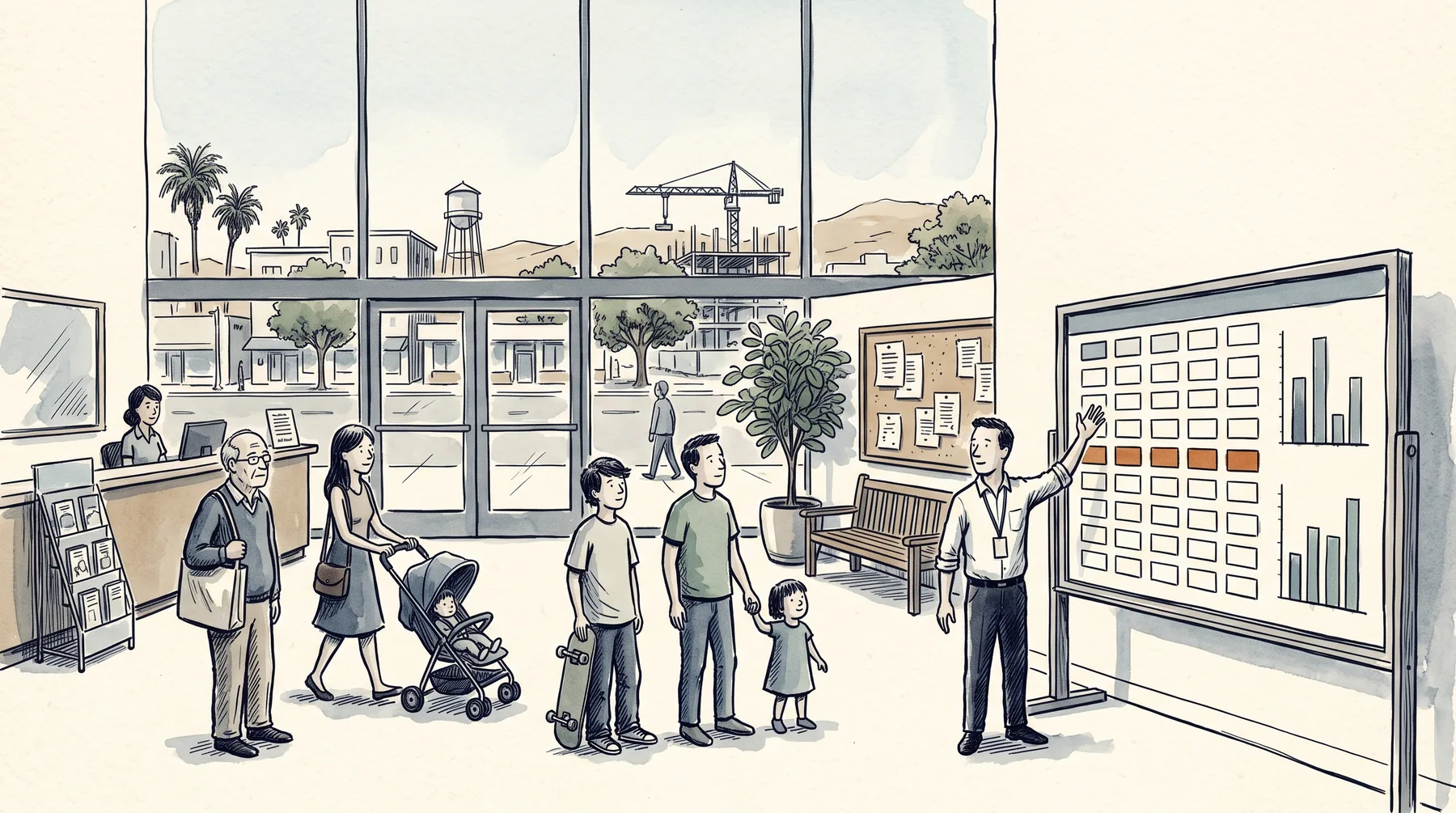
You start from what you already maintain. Nothing here asks a department to re-enter its projects a second time. Watch the same six rows go from a workbook to a council dashboard.
Your adopted capital plan comes in as one row per project, with budget, phase, and department. No retyping.
This is the step most portfolios skip. It is also the one worth 2.2× on completion. Every blank shows up in orange until someone owns it.
Owners get a reminder on your reporting cycle and update in place — no chasing attachments. Status appears the moment they do.
One council view, and — if you want it — one public dashboard, from the same six rows.
| Project | Budget | Phase | Owner | Status |
|---|---|---|---|---|
| Elm St. bridge rehab | $4.2M | Design | D. Reyes | On track |
| Fire Station 4 | $11.8M | Construction | M. Chen | At risk |
| Water main — Phase II | $2.6M | Bid | No owner | Off track |
| Riverside Park | $1.9M | Construction | A. Okafor | On track |
| Civic Center HVAC | $3.4M | Planning | No owner | At risk |
| Route 9 resurfacing | $6.1M | Design | No owner | On track |
Finance owns the budget, engineering owns the schedule, GIS owns the map. ClearPoint sits on top and pulls each on a schedule, through one authenticated door.
Excel / CSV · SQL Server · Snowflake · Column mapping saved, so the next import is one click
REST API · Project, phase & status fields · Key-scoped, per-integration credentials
Power BI · Tableau · Council report · Public dashboard


The Capital Project Tracker is one row per project with the two columns most CIP spreadsheets are missing: a named owner and the current phase. Fill it in for your own portfolio, see where you stand against 3,131 capital projects, and print the council summary. Count the rows with nobody's name in them. Then watch what happens when there's one.
Capital improvement plan tracking software gives a local government one record per project in its CIP — a named owner, a phase, a budget, and a status — rolled up into a single view for council and residents. Ownership is the variable that decides whether the work finishes: across 3,131 capital projects at roughly 100 local governments, 54% had no named owner, only 13% were ever marked complete, 79% of past-deadline projects were still open, and owned projects finished at 2.2× the rate of unowned ones.
Because nobody owns them. Across 3,131 capital projects at roughly 100 local governments, 54% have no named owner, and a project with no name attached is a project nobody is accountable for reporting on. Only 13% are ever marked complete, and 79% of past-deadline projects are still open.
Capital project tracking software gives a local government one record per capital project — phase, named owner, budget, and status — and rolls the whole portfolio up into a report for leadership, council, and residents. It sits above the tools that run construction day to day.
The right capital improvement plan tracking software is the one your departments will actually update. Look for three things: a named owner field on every project, a roll-up that produces the council report without rekeying, and a public view you can publish without a second system. ClearPoint does all three; Hayward, CA publishes its $905M capital program on one.
Capital project management software for government covers two different jobs. Construction management platforms run the job — RFIs, submittals, pay applications. Governance platforms like ClearPoint run the program: which projects exist, who owns each one, what phase it is in, and what council is told. Most cities need both.
No. ClearPoint doesn't touch a submittal, an RFI, or a pay application. It is the governance layer above your construction tools, tracking the capital portfolio as commitments with owners, phases, budgets, and status.
Owner is a field on the project, not a note in a status update. When you import the CIP, every project without a name is immediately visible as a gap — and in our 2026 read, owned projects complete at 19.7% versus 9.0% for unowned, a 2.2× difference.
Yes, if you want them to. The same data that produces the internal roll-up can be published as a public dashboard. Hayward, CA runs its $905M capital improvement program that way at ciphayward.clearpointstrategy.com.
ClearPoint reads capital data through a REST API, CSV and Excel imports of your adopted CIP workbook, and scheduled syncs that keep the council view current. Staff access supports SSO / SAML with role-based permissions.
No. ClearPoint is ISO 27001 aligned — aligned to the standard, not certified to it — and supports SSO / SAML and role-based access. Aurigo and Kahua hold FedRAMP authorizations; we do not. If FedRAMP is a hard requirement in your solicitation, we will say so on the first call.
You start from the CIP you already maintain: import the adopted plan, name an owner on every line, set the update rhythm on your existing reporting cycle, and publish the roll-up. Implementation is scoped with you rather than sold as a fixed package.
Bring your CIP spreadsheet. We'll show you the council view it becomes.


Don't want to schedule a demo yet? No worries. Just enter your contact info below to get instant access to an interactive tour of ClearPoint.


.webp)