Only 10% of organizations actually execute their strategy.
- Assign each strategic objective to an individual on the leadership team. A small core team cannot make strategic decisions, so ownership has to sit with leaders.
- Review parts of the strategy monthly and the whole strategy quarterly. Looking once a year leaves no time to react to changing conditions.
- Write a data policy that names the official source for each figure. Fix numbers in the source system rather than in exported spreadsheets nobody can reproduce.
- Publish minutes and the action plan within 24 hours of each meeting. Action items cannot start until people know what they own.
- Plan review agendas with the 8-part guide to leading a strategy meeting. Send materials ahead so the time goes to decisions.
Say your organization has just developed a new strategic plan, complete with a set of long-term objectives, a strategy map, resources to support it, and even some strategic measures that will be used to track progress. You might think this plan, thorough as it is, will be all that’s needed for teams to go forth and “make it so.”
The hard lesson many organizations learn in this scenario is, it’s not. (Unless, of course, you’re on board the starship Enterprise and your name is Captain Jean-Luc Picard.)
Planning is the foundation of strategy, but it isn’t everything. Your plan alone doesn’t include the elements that coordinate and sustain your activities over the long term, like monitoring and reporting on progress.
These elements matter because strategic plans are carried out over three to five years. Over that time, plans may be forgotten, distractions arise, and people come and go. Keeping focus and directing a coordinated set of activities over that long a period is ongoing work that requires dedicated leadership and a systematic approach.
That work is known as the strategy implementation phase: the act of executing your strategic plan. It’s the detailed process of reviewing your strategy on a regular basis, talking about how you’re doing, considering the implications of where you are in your progress, and determining necessary changes going forward.
Most business literature about strategy puts more emphasis on the planning stage than the implementation stage. That’s unfortunate, because most failures are rooted not in the planning but in organizations’ inability to follow through. Companies that fail to develop their strategy implementation process tend to fall prey to some common problems:
- They don’t adapt when internal or external conditions change.
- They work in silos as opposed to a unified team.
- They can’t identify and react to performance problems.
- They suffer from strategy fatigue or lack of motivation.
Each of these threatens to sink the ship and lowers the chances of success.
Next, you need to understand the activities that keep you focused. (Hint: There’s more to it than pulling together an annual report.) This guide covers strategy implementation from reporting and running effective strategy meetings to overcoming common challenges and using strategy software. Start at the beginning or skip to the chapters you’re most interested in. If you have questions, we’re a click away.
Chapter 1: The Strategy Implementation Process In Brief
Before we go deeper into strategy implementation, let’s rewind a bit: a successful implementation starts with a solid strategic plan.
Think of a strategic plan as both the destination your company wants to get to and the roadmap that describes how to get there. Most companies look five years out, consider what they want their company to look like at that point in time, and then begin to lay out activities that will help them achieve that vision. Your leadership team must agree on what your company should look like in five years and how you’ll get there; otherwise, there’s no path forward.
For smooth implementation, your strategic plan should include the following:
- A defined set of goals (or objectives) that state what your organization is trying to achieve or accomplish over a specific length of time. These goals should tie together to create one clean story. So, you should not have conflicting goals; your leadership should agree on all of them. They might debate some, but a unified plan and unified team to manage the plan will have a much higher chance of success.
- A strong set of KPIs (or measures) that help you understand if you’re accomplishing your objectives. Effective KPIs are actionable, easily communicated, and force you to answer whether you’re on the right track with each company-wide goal. It is one thing to have a bunch of goals, and another thing entirely to be able to clearly measure your progress in achieving these goals.
- A clear idea of major projects (or initiatives) that will help you improve on your KPIs and get closer to your goals. Some of these projects will help you improve a current process, while others will be focused on capital projects. But if you are trying to improve your performance at a rate faster than your current improvements, you will need to link projects and actions to your strategy to drive that change.
(If you aren’t sure whether your strategic plan is up to snuff, take a look at some of the additional resources in the “Additional Resources” box below.)
Once you have the strategic plan solidified, it’s time to implement it. There are five steps involved in the implementation phase, each of which is outlined below. You can find more on each step in the linked articles in the resource boxes and in the remaining chapters of this guide.
1. Determine roles and responsibilities.
For employees to actively work toward the strategic goals, they must know how they can contribute. So in this stage, you’ll focus on getting people on board with the strategy so they are bought-in and motivated. Explain the objectives clearly, show how success and progress will be measured, and assign each element or component of your strategic plan to a responsible party or owner.
2. Monitor performance.
Once your strategy is in motion, you need to know whether or not you’re making progress. Performance monitoring paints a picture of how well you’re doing when it comes to reaching your goals.
Your strategic plan already includes measures that will determine if your organization is on track. In this step, you’ll gather and track measure-related data from across the organization, and organize it in one place for future analysis (preferably using software like ClearPoint, which makes collecting, organizing, and analyzing data easier).
3. Report on progress.
Next, it’s time to analyze the data and review your performance. We recommend reporting on your entire strategy on a quarterly basis. The report you issue should highlight progress on your measures and projects, and how those link to your objectives. The point is to show how all these elements fit together and relate to the strategic plan as a whole. (See Chapter 4 for more information.)
Strategy reporting trips up many organizations; most aren’t prepared for the time and effort it requires. See Chapter 7 for information about how strategy implementation software like ClearPoint makes reporting time a non-issue, and boosts the value and usefulness of your reports.
4. Conduct strategy review meetings.
A strategy review meeting is exactly what it sounds like: a meeting focused entirely on assessing and improving progress in achieving the organization’s goals. During these meetings, which usually happen at least quarterly, participants review the performance data as presented in the progress reports, and discuss if action needs to be taken to continue making progress or get back on course.
5. Adjust your course of action or your strategy.
Finally, you’ll need to adapt your actions as your strategy unfolds. If you’re off-track on some of your measures, implement initiatives that will steer you back on course. Or, you may want to consider adding measures or updating your measure targets.
All the above-named activities in the strategy implementation process serve to keep your strategic objectives in focus throughout the duration of your strategy. Leaders play a large role, so they should be prepared to allocate sufficient time to the process. Performance management should change the way they manage, and they need to understand that for it to succeed.
Similarly, performance management will also fail if you don’t plan how it will be implemented, implement all aspects of it appropriately, and take action where needed. This isn’t a simple business change. It’s a strategic overhaul.
This change in mindset is just one of the challenges associated with strategy implementation; other things may also be standing in the way of your success. In the next chapter, we’ll cover some of the most common obstacles and what you can do to overcome them.
Additional Resources
- Strategic Planning: The Ultimate Guide To Preparing, Creating, & Deploying Your Strategy
- 20 Strategic Planning Models To Consider
- Four Things You Must Do For A Successful Five-Year Strategic Plan
- Balanced Scorecard: The Comprehensive Guide
Chapter 2: Strategy Implementation Challenges

Once you have a well-defined strategic plan, it’s time to put the pieces in place to execute it. Through decades of strategic planning experience, we’ve seen companies encounter a range of obstacles during the implementation process. To help smooth the way, we’ve outlined the five most common mistakes and a solution to each.
Challenge #1: “We don’t all have a common understanding of our strategy.”
Take General Electric, for example. GE has a longstanding strategy of being the leader (or second in line) in industries where it competes. That statement leaves open questions: whether GE needs to acquire to get to that position, whether it should sell or shut down businesses that are not in first or second place, and what happens if the company reaches first or second place but isn’t profitable. All of GE’s leaders need the same understanding of this strategic statement.
Solution: Create objective statements.
Write objective statements that describe your top strategic goals. They may range from a few sentences to full chapters of guidelines. You may also want to consider holding strategy-related workshops or sharing information through various forms of company-wide communication to keep everyone on the same page. This helps prevent any misunderstandings or unintended consequences.
Challenge #2: “We don’t have buy-in from our executive team.”
On the surface, this sounds unlikely. No one plans to execute strategy without the executive team. But it can happen without anyone realizing it.
Many organizations turn their strategy over to a small “core team” to measure and manage. The problem is that this core team, however well-connected in the organization, doesn’t have the power to make strategic decisions. When the leadership team isn’t closely entwined in the process, strategy becomes less important to them. Yet they will inevitably be shocked when an annual reporting document doesn’t show any real progress toward strategic goals.
Alternatively, your organization may not even have a documented strategy, which is another strategy execution challenge. If this is the case, it may be tempting for a core group of people in a division or department to “reverse-engineer” a loose strategy based on clues from conversations, meetings, or company documents. Don’t do it. Even a go-getter team will never get the attention and resources necessary for the strategy to be successful.
Solution: Confront the issue of executive involvement head-on.
The leadership team has to be involved in strategy execution. It is part of their job. They can delegate some of the nuts and bolts of the execution, but they still need to be involved with regular strategy review meetings and be part of the conversation when decisions and resource allocations are made.
Challenge #3: “We created our strategy but haven’t reviewed it since then.”
Developing a strategy is hard. If done correctly, the leadership team (in conjunction with a facilitator) could easily spend weeks to months developing a five-year strategic plan.
Then come the details, including goals, measures, and projects, until it’s all refined and added to a neat, formatted document with visuals. This is no walk in the park.
But too many companies make the mistake of creating the strategy and never looking back. The leadership team may be so ready to move on from strategy development that they’ll be tempted to report on it yearly and revisit it at year five. But if you only look at your strategy once every 365 days, you aren’t giving yourself time to adjust and react to changing conditions. That is a recipe for failure. Take it from Winston Churchill, who once famously said: “However beautiful the strategy, you should occasionally look at the results.”
Solution: Commit to reviewing your strategy on a monthly or quarterly basis.
We recommend reviewing parts of your strategy on a monthly basis and reviewing the entire strategy quarterly. Of course, you’ll need to have the right people in the room for this meeting, and all of them will need to be well-prepared.
Pro Tip: At the end of year two of a five-year strategy, set aside time for an all-day macro-level strategy review. You need to be certain that the goals, measures, and projects you have in place are moving the organization in the right direction!
Challenge #4: “We have little to no accountability with our strategy implementation.”
Perhaps you’ve developed a great strategy that your team is excited about and you’re ready to execute on it. But three to six months later, when it’s time for a strategy review meeting, you can’t find any of the data you reviewed at the off-site company meeting. And the key projects you discussed then haven’t gone anywhere or been updated at all.
Or, perhaps one person (or a small group of people) are trying to take on the responsibility for everything associated with the strategy execution. They may have decent support from some areas in the organization, but leadership hasn’t given them the authority to act.
Solution: Assign ownership of your strategic objectives to an individual on the leadership team.
This leader should be responsible for high-level analysis of your KPIs and managing the investments in projects that drive change around your strategy implementation. Of course, you should also have project managers and analysts to stay on top of collecting and presenting the data. But to make strategy work, ownership should be spread across the leadership team.
Challenge #5: “We don’t really have high-quality data.”
Data-based decision-making requires accurate data. Unfortunately, many people don’t spend the time to determine whether the numbers they’re using for reporting are accurate. Or, they have no way to check the data because they don’t know where it’s coming from. Both situations are toxic to strategy execution.
Solution: Don’t accept the data given to you at face value.
Ideally, someone with the authority to do so (maybe that’s you!) should be charged with creating a data policy. The responsible party should work alongside the IT team to get data structured in a proper format or dig deeper to find other data sources, and should also communicate the data policy (an official source of certain data points) via training sessions to everyone involved with the strategy. So if you are going to report information per capita, there should be an official population number. Or you may have rules against changing data that comes out of key systems.
The challenge with high-quality data is when individuals (including managers and executives) take data from their source (like HR systems, sales software, finance software, etc.), manipulate the data locally, and then use the changed data in a strategy review meeting. This becomes data that you cannot reproduce without the individual’s involvement. Your strategy execution data policy should guide you to correct the data in the source location, rather than change it after it has been exported to a spreadsheet.
Strategy implementation is difficult, but when you overcome these challenges, it becomes much simpler.
By implementing the solutions above, you’ll have a strategy based on high-quality data that is well-documented, valued by the leadership team, reviewed regularly, and updated when necessary.
Additional Resources
- Project Management: The Extensive Guide
- How To Use The Balanced Scorecard (& Know If Yours Is Failing)
Chapter 3: The Strategy Implementation Manager

After reviewing the challenges and solutions in chapter 2, you know how important it is to have leadership on board and have clear accountability. Your leadership team is responsible for the success or failure of your strategy implementation and for whether your company meets its goals. They’ll need the support of someone in the strategy management office to take the reins on managing the implementation process, including strategy review sessions.
This strategy management officer, or strategy execution manager, should have certain qualities to be successful in the role:
1. Trustworthiness
Your strategy management officer will spend a lot of time interacting with people in various departments in your organization as you introduce your strategy. While this concept may be exciting to the strategy execution manager, it’s going to feel like additional work to everyone else. The strategy manager doesn’t have to be popular, but they do have to be trusted to lead others in the right direction. They should also be trusted to understand the challenges in each department and how to position the ups and downs in an appropriate way without throwing department heads under the bus. They should be seen as a partner and helper to each contributor.
2. Enthusiasm
Strategy implementation managers should live and breathe the organization’s vision and mission, and know the company’s long-term (likely five-year) strategy inside and out. They’ll have to field frequent questions about the strategy (like “How does this activity fit in with our vision?”), and should be able to respond clearly and authoritatively. Proper scorecard management also requires them to see the big picture, understanding how all departments and divisions fit into the vision.
3. Active Listening
Excellent strategy execution involves hearing people’s feedback and taking it to heart. This person should prepare for some emotional feedback when your strategy is unveiled. Some people may be resistant to trying something new, and others may be upset that their project isn’t part of the strategic plan. Listening, validating people’s concerns, and providing strategic guidance is a big part of the job.
4. Adaptability
The strategy implementation process will change and evolve over time, and it’s this person’s job to change and evolve with it. They should also try to anticipate that change. Still, there will be rough patches where a change isn’t the right solution. Having the ability to discern the right path forward is the sign of a great strategy implementation manager. There are a lot of materials online and in books about managing strategy, and the strategy manager should know about theory and then be flexible in the implementation of this theory. If the process isn’t working for the organization, he/she should be willing and able to change the process to ensure its success.
5. Precision
A key part of the job is strategy meeting preparation. To organize meetings effectively, they need to have a keen eye for detail. There are also other benefits to being detail-oriented. For example, if this person executes on your reporting calendar precisely, they’re more likely to gain trust and respect from others and get buy-in across departments. It is also important to have consistent reports (where the dates all match, and the data on the summary page matches that of the detail page). Errors in reporting will cause leaders to question the reports and all the effort that went into creating them.
6. Empowerment
No one can work efficiently without the help of others, so your strategy execution manager should know how to empower those around them. Provide people with the tools they need to understand how strategy management works. This may include giving each department the freedom to create their own strategic plan. Some level of autonomy will help those around this person take ownership of the process.
7. Leadership Management
This person needs to be able to manage up. In other words, they’ll need to steer the management team toward the idea of consistent strategy management. Their leadership style should result in those around them feeling participatory in the development of the strategy, not that they’ve been pushed into it. (Check out this scorecard management article for more details.)
Finally, we recommend that strategy implementation managers connect with other people involved in strategy management inside and outside their organizations to avoid “lone wolf syndrome.” This is a great way for them to develop the qualities listed above and learn from those in the field.
Additional Resources
- How To Effectively Communicate Your Strategic Plan To Employees
- Strategy Implementation: How To Get Leadership Buy-in
Chapter 4: Reporting On Your Strategy

Another trait of a good strategy execution manager is knowing how and when to report on progress toward strategic goals.
Reports are the push-off points that guide discussion about where you’re at with your strategy and where you can improve. Too many organizations only review progress at the halfway point (or at the end of the strategic planning horizon) to see how they are performing. But this is like keeping the scoreboard covered until the last minute of a basketball game. You don’t know whether the game is in the bag or you need a change of tactics to win.
Say your five-year strategic plan states that your company will increase revenue by 40%. If you check in for the first time at year three, you’re already past the ideal point for taking corrective action if you need to, whether that means catching up or raising the bar. Flying blind is not advised, and can easily lead to failure.
Remember: Keep emotion (and error) out of your measure evaluations.
Since reports should initiate action, they need to be easy to understand and include only relevant information. Ask yourself the following questions about your reports:
- Are you reporting with the right regularity? Regularity is objective, based largely on your strategy and industry. We suggest you report at least quarterly, so you can make adjustments throughout the year based on your results. If your industry or company is going through a great deal of change, you may want to look at your data monthly instead.
- Are you capturing the right information in each report? Your report should include all your company’s objectives, measures, and projects. Some organizations look only at the areas in which they’re underperforming, but they’re missing out on valuable opportunities to acknowledge successes, and also for team members to discuss how they can apply those lessons elsewhere.
- Is the report being reviewed by the right people? You may need to build different reports for different audiences. For example, department heads may need to see specific projects and KPIs they’re involved in, while the leadership team may need a broad overview of progress in all departments.
Reporting On KPIs
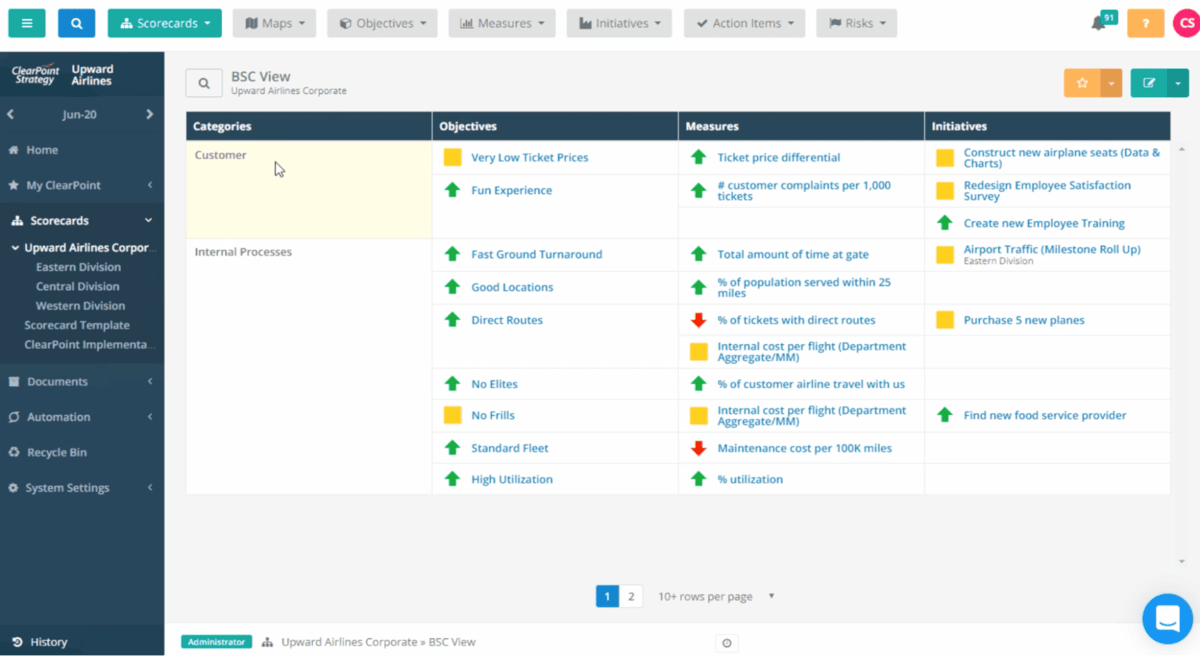
As we mentioned in chapter one, key performance indicators (KPIs) are critical in understanding if you’re on track with your company’s objectives. Each quarterly (or monthly) report should touch on the progress you’re making with each KPI.
KPIs differ for every company depending on strategy and industry; take a look at these sample KPIs to decide which ones your company should put into place:
1. LOB Revenue Vs. Target
LaggingThis is a comparison between your actual revenue and your projected revenue.
- Formula
(Actual LOB revenue ÷ target LOB revenue) × 100.- Example
- $4,600,000 ÷ $5,000,000 = 92%.
- What good looks like
- there is no universal number — aim to land close to 100% and explain the gap, since a line that always beats target easily may have a target set too low
- Weak → strong
- "Hit our revenue numbers" → "Bring the line of business from 92% to at least 98% of its revenue target by Q4, owned by the LOB general manager."
Charting and analyzing the discrepancies between these two numbers will help you identify how your department is performing.
2. Sales By Region
LaggingThrough analyzing which regions are meeting sales objectives, you can provide better feedback for underperforming regions.
- Formula
(Regional sales ÷ regional sales target) × 100.- Example
- $1,350,000 ÷ $1,500,000 = 90%.
- What good looks like
- there is no universal number — set each region's target from its own market size and history, and look for regions that miss target several periods in a row
- Weak → strong
- "Grow sales in every region" → "Bring the Southeast region from 90% to 100% of its sales target by Q4, owned by the regional sales director".
3. Customer Acquisition Cost (CAC)
LaggingBetter when lowerDivide your total acquisition costs by the number of new customers in the time frame you’re examining.
- Formula
Total sales and marketing spend ÷ new customers acquired.- Example
- $300,000 ÷ 100 = $3,000.
- What good looks like
- there is no universal dollar figure — judge CAC against customer value; many of the best SaaS businesses recover CAC in 5–7 months, and past 12 months profitability is anemic (lower is better)
- Weak → strong
- "Spend less to win customers" → "Cut CAC from $3,000 to $2,500 within two quarters, owned by the CMO via channel mix shift".
Voila! You have found your CAC. This is considered one of the most important ecommerce metrics because it helps evaluate the cost-effectiveness of your marketing campaigns.
Show all 10 Reporting On KPIs
4. Net Promoter Score (NPS)
LaggingBetter when higherNPS is one of the best indicators for long-term company growth.
- Formula
% Promoters − % Detractors.- Example
- 60% promoters − 15% detractors = +45.
- What good looks like
- any positive score means more promoters than detractors; across 150,000+ organizations the 2025 median is +44 and the top quartile is +72 or higher, though norms vary widely by industry
- Weak → strong
- "Grow loyalty" → "Raise relationship NPS from +45 to +55 by year-end, owned by the VP of Customer Experience".
To determine your NPS score, send out quarterly surveys to your customers to see how likely it is that they’ll recommend your organization to someone they know. Establish a baseline with your first survey and put measures in place that will help those numbers grow quarter to quarter.
5. Customer Support Tickets
Analysis of the number of new tickets, the number of resolved tickets, and resolution time will help you create the best customer service department in your industry.6. Employee Turnover Rate (ETR)
LaggingBetter when lowerTo determine your ETR, take the number of employees who have departed the company and divide it by the average number of employees.
- Formula
(Separations ÷ average headcount) × 100.- Example
- 18 leavers ÷ 200 avg headcount = 9%.
- What good looks like
- ~10% annual voluntary turnover is often considered healthy; sustained 20%+ usually signals a retention problem, though it varies sharply by sector
- Weak → strong
- "Keep turnover low" → "Hold voluntary turnover below 10% annually, owned by the People team, reviewed each quarter".
If you have a high ETR, spend some time examining your workplace culture, employment packages, and work environment.
7. Knowledge Achieved With Training
LaggingBetter when higherThis metric helps determine the effectiveness of employee training.
- Formula
((Average post-training score − average pre-training score) ÷ average pre-training score) × 100.- Example
- ((84 − 60) ÷ 60) × 100 = 40%.
- What good looks like
- there is no universal number — look for a clear pre-to-post gain, high pass rates on the exam, and evidence people still apply the skill weeks later, compared against your own course baseline
- Weak → strong
- "Make training stick" → "Raise average knowledge gain from 40% to 50% on core compliance courses by Q3, owned by the Learning & Development Manager".
To rate your company’s training program, create an exam based on concepts taught, then monitor the exam pass rate and average score. Larger organizations sometimes conduct a pretest and a posttest to see specifically what employees learned.
8. Percentage Of Customers Who Are “Very” Or “Extremely” Satisfied
LaggingBetter when higherKnowing these results opens up an opportunity for further surveying of what makes happy customers so satisfied.
- Formula
(Customers Who Consider Themselves “Very” or “Extremely” Satisfied) / (Total Survey Respondents) = (Percentage of Customers Who Are “Very” or “Extremely” Satisfied).- Example
- 620 ÷ 1,000 respondents = 62%.
- What good looks like
- there is no universal number — this top-two-box share is stricter than overall satisfaction, so track it against your own baseline and by segment, and watch the gap between merely satisfied and top-box customers
- Weak → strong
- "Delight more customers" → "Lift the very or extremely satisfied share from 62% to 70% on the annual survey, owned by the head of customer experience".
This is also a good measure to look at over time, so keep your survey questions consistent.
9. EBITDA (Earnings Before Interest, Taxes, Depreciation, & Amortization)
LaggingBetter when higherMeasures revenue after expenses are considered and interest, taxes, depreciation, and amortization are excluded.
- Formula
(Revenue) – (Expenses Excluding Interest, Tax, Depreciation & Amortization) = (EBITDA).- Example
- $120,000 + $30,000 + $40,000 + $50,000 + $10,000 = $250,000.
- What good looks like
- read it as a share of revenue — EBITDA averaged ~17% of sales across U.S. listed firms in January 2026, with wide swings by industry
- Weak → strong
- "Improve earnings" → "Grow EBITDA from $250,000 to $300,000 this fiscal year, owned by the CFO via pricing and cost discipline".
10. (Customer Lifetime Value) / (Customer Acquisition Cost)
LaggingBetter when in target rangeThe ratio of customer lifetime value to customer acquisition cost should ideally be greater than one, as customers are not profitable if the cost to acquire them is greater than the profit they will bring.
- Formula
(Net Expected Lifetime Profit from Customer) / (Cost to Acquire Customer).- Example
- $18,000 ÷ $3,000 = 6.0:1.
- What good looks like
- 3:1 is the widely cited healthy target — below 1:1 you lose money on every customer, while above ~5:1 can mean you're under-investing in growth
- Weak → strong
- "Our customers are worth more than they cost to win" → "Hold blended LTV:CAC at or above 3:1 while scaling spend 20%, reviewed monthly by RevOps."
For additional KPI libraries that span a number of areas and industries, take a look at the links in the resources section below!
Additional Resources
- Your Complete Guide To Strategy Execution Tips & Techniques
- How Are Briefing Books Used In Management Reporting?
- What Should Go In Your Monthly Management Report?
- 6 Time-Saving Management Reporting Techniques That Could Save You Hundreds Of Hours
- Strategy Reporting: The Ultimate Guide
Chapter 5: Strategy Meetings

Just because you’ve created a great management report doesn’t mean that others in your organization will interpret what you’ve written the same way. For example, someone responsible for the implementation of a large IT project could be aware of all its difficulties and the solutions that will be used to fix them before the end of the year, while someone not involved in that project might panic at the complexity in front of them.
This is why bringing your leadership together to openly discuss the reports is so important. But productive strategy execution meetings don’t happen by accident. For a meeting to be effective, you have to:
- Prepare for the meeting.
- Ensure the right people are in the room.
- Manage a tight agenda.
- Review the content beforehand.
- Prepare for decisions to be made during the meeting.
- Follow through after the meeting.
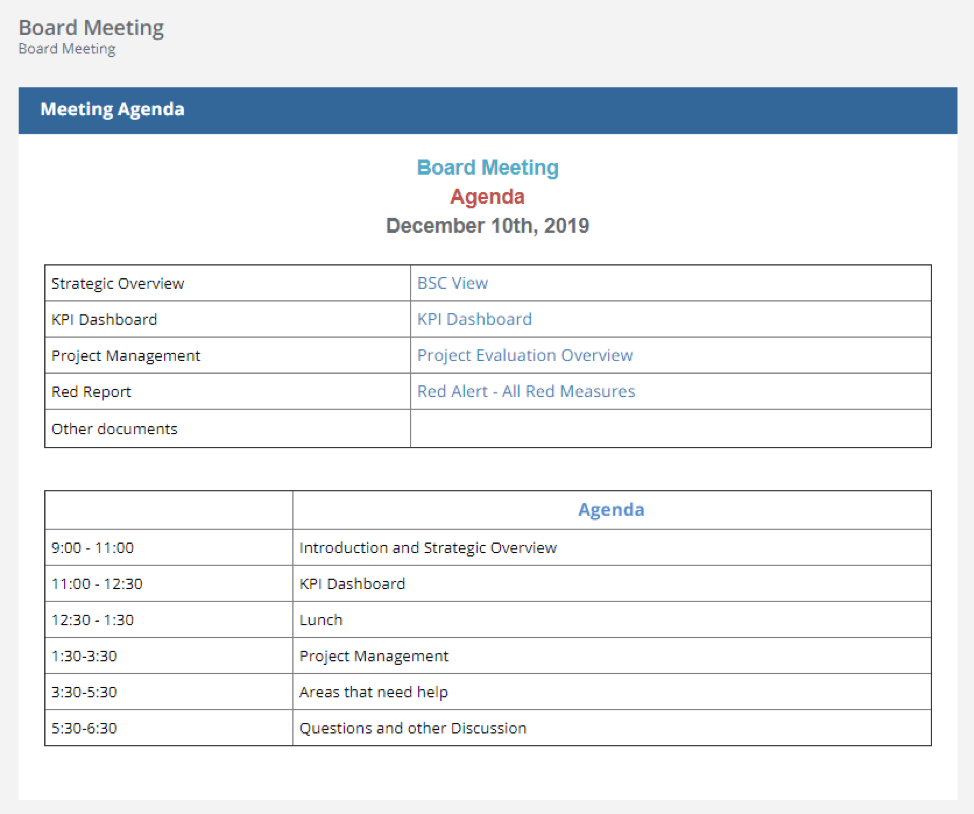
Here’s how to run effective strategy implementation meetings, including what to do before, during, and after.
Before The Meetings
In preparation for your meetings, take the following into account:
- There must be clear accountability around who is presenting each part of the agenda.
- The meeting facilitator is responsible for being able to answer the following questions prior to the meeting:
- Why are we having this meeting?
- What do we need to accomplish once we are done?
- What is my role in the decision-making?
- Why should I invest time in this meeting?
- Information for upcoming meetings must be sent in advance to allow meeting participants time to prepare.
During The Meetings
There are three different types of management meetings:
- Monthly meetings
- Quarterly meetings
- Annual strategy refresh meetings
Each of these meetings “feed” into one another in the following way:
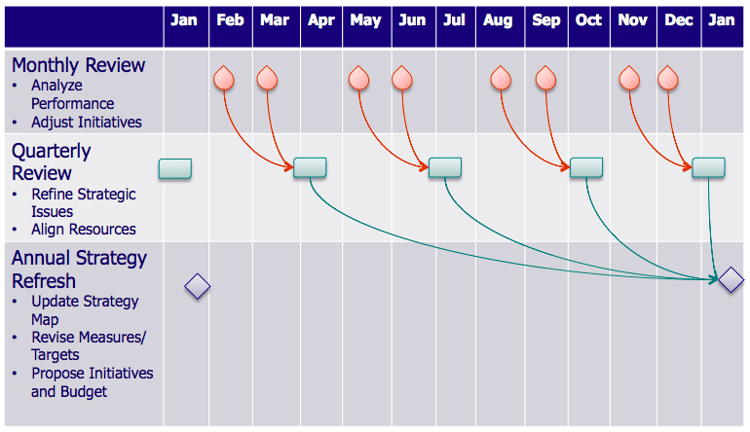
Monthly Review Meetings
The purpose of monthly review meetings, typically an hour or two long, is to review your current progress against your ideal performance. These meetings are typically about parts of the strategy (rather than the full strategy), sometimes referred to as the key themes or strategic thrust. During the meetings, you should capture a set of key decisions and some action items that will also contribute to your quarterly review meeting.
During the monthly meetings, we suggest dividing up your time like this:
- Review the status of action items from the previous meeting (15 minutes).
- Review your objectives and measures (20 minutes), noting the RAG (Red, Amber, Green) status for each.
- Review progress of your projects and initiatives (20 minutes).
- This should include a review and discussion of your initiatives in more detail and a review of both budget and alignment.
- You may slow things down, speed things up, or add resources, as needed, to projects that either impact your strategy or need management attention.
- Discuss key issues (60 minutes).
- During this chunk of time, review your key metrics and problem areas and discuss how your initiatives meet any key issues. This is a good time to discuss, as a team, any strategic decisions or adjustments needed within the entire theme.
- Review action items and assign accountability (5 minutes).
Monthly review meetings allow you to analyze your performance for the month to see how well you’re progressing on your strategy implementation plan.
Quarterly Meetings
The purpose of quarterly strategy review meetings, which can last half a day to a full day, is to review progress against your overall strategy and discuss your key action items.
Quarterly meetings should proceed as follows:
- Review action items assigned at the previous monthly meeting (45-90 minutes).
- Review your organization’s overall key strategic goals (45-90 minutes).
- If you are using a Balanced Scorecard, this would be the goals on your strategy map with associated measures. If you are not using a scorecard, then these are typically the key focus areas in your strategic plan.
- Discuss key issues (1-2.5 hours).
- You’ll want to understand your options, outline your decisions, and make decisions.
- Review initiative allocation (1-2 hours).
- Something may have occurred over the course of a year that impacts your budget. This could be related to weather, government regulations, or financial markets. It could even be a major competitor-related event or an unforeseen calendar event.
- If you have a larger budget surplus in one quarter, then you may have an opportunity to invest more in areas of your strategy. If your budget surplus is smaller than expected, you may need to shift your priorities to completing specific measures only.
- Review action items (30 minutes).
- Again, the last part of the meeting should be used to review the action items you’ve captured during the meeting and make sure each item has a responsible owner.
Quarterly reviews are for refining your strategic issues or reviewing your strategy, and making sure you’re still on track. This is the time for you to decide if money or management attention needs to be reallocated as well. If you review key components of your strategy only once a year, you may be faced with some serious challenges or surprises at the end of the year.
Keeping your team on the same page quarterly also means you're always prepared to report your progress to your board if that's something you need to do.
Annual Strategy Refresh Meeting
The purpose of annual strategy refresh meetings is to review year-to-date performance and adjust your strategy as necessary. This meeting typically lasts 1-2 days. By the close of the meeting, you should have an updated strategy map or scorecard.
During the annual meetings, you may want to divide up your time like this:
- Do a strategy map refresh to review and adjust themes, perspectives, and objectives (2-4 hours).
- Ask questions about whether your current strategy is still valid going forward.
- Review current measures and adjust future targets based on what you’ve learned over the last year (2-4 hours).
- Review initiative allocation (2-4 hours). Your initiative allocation section will allow you to:
- Set your strategic budget for the next year.
- Allocate your budget according to your themes.
- Review your proposed initiatives.
- Refine and rationalize your initiatives.
- Determine key scorecard owners for the upcoming year (1 hour).
An annual strategy review meeting is a forum to question your strategy as a whole. It should answer the following questions:
- Is our strategy still valid for the upcoming year?
- Do we need to change our strategy map or some of our measures?
- Should we add more sophisticated measures or update some of our targets?
- Should we change our initiatives or budgeting process?
After The Meetings
Following your meetings, you’ll need to take the following into account:
- Publish your meeting minutes and action plan within 24 hours so everyone understands their responsibilities.
- Meeting minutes should consist of high-level meeting notes and details that are important for those involved.
- This step is important both because the decisions will be fresh in everyone’s minds and because action items can only be completed after the meeting minutes are published and sent out.
- Prepare for the next meeting by creating a new agenda.
- Have the strategy execution manager monitor the completion of action items and offer assistance where needed.
Keep In Mind…
Your first few management meetings might be overwhelming; it’s helpful to have a designated facilitator in the meetings to keep you on track. (Choose someone who isn’t on the management team!) There are a lot of moving parts involved in effective management meetings. Give it some time and you’ll be having more effective meetings shortly.
Additional Resources
- The 8-Part Guide To Leading A Successful Strategy Meeting
- 8 Great Pieces Of Meeting Management Advice
Chapter 6: Strategy Refresh

A lot can change in a company over a five-year period, and the conclusions you draw during your strategy review meetings will help you determine whether your strategy is still valid or not.
For example, you could be facing unexpected issues at the end of a five-year period, such as:
- Political changes that impact your company, like a change in the tax code that affects corporations or international trade disputes in your biggest markets.
- Economic issues, like the recession of 2008 or the record-breaking market growth in 2017.
- Environmental issues, like changes in weather patterns that affect your municipality, or, for manufacturing organizations, the availability of a natural resource.
- Technological changes, which may directly impact your business (like the introduction of driverless cars) or indirectly impact your business (like cell phones and tablets surpassing the use of computers).
Disruptions like these could mean you need to make some adjustments. That is why we recommend you look at the validity of your strategy on an annual basis. This is a good way to check your goals, ensure your KPI targets are set correctly, and reassess the relevancy of your projects and their funding sources.
There are four primary components to a strategy refresh in the strategy execution process:
- First, look at the big picture to get a “zoomed-out” perspective of your high-level goals, mission, and values. Are you still in the same business or have you drifted into other business areas? Are you planning for growth or anticipating steady revenue? Do you have the right structure and skills in place for the long term?
- Next, deep dive into the details of the plan itself, including your objectives, measures, and initiatives. Are your objectives still relevant? Are you tracking all your KPIs? (If not, what’s stopping you?) Are some of your projects delayed, off track, or cancelled? Completing this step will require departmental collaboration, but helps you consider adjustments to specific areas of your plan.
- After the details of your plan are solidified, focus on improving your reports. On average, how long does it take you to create a report? Are the reports usually accurate? Does everyone have access to the most up-to-date versions? During this process, you’ll be able to determine if your reporting meetings are effective, and what you can do to shore up your reporting process in the future.
- Finally, communicate any changes to your strategic plan both internally and externally. Everyone needs to understand why changes were made and how those changes will affect them. Otherwise, your strategy execution will fail. If you decide to stop doing something, make sure everyone knows. If you decide to start doing something new, decide who will lead it and how they will communicate responsibilities for that new task. Without clear and open communication about updates, your employees will continue to be focused on executing the previous, now outdated, strategy.
Additional Resources
- How To Refresh Your Strategic Plan For The Next Fiscal Year
- Refreshing Your Management Reporting Process: A Starter Guide
Chapter 7: Strategy Implementation And Reporting Software
Consider all the steps we’ve covered so far: validating your strategic plan, addressing potential strategy execution challenges, appointing a person to champion your strategy implementation process, simplifying your reporting process, structuring your strategy meetings, and scheduling an annual strategy refresh.
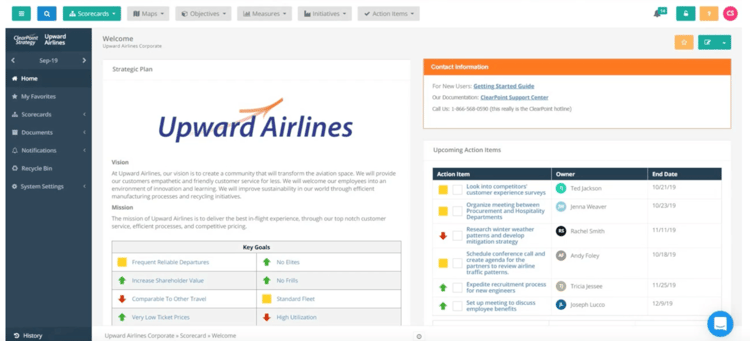
These steps take a lot of work. To make the strategy execution process run as smoothly as possible, you need to find software that supports your entire strategy execution process. Software like ClearPoint can help pull all the pieces of your strategy together in an organized, consistent format.
Here is how software supports four parts of the strategy execution process: tracking results, meeting to discuss progress, making adjustments, and reporting.
Strategy Implementation Step #1: Track the results of your goals, measures, and projects.
You’ll need an effective way to track the progress you make on your goals, measures, and projects, but the very nature of the tracking process can make your strategy implementation difficult. For instance, you could have 20 or more individuals involved in different projects at any given time. Gathering details from each contributor is a lot of work, and if one or two people don’t participate, it can throw off the whole strategy execution plan.
Without software, it’s your job to follow up with all the people involved in each goal, measure, and project to ensure they update a single spreadsheet. They may never do the updates, or they might unintentionally alter the report in ways you didn’t intend. Or, they might show up to the meeting claiming they have updated numbers that your final spreadsheet does not have.
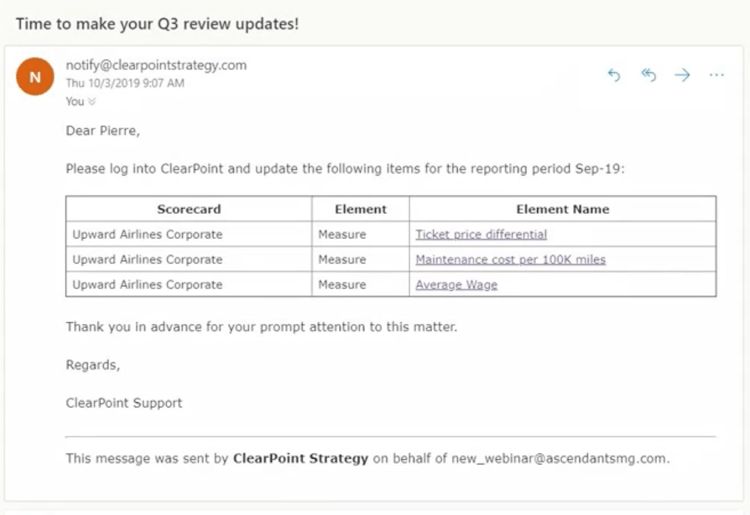
With software, reporting is simpler for everyone involved. Each owner is automatically notified to load their data into a central, cloud-based system. They have a structured way to update their data, and they are all told when the strategy report is complete, so they can prepare for the meeting.
Strategy Implementation Step #2: Meet as a leadership team to discuss progress.
As we’ve covered, you need to discuss your strategy on a regular basis so you can adjust it based on tracking results and progress. The focus should not only be on “How did we do?” but on “What can we do to improve our results?” This leadership team meeting is a key step in the strategy execution process.
Without software, you’ll face several challenges. The main one is getting everyone on the same page before your meeting. You run the risk of some people coming to the meeting with a detailed, 10-page project update, and others coming with a brief overview of how things are going. This can cause a long, disjointed meeting.
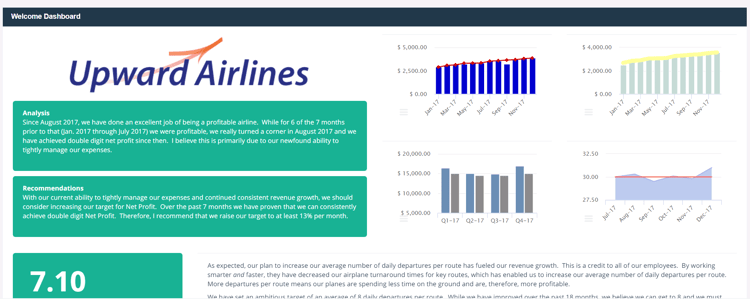
With software, you can gather information in a consistent format at a level of detail you choose. If you need more detailed information during your meeting, you can easily access this data through strategy software. Plus, using technology as your presentation medium allows you to move naturally through areas of discussion instead of flipping from page to page. Finally, you can send out meeting and information update reminders, so everyone is prepared ahead of time.
Strategy Implementation Step #3: Make strategic adjustments or decisions along the way.
You need a system to reevaluate your strategy in response to external changes. Economic or political events, environmental disasters, or strategic shifts from a competitor could all impact your organization’s strategy. You’ll need a simple way to evaluate your options, make decisions, and follow through.
Without software, your team may gather in a conference room to discuss strategic issues and make decisions, then walk away, leaving discussion notes on flip charts or white boards. There’s rarely any follow-up on how those decisions are impacting your strategy as a whole, and no one seems to be responsible for taking action on the decisions made.
With software, you can base your discussions on clear, thorough data reports, track those decisions, see the outcome of those decisions over time, and record any analysis or recommendations. Technology removes the guesswork. The next time you meet you can brief your team on the actions that have taken place, or still need to take place, since the decision was made.
Strategy Implementation Step #4: Create progress reports as you go.
Now that you’ve taken on the task of strategic planning, you’ll want your key stakeholders to know you’re tracking and implementing the strategy in an organized, planned fashion. That means generating reports.
Without software, you have to create your reports manually. And since different people want to see information in different ways and in varying levels of detail, manual reporting presents a unique challenge. On top of that, you have to be certain that every person creating or updating the reports uses the same data. You wouldn’t want to report two different revenue numbers to two different groups, even if there’s a good reason for it.
With software, you can use a common set of data to create reports for division heads, enterprise employees, boards of directors, city council members, the general public, etc. With the click of a button, you can create templates for easy reproduction every time, and you can publish certain data online, knowing with certainty you’re using the most up-to-date version of the report. (Every report is time-stamped and dated.) Using software for report creation is one of the ways technology can be most helpful in implementing your strategic plan.
Additional Resources
- Strategy Map Software: The Proven Way To Stay On Course
- What Is Balanced Scorecard Software—& Should I Be Using It?
Nail Your Strategy Implementation With ClearPoint
You made it! Don’t be overwhelmed. Once you get in the rhythm, this will become a “living” strategy implementation process ingrained in your organization.
When everyone in the company starts to automatically consider how the decisions they make will impact the overall strategic vision, you’ll know you’ve nailed your strategic implementation. A tool like ClearPoint keeps you on track with consistent monitoring and reporting.
If chapter 7 convinced you that technology will help you implement your strategy, give ClearPoint a try. ClearPoint has made strategy implementation easier for hundreds of companies. To learn more and see how it works, schedule a demo and we’ll show you around.
Additional Resources
Common questions
What are the 5 steps to strategy implementation?
Effective strategy implementation typically involves the following five steps:
- Setting Clear Goals: Define specific, measurable objectives that align with the organization's vision and mission.
- Allocating Resources: Allocate sufficient resources, including budget, personnel, and technology, to support strategy execution.
- Assigning Responsibilities: Delegate tasks and responsibilities to individuals or teams with the necessary skills and expertise.
- Monitoring Progress: Regularly track and assess progress towards goals, adjusting strategies as needed to address challenges or capitalize on opportunities.
- Reviewing and Improving: Continuously evaluate the effectiveness of the implemented strategy, learning from successes and failures to refine future initiatives.
What are common challenges to strategy implementation?
Common challenges to strategy implementation include:
- Resistance to Change: Employees may resist new processes or systems required by the strategy.
- Lack of Resources: Inadequate budget, staffing, or technology can hinder execution.
- Poor Communication: Unclear objectives or insufficient communication can lead to misunderstandings.
- Ineffective Leadership: Weak leadership support or inconsistent direction can derail implementation efforts.
- External Factors: Market shifts, regulatory changes, or competitive pressures may impact strategy execution.
What are some solutions to overcoming a lack of common understanding of a strategy?
To overcome a lack of common understanding of a strategy, consider these solutions:
- Clear Communication: Clearly communicate the strategy's goals, objectives, and expected outcomes to all stakeholders.
- Training and Education: Provide training sessions or workshops to educate employees about the strategy's relevance and their role in its implementation.
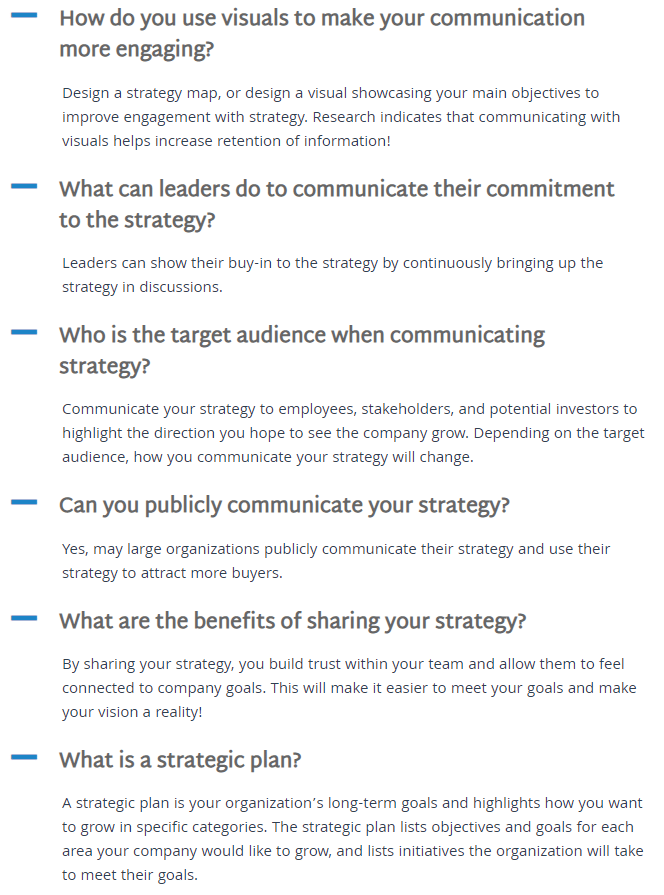
- Visual Aids: Use visual aids such as diagrams, charts, or infographics to illustrate key concepts and processes.
- Feedback Mechanisms: Establish feedback mechanisms to encourage questions, clarify doubts, and address concerns about the strategy.
- Leadership Alignment: Ensure that leadership is unified and consistently reinforces the strategy's importance and benefits.
How can you ensure effective strategy meetings?
To ensure effective strategy meetings, follow these best practices:
- Preparation: Set clear meeting objectives, prepare an agenda, and distribute relevant materials in advance.
- Engagement: Encourage active participation from all attendees, seeking diverse perspectives and input.
- Focus: Stay focused on strategic priorities and key decisions, avoiding tangential discussions.
- Actionable Outcomes: Document action items, decisions, and next steps with assigned responsibilities and timelines.
- Follow-Up: Schedule follow-up meetings as needed to monitor progress and address any issues that arise.
What are the benefits of using strategy software?
Using strategy software offers several benefits, including:
- Centralized Data: Consolidates strategic plans, goals, performance metrics, and progress reports in one accessible platform.
- Collaboration: Facilitates collaboration and real-time communication among team members and stakeholders.
- Automation: Automates routine tasks such as data analysis, reporting, and performance tracking, saving time and reducing errors.
- Visualization: Provides visual dashboards and reports to simplify complex data and facilitate informed decision-making.
- Integration: Integrates with other organizational systems, enhancing data accuracy and operational efficiency.
Implementing strategy software enhances transparency, agility, and alignment across the organization, supporting effective strategy execution and performance management.