Strategic Planning, Simplified.
- Name an owner for every objective. An objective with an active owner is more likely to be on track (23.6% vs 10.6%).
- Schedule a formal assessment for each objective. ClearPoint shows which objectives haven't been formally assessed yet.
- Pick one framework and set priorities inside it. Balanced Scorecard, OKRs, SWOT or your own model all work once objectives, measures and owners are clear.
- Tie resources directly to strategic goals. Every dollar then funds a long-term objective instead of drifting to unrelated work.
- Draft objectives with the SWOT Analysis AI Assistant. It interviews you, suggests objectives and metrics, and helps assess risk.
Organizing strategy sounds like housekeeping. It’s actually where execution is won or lost. Across organizations managing strategy on ClearPoint, initiatives with a named owner complete at 2.5× the rate (21.5% vs. 8.7%), and ClearPoint shows which objectives still need an owner or a formal assessment. Those gaps don’t come from bad strategy; they come from strategy that was never organized into clear objectives, measures, and owners. This is the first of ClearPoint’s strategy success factors, and the foundation the others stand on.
Strategic Planning is the process of defining an organization's direction and making decisions on how to pursue it. A strategic plan helps organizations establish priorities, focus energy, and ensure that employees and other stakeholders are working together, with an eye on anticipated future outcomes and changes. The work is essential, and often difficult. Aligning long-term goals with short-term operations, reporting on results, and adapting plans when needed can quickly become hard to manage.
The process is a two-part exercise: Planning, which involves setting goals, determining their objectives and measures, and allocating resources toward them, and Execution, which involves taking action to reach those goals and tracking the progress.
ClearPoint Strategy was created to help with both. Designed by executives, for executives, ClearPoint was developed to make strategy and performance management go hand-in-hand. Strategic planning can be a rewarding part of your business operations rather than a routine task. With tools and frameworks built for it, ClearPoint Strategy makes strategic planning simple, no matter the size or complexity of your organization.
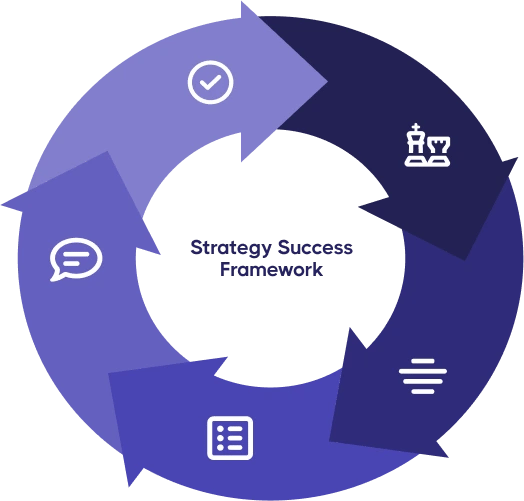
With over 50 years of experience working with strategy, we’ve developed the ClearPoint Strategy Success Framework. Here is how ClearPoint supports the first and foundational strategy success factor: Organizing Strategy.
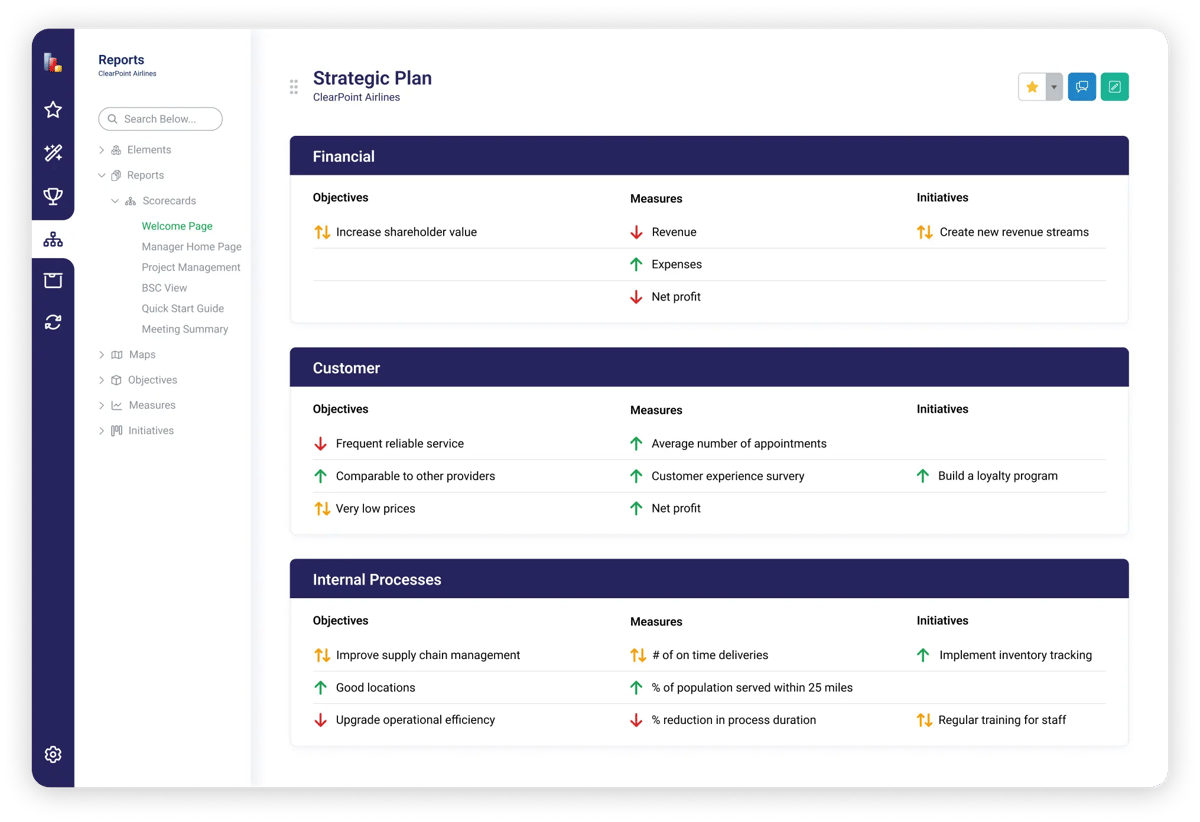
Part 1: Developing the Strategic Plan
It starts with developing your strategic plan: defining where you want your organization to go. ClearPoint simplifies this by helping you set strategic priorities within any strategy framework, such as:
- The Balanced Scorecard
- Porter’s Five Forces
- SWOT Analysis
- PEST Analysis
- OKRs
- VRIO
- V2MOM
- Blue Ocean
- Baldrige Excellence
- Quality Improvement
- ...and more!
ClearPoint also builds in artificial intelligence. ClearPoint Strategy’s AI Assistants guide you through the planning process in an interactive interview format. They offer suggestions and insights and can automate parts of the plan based on your inputs. They adapt to any framework, even your own.
Your framework can also change over time. The American Association of Critical-Care Nurses (AACN) started with a Balanced Scorecard built on four perspectives: Financial, Customer Satisfaction, Internal Processes, and Learning and Development. After some internal research, AACN moved to the Input-Impact Model, also known as I2I. Tracey Birosak, Business Strategy Specialist, said that “when we were ready to implement a new performance measurement model, the ClearPoint tool offered the flexibility we needed to make the change.” Under I2I, AACN tracked shorter-term outcomes on one to three-year intervals and its high, societal-level impacts every three to five years.
ClearPoint's AI Assistants also help with risk assessment, so your plan is well-structured and adaptable. They analyze trends, give real-time feedback, and help prioritize initiatives, so strategists can make informed decisions and focus on the creative side of strategy execution. The result is a faster, more effective planning process.
The AI Assistants help you identify key objectives and recommend metrics to track progress, so nothing is overlooked. As you roll out a strategic plan across your organization, ClearPoint continues to support you by centralizing strategy data, automating workflows, and helping your team stay aligned. Whatever the scope of your strategy model, ClearPoint has the tools and the intelligence to make it manageable.
Part 2: Executing the Strategic Plan
As you move from planning to execution, ClearPoint helps you monitor progress and manage initiatives. Real-time tracking and automated reporting features keep everyone informed and focused. Strategy review meetings shift from speculation to decisions, driven by accurate, up-to-date data.
ClearPoint goes beyond basic tracking with features to calculate and evaluate the performance of your strategic initiatives. Calculations aggregate data across departments or projects, so you can see how each part of your strategy contributes to your overall mission. These evaluations help you identify trends, measure progress, and make informed decisions on where to reallocate resources or adjust your approach.
The Choctaw Nation of Oklahoma shows what organizing strategy can do at scale. With 12,000 associates and thousands of projects across the tribe, it shifted in 2019 from individual departmental plans to one overall tribal plan built on five tribal strategies. In ClearPoint, the main scorecard holds those five strategies, followed by focus areas, then strategic objectives, where the “bulk of the work” is done. Seeing everything in one place revealed projects and resources that could be combined, and the tribe turned 10,000 projects into around 200.
Brandie Holloway, Director of Strategy, said: “ClearPoint really changed the way we look at our own organization of the strategic plans’ initiatives.” Each month, the tribe generates 60-70 individualized reports in ClearPoint for specific leads, and tags keep the reports filtered to what each lead needs.
ClearPoint shows the results of these calculations in charts, graphs, and dashboards. Stakeholders at every level can quickly see the status of key initiatives, which builds transparency and alignment across the organization. Visual results also give you insights that drive strategic decisions.
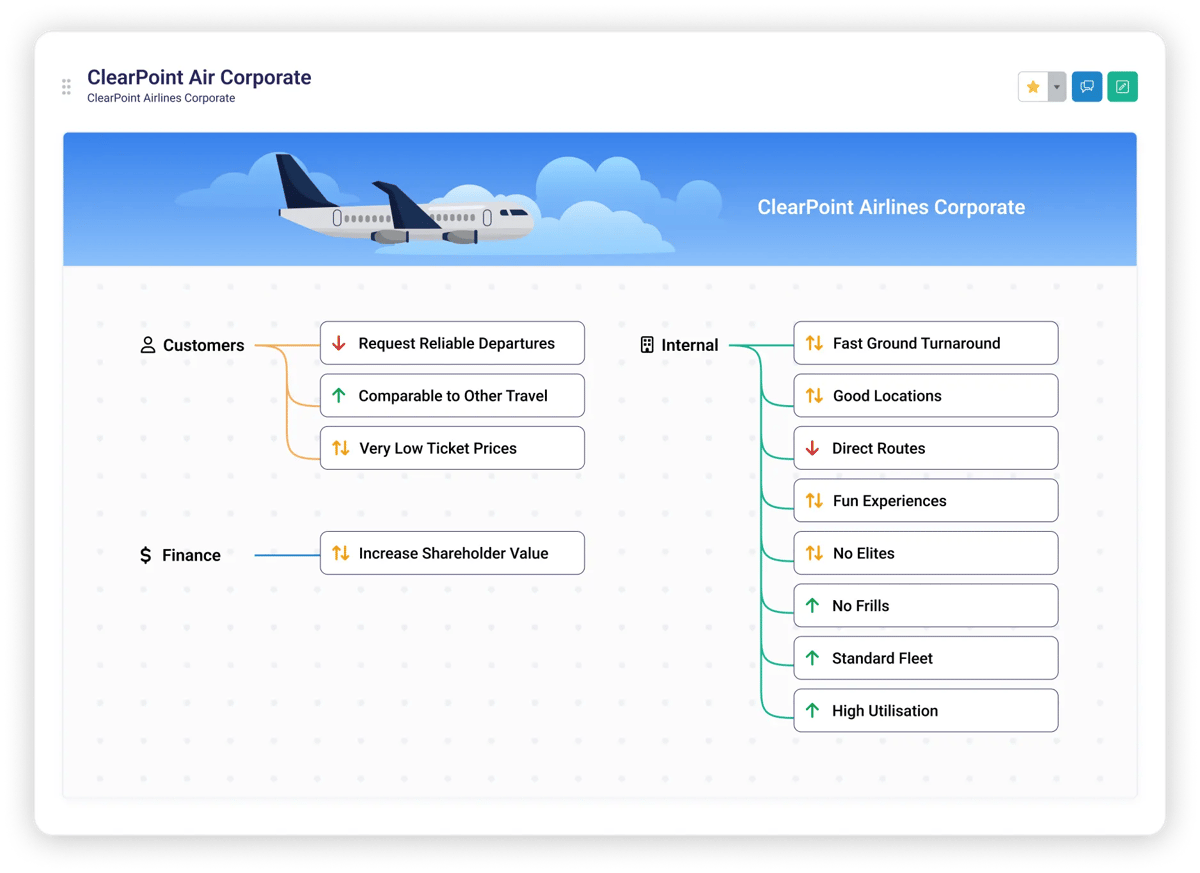
Organizing your strategy with ClearPoint brings better decisions, better resource allocation, and better alignment.
With reliable data at hand, leaders make informed decisions as a matter of course. Tying your resources directly to your strategic goals means every dollar spent is an investment in your organization's future. Keeping everyone on the same page helps communication flow, which improves processes and performance.
The City of Durham, North Carolina, ties budget requests to performance data. Its Emergency Communications team avoided the unnecessary hiring of 4-5 communication officers annually after data showed a 95% emergency response level was already achieved. Unfounded initiative requests also dropped sharply, because departments must now demonstrate strategic benefits and performance impacts. These changes did not simply cut costs; they removed spending that did not advance strategic priorities.
Read how customers use ClearPoint to make strategic planning less daunting. To join the ClearPoint Community, talk to a strategy expert about making your strategic plan a blueprint for success.
Test out our SWOT Analysis AI Assistant
Related: ClearPoint Next AI: Your Strategy Team’s Always-On Co-Pilot
Common questions