Struggling with strategy alignment? Learn how ClearPoint’s digital Kanban Boards and Explorer Views help teams stay aligned and agile.
- Retire spreadsheets and email threads for plan updates. Updates get lost, versions multiply, and compiled data is outdated by the time you finish.
- Link each new initiative to its objectives and measures when you add it. Visible linkages mean fewer gaps and fewer misaligned efforts when priorities shift.
- Move initiatives through clear stages on a Kanban board. In Progress, Pending Approval and Completed columns show what is moving and what has stalled.
- Fix visibility before rewriting the plan. Alignment problems usually come from teams that cannot see what is working or adapt quickly.
- Run review meetings from the board with Kanban boards for strategy meetings. Leaders see where every initiative stands without chasing separate reports.
If you’ve ever tried to manage a strategic plan using spreadsheets, you know the pain. Updates get lost in long email threads, version control is a nightmare, and by the time you compile the data, it’s already outdated. Strategy execution requires alignment, but too many teams rely on scattered tools that add confusion.
At ClearPoint Strategy, we’ve spent years helping organizations run their strategy. We’ve seen disconnected workflows and outdated reporting derail even the best-laid plans. That’s why we built the Kanban Board View and Explorer View into our software. They help teams align, track, and adjust their strategy as it changes.
Why Your Strategy Won’t Succeed (Without the Right Tech)
Strategic alignment means every initiative, objective, and metric is connected. Too often, organizations rely on outdated methods and disconnected reporting tools that make that nearly impossible. Without one central system, leaders struggle to track progress, teams work in silos, and execution falls apart.
Alignment needs a platform that keeps everything in one place, where you can see progress in real time, adjust priorities, and keep everyone focused on the big picture. Technology gives teams the structure and visibility to stay aligned.
Making Alignment Agile
Strategic plans rarely stay still. They evolve, and teams adjust. To stay aligned, organizations need to track these shifts in real time while keeping key initiatives and objectives connected. Digital tools make that possible.
Linkages
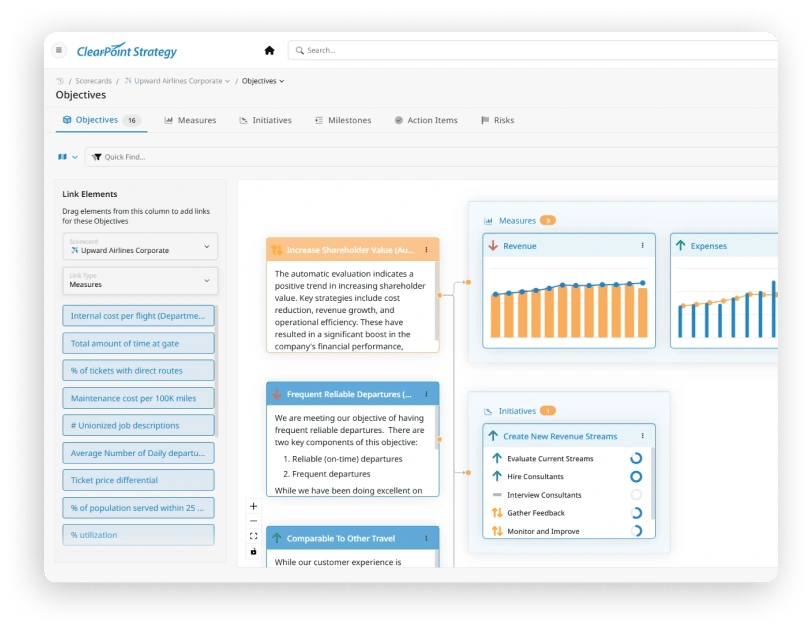
Managing a strategy means understanding how everything connects, not only tracking individual tasks. Organizations often struggle with alignment because they can’t see the relationships between their objectives, measures, and initiatives. That’s why we built the Explorer View.
This tree shows teams how the parts of their strategy fit together. You adjust linkages with drag-and-drop, so when priorities shift, your strategy stays connected.
For example, let’s say your organization adds a new sustainability initiative. With Explorer View, you can connect it to the relevant objectives and measures without digging through multiple pages or reports. That means fewer gaps and fewer misaligned efforts.
The City of Vaughan, Ontario, uses linkages this way. On the strategic side, the city uses ClearPoint to create linkages and show alignment between the elements of its strategic plan, and to display its public-facing performance measures. On the operational side, each department has a dashboard that shows the relationships between its performance measures and departmental initiatives.
Kanbans
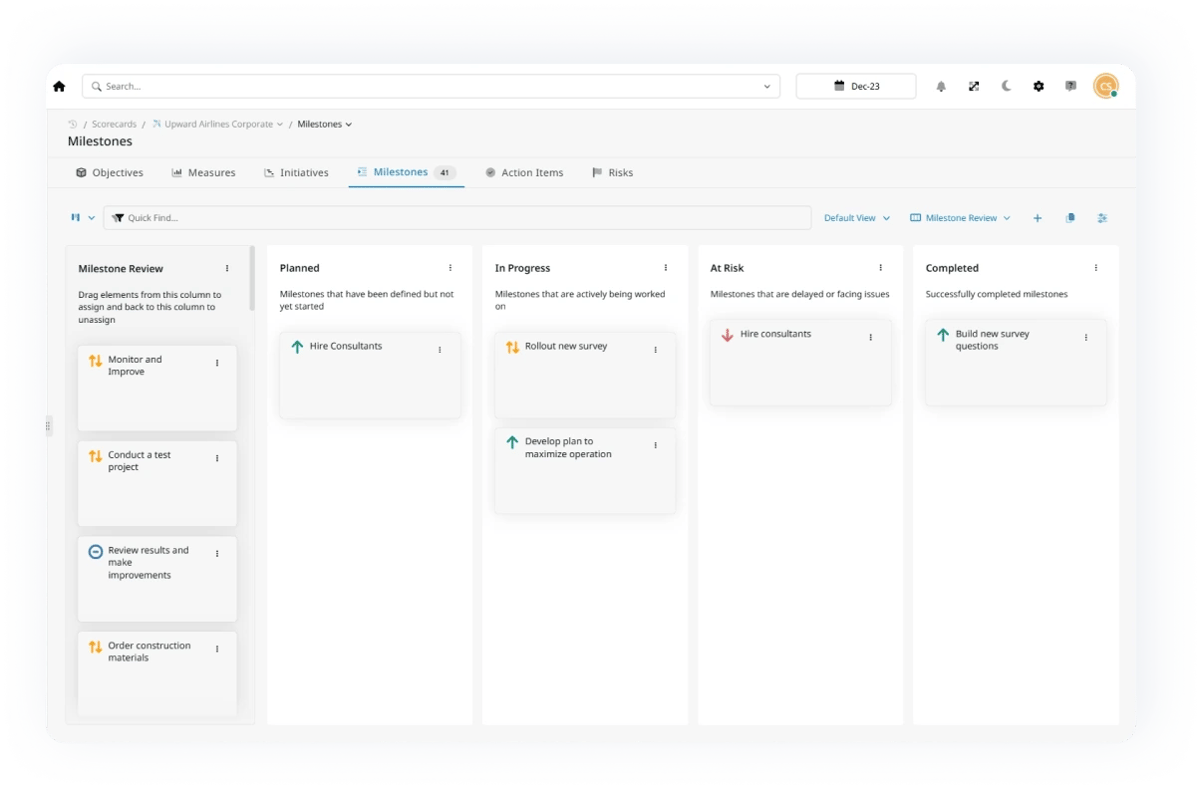
Traditional task management tools force teams into rigid workflows. Strategy execution doesn’t happen in a straight line. Priorities shift, approvals get delayed, and sometimes, initiatives need to be restructured entirely. That’s where Kanban Boards come in.
Inspired by agile project management, ClearPoint’s Kanban View gives teams another drag-and-drop interface to move tasks through different stages, such as:
- In Progress
- Pending Approval
- Completed
Instead of tracking down updates in disconnected reports, teams see in real time what’s moving forward and what’s stalled. Nobody has to guess who owns what or update spreadsheets by hand, because everything lives in one place.
The City of Arvada, Colorado, tracked complex shared projects this way. As Jefferson County consolidated its local 911 dispatch centers into one regional center called JeffCom, the Arvada Police Department worked on the project with county staff and employees from other cities. All phases were tracked in ClearPoint. Arvada Police could monitor milestones, see the project in a Gantt chart, use owner and collaborator fields to see who was responsible, and share attachments, all in one central location.
See ClearPoint project management software
Why These Tools Matter
I’ve worked with hundreds of organizations on strategy execution, and alignment issues don’t come from a lack of planning. They come from a lack of visibility and flexibility. Organizations get stuck because they can’t see what’s working, can’t adapt quickly, and can’t keep everyone on the same page.
The Kanban Board and Explorer View solve these challenges by:
- Simplifying workflows so teams can move tasks efficiently from one stage to the next.
- Enhancing visibility so leaders always know where things stand.
- Improving flexibility so teams can adjust priorities without losing alignment.
With these tools, strategy execution stops being a frustrating, manual process. You can see these tools in action.
Common questions
What is strategic alignment really about?
Strategic alignment is not simply about having a plan, it is about ensuring every initiative, objective, and metric is connected. Most alignment problems do not come from poor planning, they come from a lack of visibility and flexibility. When teams cannot see how their work relates to broader goals, or cannot adjust as plans change, even a well-written strategy fails to come together in practice.
Why do spreadsheets and disconnected tools hurt alignment?
Outdated methods and disconnected reporting tools make it hard to see the relationships between objectives, measures, and projects. Strategy lives in those connections, so when the tooling treats everything as isolated rows and tasks, alignment breaks down. Teams end up tracking individual items without understanding how they ladder up, which is exactly where most organizations get stuck.
What are Linkages in ClearPoint?
Linkages are a way to see how everything in a strategy connects. Rather than tracking individual tasks in isolation, Linkages show the relationships between objectives, measures, and projects, so teams understand how their work fits into the bigger picture. This visibility is central to alignment, because it makes clear how each piece contributes to the organization's goals.
How do Kanban views help with strategy execution?
Traditional task tools force teams into rigid, linear workflows, but strategy execution rarely runs in a straight line. Priorities shift, approvals get delayed, and initiatives sometimes need restructuring. Kanban views give teams the flexibility to manage that reality, tracking work as it moves through stages and adapting to change without losing sight of how initiatives connect to strategy.
Why do visibility and flexibility matter more than planning?
Across hundreds of organizations, alignment issues consistently trace back to a lack of visibility and flexibility rather than a lack of planning. Organizations get stuck because they cannot see how their initiatives connect and cannot adapt when circumstances shift. Tools that surface those connections and allow agile adjustment are what turn a static plan into a strategy teams can actually execute.