How did Dwight Eisenhower solve some of the big problems of the twentieth century?
- Make a stuck problem bigger instead of smaller. Eisenhower found that widening the frame let him see the outlines of a solution.
- Put the whole strategy on one page with a strategy map. It shows how objectives link and measures align, which isolated KPIs or MBO miss.
- Group objectives into themes. Look for common areas across objectives, or step back from where the strategy is struggling.
- Look for the bigger problem behind a stalled objective, measure or initiative. Stepping back often reveals an underlying cause and a different approach.
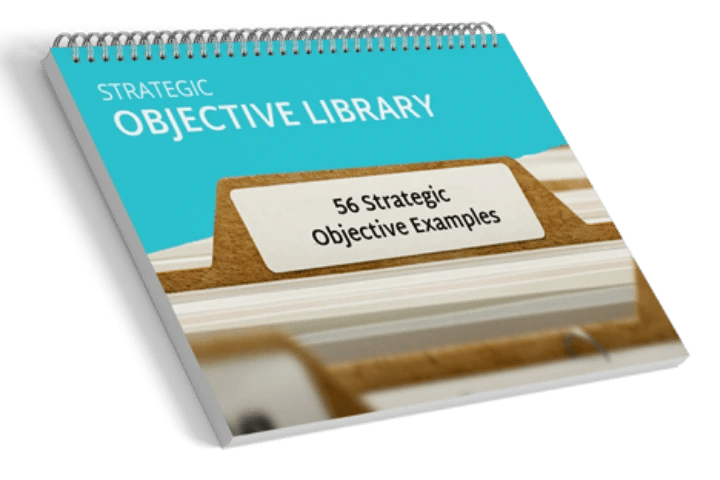
- Draft objectives from these strategic objective examples. Then look for the themes that connect them.
Recently, I was reminded of General Dwight Eisenhower's penchant for effectively executing strategy. In World War II, Eisenhower coordinated the largest military undertaking ever with the D-Day invasion of Normandy. He managed huge sea, air, and land forces, and he also accounted for unpredictable weather and the political wills of Roosevelt, Churchill, and de Gaulle.
When asked about his success, Eisenhower said "Whenever I run into a problem I can't solve, I always make it bigger. I can never solve it by trying to make it smaller, but if I make it big enough, I can begin to see the outlines of a solution."
That approach to problem-solving made him a successful leader in many settings. The "Eisenhower Principle" still applies directly to business strategy management and to leaders today.
What Eisenhower Taught Us About Business Strategy Management
Organizations sometimes take an approach towards strategy management that is too detailed or too narrowly focused. Management By Objective (MBO) can give you a random set of objectives that do not link together in any coherent fashion. Key Performance Indicators (KPIs) also can get an organization focused on something small, and not necessarily strategic. Both approaches have real benefits, but they can come up short when you need to manage the whole strategy.
With the Balanced Scorecard, a Strategy Map allows an organization to see the entire strategy on one page. That one-page view shows how your objectives link together and how your measures align to the strategy. "Themes," or groups of objectives, help an organization focus. Themes can be created by looking for common areas across a set of strategic objectives, or they can be devised by using the Eisenhower Principle.
Our guide to what a strategy map is sums up how to read one. You build it top-down and read it bottom-up. The bottom two perspectives are leading: what your people learn and how your processes run drive value. The top two are lagging: customer satisfaction and financial results come from executing the bottom well. The map holds objectives, not measures. The map is the story; the scorecard is the data behind it.
In this approach, think about the areas where you are struggling with your strategy, and take a step back. Look for underlying causes, or a bigger problem, that you need to address. Seeing the issue a different way may lead you to a different approach to solving the crisis.
In my experience, stepping back from the frenetic activity or crisis often lets an organization see a new approach, an underlying theme, or a broader set of issues it must address to achieve its mission. Improving an objective, measure, or initiative may not need laser focus. It may need a broad view of how you manage your business' strategy and all the factors. Next time you are faced with a problem, apply the Eisenhower Principle... make it bigger.
Common questions
What is business strategy management?
Business strategy management is the ongoing process of formulating, implementing, and evaluating strategies that enable a company to achieve its long-term goals and objectives. It involves making strategic decisions about how to allocate resources, compete in the marketplace, and create value for customers and stakeholders.
What is business strategy in strategic management?
In the context of strategic management, business strategy refers to the specific approaches and actions that a company takes to achieve its competitive advantage within a particular industry or market segment. It outlines how a company will differentiate itself from competitors, attract and retain customers, and generate sustainable profits.
What is business policy and strategy management?
Business policy and strategy management is a broader field that encompasses both the formulation of high-level policies and the development and execution of specific strategies to achieve those policies. It involves making decisions about the overall direction of the company, its target markets, its competitive positioning, and its resource allocation.
How do you implement the Eisenhower Principle in business strategy?
The Eisenhower Principle, also known as the Eisenhower Matrix, is a decision-making tool that categorizes tasks into four quadrants based on their urgency and importance:
- Urgent and Important: Do these tasks immediately.
- Important, but Not Urgent: Schedule these tasks for later.
- Urgent, but Not Important: Delegate these tasks if possible.
- Not Urgent and Not Important: Eliminate these tasks.
Applying this principle to business strategy, you would:
Focus on the most important strategic initiatives: Identify the projects and activities that will have the biggest impact on achieving your long-term goals.
Delegate or eliminate non-essential tasks: Free up time and resources by delegating or eliminating tasks that are not critical to your strategy.
Plan for the future: Schedule time to work on important, but not urgent tasks that will help you achieve your long-term goals.
Avoid distractions: Minimize interruptions and distractions so you can focus on the most important tasks.
Why is strategic management important in business?
Strategic management is crucial for business success because it:
Provides a clear direction: It helps businesses define their vision, mission, and goals, and develop a roadmap for achieving them.
Creates a competitive advantage: It helps businesses identify and leverage their unique strengths to outperform competitors.
Optimizes resource allocation: It ensures that resources are allocated to the most impactful projects and initiatives.
Enhances decision-making: It provides a framework for making sound, data-driven decisions that align with the overall strategy.
Promotes adaptability: It helps businesses stay agile and respond to changes in the marketplace.