The basics surrounding project budgeting - and the software tool to stay on track.
- Aim for budget accuracy over coming in under budget. Chronic under-budgeting ties up resources and forfeits projects you could have funded.
- Pick an estimating method that fits each project. 28% of project failures are attributed to inaccurate cost estimates; refine your method as project data accumulates.
- Record why each project ran over or under. The story behind the numbers improves budget adjustments and future estimates.
- Set one policy for counting staff time on projects. A project with no extra spend may still have taken six people three months.
- Compare budget to actual on a project dashboard. A wall of spreadsheet numbers takes effort to absorb and offers little context.
Budget is only one factor in a project’s success, but it’s an important one. Inaccurate cost estimates are blamed for 28% of project failures. It takes skill and experience to forecast a project’s cost correctly, and, as you’ll read below, even skilled project managers typically need software to support their efforts.
At ClearPoint, we talk with a variety of customers about ways to structure their project cost data in our reporting software. Those conversations have taught us a lot about the project budgeting process and the different approaches to project budget management. This post covers the importance of budget in project management, budgeting techniques, and how to track and report cost data.
What is Project Budget Management?
Project budget management is the process of administering and overseeing the finances related to business projects. It means more than coming up with a single overall number, say $20,000 for a particular project. It also means understanding the individual cost elements and the logistics of budget tracking. It includes thinking about things like:
- How is the overall number derived?
- How will the costs be spread out across project milestones?
- How will you track project costs?
- How will you report cost data periodically, and will you use project budget tracking software or some other tool?
- How will you handle scenarios in which projects are running over or under budget?
- What’s your process for learning from past projects so you can make future project budgets more accurate?
- How will you handle portfolio budget management? Few organizations run only one project at a time. What’s your framework for managing multiple budgets at once and in context with one another?
The project budgeting process is ongoing work, not a one-time cost estimate. Costs fluctuate, circumstances change, and project elements get derailed. Effective budget management accounts for these changes throughout the life of a project.
The Importance Of Budget In Project Management
Budget is one of the criteria commonly used to determine whether a project was completed successfully. (Note that while budget, scope, and schedule are indicators of success in terms of project delivery, an overall determination of project success must also take into account if the outcome has supported the overall organizational strategy.) But budgets matter for more than whether a finished project stayed on or under budget.
Finances determine which projects an organization will undertake. Some organizations plan projects as part of the creation of their strategic plan; others have project charter phases to review new projects intermittently. Either way, cost plays a role in new project analysis. Organizations must determine whether they can afford to take on a project and, if its outcome requires continued funding, whether money will be available in the future to do so.
Organizations must also be concerned with strategic funds allocation. That means knowing the organization’s priorities and where money would best be spent. If three projects are presented, and two could be done for the cost of one, leaders have to judge which choice has the better outcome. In some cases, two projects might be the wiser decision; in others, the more expensive project might have a bigger impact. A project budget framework helps you balance choices like these.
If your organization is doing project budget management right, you’ll have data from previous years showing what worked and what didn’t. If you can apply those insights to upcoming projects, you can choose the projects with the greatest potential for future success.
Coming in under budget isn’t as great as you think it is...
Most finance departments would count a project that comes in under budget as a success. From their perspective, that may well be true. But we would argue that, from an organizational perspective, emphasizing budget accuracy over keeping projects under budget is better for a company’s long-term prospects.
Under-budgeting isn’t always bad, but if it happens consistently, your organization is likely missing out on opportunities to grow. Say, for example, there are three projects on the table for consideration, all of which have budgets attached. Based on the numbers presented, company leaders may decide there aren’t enough resources to do all three, so they drop one.
If both selected projects come in under budget, resources were tied up for no good reason, and your organization may have forfeited the chance to do an additional project that could’ve also produced a measurable return. Accurate cost estimates can let organizations do more projects and reap greater benefits.
That said, there are always legitimate reasons why projects might come in under or over budget. Unforeseeable circumstances may increase costs; on the flip side, something once identified as important to a project may turn out to be not very useful. But rather than examine each project individually, some organizations emphasize always delivering under budget, sometimes to the detriment of the final output. Still others are too cavalier with the budget, and don’t feel bound by a predetermined set of numbers.
A “Goldilocks” Budgeting Approach
Most high-performing organizations take a “Goldilocks approach” and try to strike a balance between being budget-obsessed and totally carefree, assigning the “just right” amount of importance to the budget in project management.
To better analyze a project budget and all its twists and turns, your project budgeting process should include some way of gathering qualitative data (in addition to quantitative data) that tells the “story” behind the numbers: why a project cost more or less than planned. That information will help you make more informed decisions around budget adjustments, and better estimates for future projects. It will also help you communicate about your project and its budget throughout your organization.
5 Project Management Budgeting Methods
There are multiple ways to approach project budgeting. Organizations differ in their types of projects, ways of operating, and resources, so no single project management budget template fits all of them. Your organization’s project management office may simply choose the approach for you.
Some of the most common project management budgeting methods are:
- Bottom-up—This approach involves looking at individual components of a project, assigning costs to each, and then totaling them up to arrive at an estimated cost. This approach often involves employees in various departments outlining the necessary tasks and steps involved to complete their portion of the project.
- Top-down—This is the opposite of bottom-up, where you start with an idea of the project total and divide it, allocating portions to various project tasks. To formulate the original figure, management may consider the cost of past projects, previous budgets, current economic conditions, and more.
- Three-point estimate—This approach takes into account the best- and worst-case cost scenarios for each task involved in the project, along with a number representing the most likely estimate; those numbers are reconciled to estimate a budget. This method can be useful because it specifically considers the risks involved in a project.
- Parametric estimation—This approach breaks down the project into various tasks and uses specific parameters based on industry data and previous projects to calculate costs. For example, if it took 10 hours and 3 employees to install a fence three years ago, you can find current industry rates for doing the same task this year to calculate how much it would cost. This method is quite accurate but also fairly sophisticated, and not as commonly used as the previous three methods.
- Analogous estimation—This approach involves estimating the cost of a current project by looking at the cost of similar past projects. If the projects are very similar, this method could be accurate, but make sure your comparisons are sound so the cost estimate is reliable.
After each project or couple of projects, we recommend reviewing how accurate your budget estimates were. The more you analyze your results, the smarter you can get about being a responsible steward of your organization’s resources.
You might start out using a bottom-up or top-down approach, but having collected enough data from your projects over time, you might try an analogous or parametric technique, which could be more accurate. Many large organizations incorporate some aspect of each of these project management budgeting methods into their calculations. (It’s also a good idea to review other aspects of project management at this time, like the ones listed here.)
A Project Budgeting Management Tip
Some projects require no extra cost beyond employee work time, which might prompt you to think, "this project didn't cost anything!"
In reality, it took six people three months to get the job done. While you could review salary as a "sunk" cost (you're paying people to work regardless of the project), labor shouldn't be completely disregarded.
Create a policy for how you count employee time on projects. Decide whether it will be counted in the budget or whether you will look at full-time equivalent (FTE) numbers separately. Whichever approach you take, be consistent across your organization. Accounting for these costs may be something you add as your process matures.
Do You Need Project Budget Tracking Software (& why)?
The job isn’t done once you’ve set a budget. Two other parts of the project budgeting process remain: tracking costs and reporting on them. Leaders care as much about the finances of an ongoing project (how the budget is performing) as they do about project status (what’s happening and when).
Project managers face a few challenges with tracking and reporting:
- They lack the tools to tie project data to the organizational goals they support. Most projects (but not all!) are intended to help your organization achieve its key goals, yet they are tracked separately from other projects, and out of context of the larger strategic plan and the portfolio budget as a whole.
- Numbers can be hard to digest. You can pass out spreadsheets filled with cost data, but this “wall” of numbers takes effort to absorb, and offers little in the way of context.
- Tracking down cost data from numerous individuals takes time. Project managers can spend hundreds of hours updating finance documents, between the time it takes to send reminders, fill in numbers, and analyze the latest cost data against projected budgets.
Tracking and reporting doesn’t have to be this hard, but lots of project teams get stuck in an Excel rut because they created their budget there. Even after a project gets the green light, they keep tracking numbers in the same spreadsheet, updating the columns and making copies manually before every meeting. Detailed benchmarking and comparisons usually fall by the wayside.
It would be hard for any project manager to generate interest in the budget with only a few numbers presented in an Excel spreadsheet.
The right project budget tracking software can solve all these challenges, giving you better insight into how projects are performing, with a lot less hassle.
ClearPoint Strategy Software: Simplify & Improve Your Project Budget Reporting
ClearPoint is comprehensive strategy management software that gives you a level of insight into your projects that you can’t get with other project management software solutions (like Microsoft Project):
It allows you to link projects directly to your organizational or departmental goals. You can track individual project budgets and also link budgets together to an overall measure tracking strategic project spend.
The reason you’re pursuing projects is to create an outcome, ideally one you’re tracking with performance measures. If a project is successfully completed, you hope to see a change in those performance measures, which in turn informs your goals. ClearPoint makes it easy to see if your projects are improving outcomes. It can also keep the information for your most important projects in one place, giving any audience a high-level view of how projects that impact your strategy are faring.
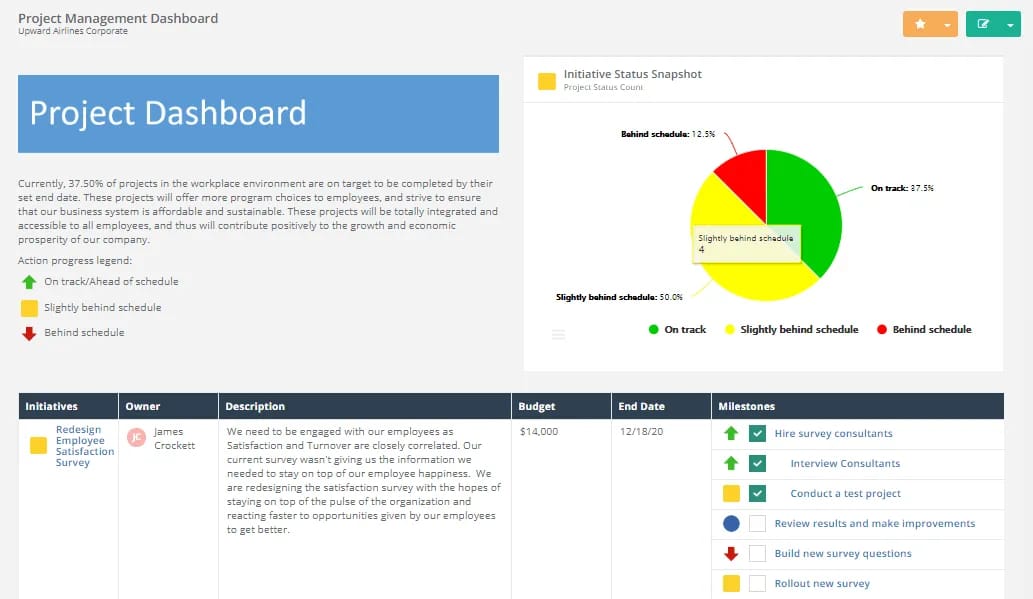
Other ways ClearPoint improves the project budget management process:
ClearPoint Turns Numbers Into Visuals and Makes Data Easier to Consume and Interpret
Dashboards go beyond reporting information. They organize it and evaluate it automatically. A budget vs. actual dashboard visually compares an initiative’s projected budget with the actual amount spent on the project thus far.
Project budget dashboards clarify various aspects of budgeting, including a comparison of actual vs. budgeted costs of one or more project(s) and a continuously updated forecast of final project cost. (ClearPoint also gives you the ability to make custom charts so you can track what you like!)
ClearPoint dashboards also include status indicators so you can see at a glance if you’re staying within budget. Green arrows mean costs are within 5% of budget, yellow boxes mean they are between 5% and 15% over or under, and red arrows mean they are more than 15% off. You can drill down into any aspect of a project to get more specifics.
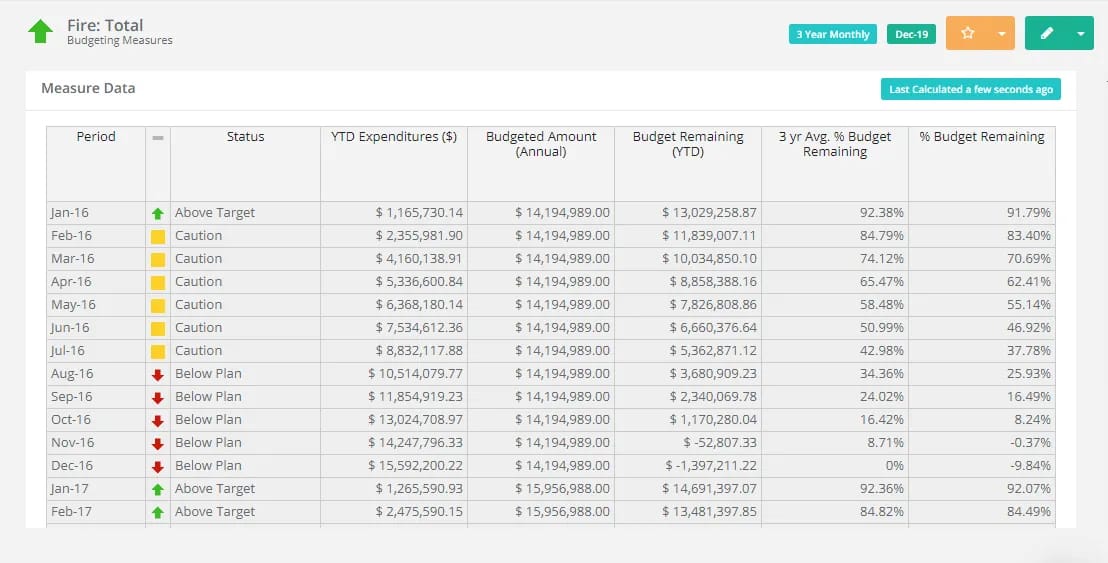
Another example of how to display budget information in ClearPoint’s project management software is shown in the project budget dashboard below. It displays the current spending to one-year average, and shows year-to-date expenditure compared to the organization's historical spending pattern.
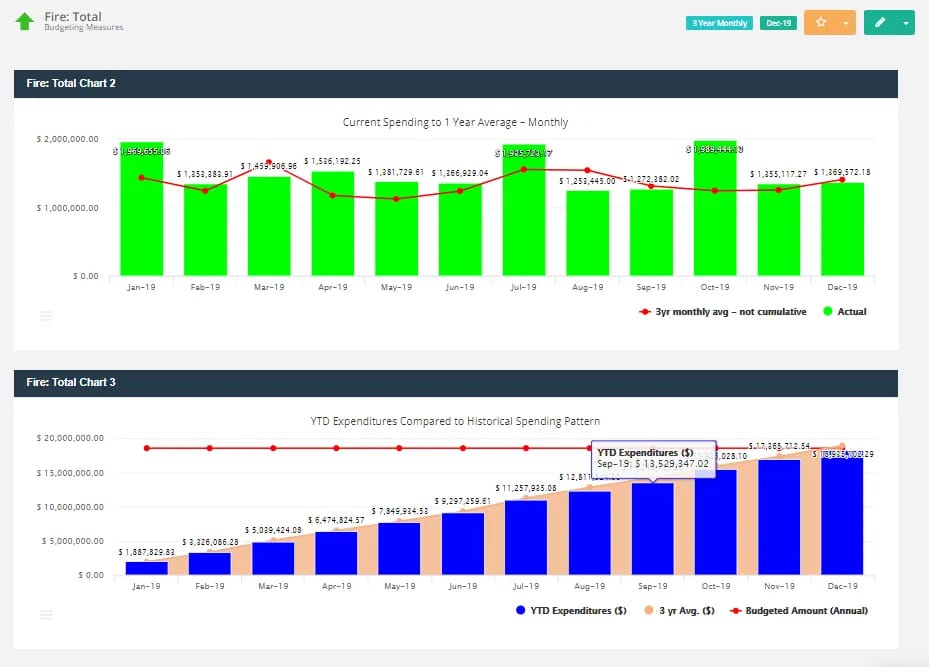
Project managers and finance departments can use dashboards and charts to see how well projects are staying on budget, and how that may impact the company’s budget for all projects.
ClearPoint Simplifies the Data-Gathering Process
All project budget management software solutions help manage your strategy in certain ways, but the best software also saves you time.
ClearPoint automates various aspects of budget tracking and reporting to make your job easier:
- It can send automatic reminders to project, measure, and goal owners with a list of what they should update, and gently nudge them a second time until they complete their work.
- It can send automatic notifications when things you own or watch turn red or off track. If, for example, your budget numbers are especially high one month, that could trigger a notification to team members or leadership informing them the project is over budget.
- It can automatically distribute PDF versions of project portfolio reports to a relevant group. (You won’t see this feature in Microsoft Project!)
Every organization wants to deliver projects successfully, and predicting project costs accurately and consistently is a big part of that. Project budget management isn’t easy, but your process will likely mature over time. Keep reviewing project results (whether projects came in under or over budget, and why) and what contributed to those results (the qualitative data mentioned above). You’ll get better at allocating project funds accurately.
ClearPoint can help you develop a more sophisticated approach to budgeting. It shows your projects in relation to organizational goals, and it gives you the support you need as a project manager to track and report on budgets (and other aspects, too) in a way that works for you.
Take Control of Your Project Budgets with ClearPoint Strategy Software!
Ready to simplify and enhance your project budget management? Book a demo with us today and discover how ClearPoint Strategy can transform your budgeting process. See firsthand how our intuitive dashboards, automated reminders, and comprehensive reporting features can help you keep projects on track and aligned with your organizational goals.
See how ClearPoint tracks your projects and initiatives — book a demo
Common questions
What is project budget management?
Project budget management is the process of estimating, allocating, and controlling the costs associated with a project. It involves planning the budget, tracking expenses, and ensuring that the project stays within the approved financial limits. Effective budget management helps in avoiding cost overruns and ensures that resources are used efficiently.
How do you budget project management?
To budget project management:
- Define Scope: Clearly outline the project scope and deliverables.
- Estimate Costs: Break down the project into tasks and estimate the costs associated with each task, including labor, materials, equipment, and overheads.
- Create a Budget Plan: Compile the estimated costs into a comprehensive budget plan.
- Include Contingencies: Add a contingency budget to account for unexpected expenses.
- Allocate Resources: Assign budget allocations to different tasks and phases of the project.
- Review and Approve: Have the budget reviewed and approved by stakeholders or management.
How do you manage a budget in project management?
To manage a budget in project management:
- Monitor Spending: Regularly track and record actual spending against the budget.
- Use Software Tools: Utilize project management software to monitor expenses and generate financial reports.
- Adjust Allocations: Make adjustments to budget allocations as needed based on project progress and changes.
- Control Costs: Implement cost control measures to prevent overspending.
- Report Progress: Keep stakeholders informed about the budget status through regular financial reports.
- Analyze Variances: Identify and analyze any variances between the planned and actual budget to understand causes and take corrective actions.
What is a project budget in project management?
A project budget in project management is a detailed financial plan that outlines the estimated costs associated with all the tasks and activities required to complete a project. It includes all direct and indirect expenses, such as labor, materials, equipment, and overheads, and often includes a contingency reserve for unexpected costs.
Why is a budget important in project management?
A budget is important in project management because:
- Financial Control: Provides a framework for managing and controlling project costs.
- Resource Allocation: Ensures that resources are allocated efficiently and effectively.
- Performance Measurement: Allows for tracking of actual spending against the budget to measure financial performance.
- Risk Management: Helps identify financial risks and includes contingencies to mitigate them.
- Stakeholder Confidence: Builds confidence among stakeholders by demonstrating that the project is financially viable and well-managed.
- Decision Making: Informs decision-making processes by providing a clear picture of the financial aspects of the project.