Strategy sets the outcome; tactics are the owned, time-bound work that delivers it. A side-by-side table, examples by sector and what ClearPoint platform data shows.
- Give every tactic one named owner and an end date. Initiatives with a named owner are completed 21.5% of the time, against 8.7% without.
- Link every tactic to an objective before the plan is adopted. An unlinked tactic can finish without anyone knowing whether the strategy moved.
- Name an owned initiative before adding another KPI to an objective. Accounts already track 5.7 measures but only 1.9 initiatives per objective.
- Review strategy quarterly and tactics monthly, side by side. If initiatives finish on time but the KPI stays flat, revisit the tactic or the measure.
- Structure your plan with the ladder in this guide's roll-up section. Goal, measure, initiative, then milestones and action items, each with an owner and a date.
Strategy vs. tactics, in one sentence each: strategy is the set of outcomes an organization commits to over three to five years, and the choices about where to focus to reach them. Tactics are the specific, time-bound actions that deliver those outcomes, each with an owner, a start date and an end date.
In a strategic plan, strategy lives in your goals, objectives and the measures that track them. Tactics live in initiatives, milestones and action items. If a tactic isn’t connected to an objective, you can finish it and still not know whether the strategy moved.
Take a typical planning retreat. By lunch, everyone agrees on five goals. By three o’clock, the whiteboard holds forty to-dos, and nobody can say which goal each one serves. I’ve heard people in all types of organizations argue about strategy vs. tactics during strategy implementation. Here is how to keep the two straight.
What’s the Difference Between Strategy & Tactics?
In short: strategy decides what you’re trying to achieve and why; tactics decide what you’ll do, by when, and who owns each piece.
Strategy vs. Tactics at a Glance
| Dimension | Strategy | Tactics |
|---|---|---|
| Question it answers | What outcome are we after, and why this one? | What will we do, by when, and who owns it? |
| Time horizon | 3 to 5 years | 6 to 12 months |
| Lives in your plan as | Goals, objectives and measures (KPIs) | Initiatives, milestones and action items |
| Who owns it | Leadership team, city manager or board | One named owner per tactic |
| How it is measured | KPIs against targets (e.g., resident satisfaction, cost per service) | Milestones hit, percent complete, budget used |
| Review cadence | Quarterly | Monthly |
| How often it changes | Rarely, at a plan refresh | Often, as results come in |
| Typical failure | A plan nobody executes | Busy work that doesn’t move the goal |
| Example | Improve resident confidence in city services | Publish a community performance dashboard by Q2 |
What Is a Strategy?
A strategy is a set of long-term choices about where an organization will focus, which outcomes it will achieve and how success will be measured.
What’s a Good Strategy?
A good strategy is actionable and well-structured. It should include goals, objectives, measures, projects, and tactics, with definitions of and a purpose for each element. (I advise strategic teams to gather input from across the organization to ensure there’s alignment between the strategy and each department’s priorities.)
After defining a good strategy, I inevitably get asked what a bad strategy looks like. A bad strategy isn’t thoughtful about each element (goal, objective, measure, etc.), so when different teams or groups work on various aspects of the strategy, efforts and results are inconsistent. You want the “objectives” in each department to be very specific and aligned with your strategy. Here is an example from a local government organization:
Good Department Objectives:
- Reduce expenses by 35%
- Increase resident satisfaction with permitting experience
- Process applications within 5 days of receipt
Bad Department Objectives:
- Evaluate, select, and deploy a new CRM system
- Get resident feedback on new road designs
- Design a new dog park system
Notice that the first example is pointing to a set of outcomes that are well-defined and give the department flexibility in how they achieve those outcomes; whereas the second example is a set of projects that don’t clearly define what success looks like.
How Many Objectives Should a Strategy Have?
Fewer is usually better. In ClearPoint platform data, plans with 21 or more objectives complete 9.1% of their initiatives, against 11.8% for plans with 1 to 10. Every extra objective spreads the same people across more tactics, and the tactics are where the work happens. See the data on the ideal number of strategic objectives.
What Is a Tactic?
A tactic is a specific, time-bound action that moves one strategic objective forward. It has a named owner, a deadline and a budget. In most strategic plans, tactics appear as initiatives or projects linked to an objective and tracked with milestones.
What’s a Good Tactic?
A tactic has a clear purpose that aids your strategy. It has a finite timeline during which specific activities will be completed and their impacts measured.
A furniture company could have a goal to decrease prices for customers by decreasing cost through waste and inefficiencies. The tactics to help accomplish this could be to analyze manufacturing processes and execute on 3 areas for cost reduction. The company can clearly measure the success of the tactics by comparing their costs before and after the cost reduction exercises.
From my experience, creating a “bad” tactic depends on how you are communicating the work, and how much work is dependent on individuals versus teams. If you are implementing a project with clear steps and outcomes, detailed tactics might be needed. If you are launching something new, detailed tactics can prevent you from having the flexibility to adapt on the fly.
For example, you want really specific tactics for changing out the uranium rods in a nuclear power plant, but you need less defined tactics for starting an employee referral program.
The rule of thumb I use for understanding the difference between strategy and tactics is: “Think strategically, act tactically.”
Which Comes First, Strategy or Tactics?
I always advise your strategy to come before your tactics. Without a clear strategy, tactical efforts tend to be disjointed because they aren’t aligned with a coherent goal.
A strategy without tactics won’t ever be executed or help you achieve your goals.
The order isn’t one-way after that. Tactical results are the evidence you use to revise the strategy. If an initiative finishes on time and the objective’s KPI doesn’t move, either the tactic was the wrong lever or the KPI is measuring the wrong thing.
Be thoughtful about how often you revisit the strategy to make sure the tactics still fit. If you’re a U.S. energy company moving to green power, broader trends in energy use can confirm the transition while also telling you not to decommission your current supply at the same pace. Tactical decisions can be adjusted more often, in response to day-to-day operations or to how well the current strategy is working.
How Tactics Roll Up to Strategy in a Real Plan
Common planning frameworks use the same ladder, even when the labels change. GOST (goals, objectives, strategies, tactics) and OGSM (objective, goals, strategies, measures) both separate the outcomes you want from the activities that deliver them. In strategic planning software, the ladder usually looks like this:
- Goal or objective: the outcome, for example “improve resident satisfaction with permitting.”
- Measure (KPI): how you’ll know it’s working. See 18 KPI examples.
- Initiative: the project you fund to move the measure. This is usually what a plan means by a “tactic.”
- Milestones and action items: the steps inside the initiative, each with an owner and a date.
What the platform data shows. In ClearPoint’s platform snapshot of October 1, 2026, active customer accounts track 5.7 measures but only 1.9 initiatives for every strategic objective. At the median account, it is 4.2 measures and 1.4 initiatives. Across the platform, that is about three measures for every initiative.
ClearPoint platform snapshot · October 1, 2026
About three measures for every initiative
At the median account: 4.2 measures and 1.4 initiatives per objective.
Here’s my position: when a team asks me to add a KPI to an objective that has no owned initiative, I ask them to name the initiative and its owner first, and I hold the KPI until they can. Across the platform, organizations already track about three measures for every initiative. Another measure makes the objective easier to watch, but it doesn’t make anyone responsible for improving it.
Who Owns Strategy and Who Owns Tactics?
The leadership team owns the strategy, and every tactic needs one named person accountable for delivering it. ClearPoint platform data shows how much that second half matters:
- ClearPoint shows which objectives still need a named owner. The objective sits in the plan, but nobody is accountable for moving it.
- Initiatives with a named owner are completed 2.5× as often. They were completed 21.5% of the time, against 8.7% when no one was named.
ClearPoint platform data · 2017–2024
Get the full Strategic Planning Report: over 20,000 plans analyzed ›
If you run the quarterly review, ask one question of every tactic on the list: whose name is on it?
My read after 25+ years of this work: plans stall at the handoff from strategy to tactics. A tactic leaves the planning meeting without a person, a date or a check-in on the calendar, and it quietly stops moving.
Strategic vs. Tactical Planning: What’s the Difference?
Strategic planning decides an organization’s goals, objectives and measures for the next three to five years. Tactical planning turns each objective into initiatives with owners, dates, milestones and budgets for the coming year. In local government, the strategic plan is adopted by council, and tactics usually live in the annual plan and budget.
Operational planning is a third layer: the recurring work that keeps services running day to day. Here is how strategic and operational planning differ.
See strategy and tactics in one live plan — take the instant tour
Examples of Strategy vs. Tactics
Local Government

In local government, accountability and responsiveness are cornerstones of good governance, so I often see an overarching goal to improve transparency.
Your strategy: Improve transparency throughout the organization in order to increase collaboration and teamwork and improve resident confidence that the city is working effectively.
Your tactics:
- Set up cross-department groups in Microsoft Teams to encourage collaboration.
- Create and publish a new community dashboard to inform residents about government goals and share progress.
- Hold regular virtual town hall meetings, and post the recordings with a short summary.
Note: In local government, most tactics show up in annual plans versus strategic plans. Link activities and funding requests (budget) in annual plans to key items in the strategy. That way, as your strategy evolves, so will your tactics. For more, see our guide to aligning public sector plans and budgets.
State Agencies
Your strategy: Reduce the time it takes to deliver a core service, such as issuing a license or determining eligibility for benefits.
Your tactics:
- Map the current process and remove the approval steps that don’t change the outcome.
- Publish a public turnaround-time measure and report it monthly.
- Assign one owner to each bottleneck, with a 90-day deadline.
Education

Most school systems are working to improve learning outcomes, often measured through standardized test scores.
Your strategy: Improve student engagement by incorporating interactive technology into classrooms.
Your tactics:
- Purchase and implement SMART systems in your classrooms for the upcoming school year.
- Train teachers to use the SMART systems in their lessons.
Healthcare

Many healthcare organizations face problems with hospital capacity: The demand for patient beds exceeds the supply.
Your strategy: Improve patient flow to free up beds more quickly in order to meet increased demand.
Your tactics:
- Implement a scheduling app to optimize OR time and move patients through the flow more quickly.
- Invest in analytics to understand capacity constraints and forecast demand.
- Introduce telemedicine for post-operative and follow-up care, saving time and resources for patients and the hospital.
Download the Strategy Execution Toolkit — build your strategy map and scorecard step by step
How to Track Your Strategy & Tactics
I strongly advise reviewing both on a set cadence: strategy quarterly, tactics monthly.
How to Measure Strategy
To track your strategy, choose key performance indicators (KPIs) that use quantifiable data to show progress. If your strategy is to increase customer satisfaction, for example, a net promoter score (NPS) could be the KPI.
How many measures per objective? Our platform data points to a middle band. Plans with 4 to 8 measures per objective complete 15.1% of their initiatives, against 10.1% for plans with 3 or fewer. With too few measures, nobody can tell whether the tactics underneath are working.
Remember to set targets that specifically detail your KPIs and break them down into achievable timeframes. (Here’s an article I wrote that explains how to do that.)
How to Measure Tactics
Tactics are tracked through their plan: a start and end date, allocated resources, and the milestones and action items that get the work done. Hold people accountable by always assigning an “owner.” If you’ve allocated budget to a tactic, track how it’s being used and how much remains. Tactics can also be tied to related OKRs or KPIs.
Review Strategy and Tactics Together
Whatever the cadence, look at both on the same page, so the meeting can see whether on-schedule initiatives are moving the objective’s KPI. For a broader starting point, see our beginner’s guide to strategy execution and our guide to OKRs.
See Strategy and Tactics on One Page
You can keep strategy and tactics straight in a spreadsheet for about a quarter. After that, the links break, owners change, and the review meeting turns into archaeology.
ClearPoint keeps both on one page. Every objective carries its KPIs. Every tactic carries an owner, a date and a status. The reports refresh before the meeting starts. Book a free demo and we’ll show you your own plan in it.
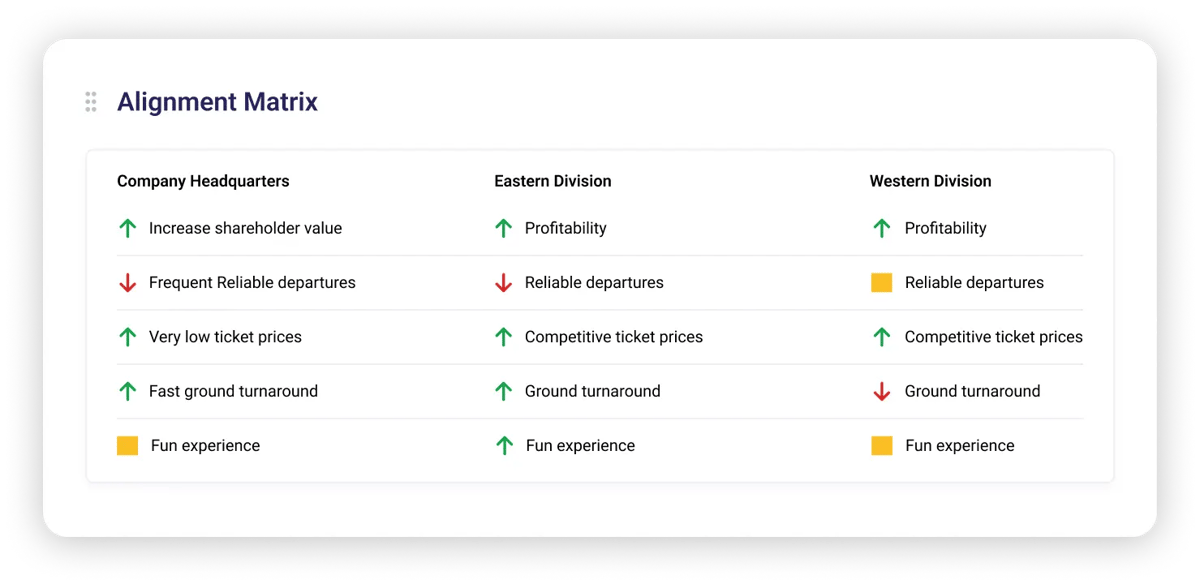
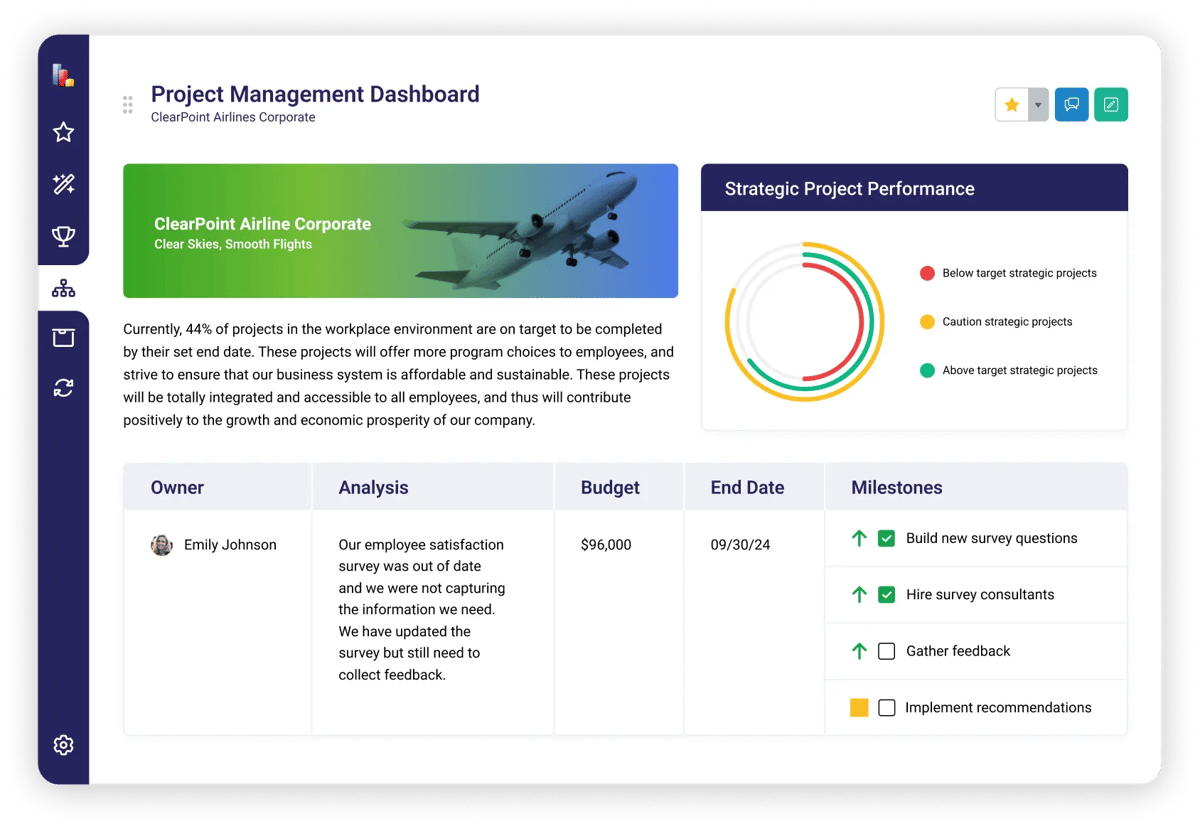
The summary report above shows the alignment between goals and tactics, with status indicators (green, yellow or red), qualitative analysis, tactic owners, percent complete and end dates.
Common questions
Is a project like “deploy a new CRM” a strategy or a tactic?
It is a tactic. Ask whether the item has an end date: if it does, it belongs in the tactic layer as an initiative, linked to the objective it serves. The strategy is the outcome the CRM should improve, such as faster permit processing or higher resident satisfaction, and a KPI tracks whether that outcome moves.
What should we do when initiatives finish on time but the KPI doesn’t move?
Treat it as evidence, not success. Either the initiative was the wrong lever or the KPI measures the wrong thing. Raise it at the quarterly strategy review, decide which one it is, then replace the tactic or redefine the measure. Reviewing strategy and tactics on the same page makes this gap visible early.
How many initiatives should each strategic objective have?
At least one, with a named owner, a start date and an end date. In ClearPoint’s October 2026 platform snapshot, organizations track 1.9 initiatives for every strategic objective. If an objective has KPIs but no owned initiative, a red result leaves the review with nothing to adjust, so name the initiative and its owner before adding another measure.
Can a team own a tactic, or does it need one person?
Name one person. A team can do the work, but one named owner should be accountable for delivery and updates. In ClearPoint platform data, initiatives with a named owner are completed 2.5× as often as those without one. At each quarterly review, ask one question of every tactic on the list: whose name is on it?
Should tactics go in the strategic plan or in the annual plan and budget?
In local government, usually the annual plan and budget. Council adopts the strategic plan with goals, objectives and measures for three to five years; tactics then appear as initiatives and funding requests in the annual plan. Link each budget request to the objective it serves, so tactics can change as results come in without reopening the adopted plan.