Ten traits. One that actually predicts whether your strategy gets executed. What over 20,000 plans reveal.
- Open each review on the red measures. A blank status is unexamined, not green; ClearPoint shows which measures still need a live status.
- Cap each objective at three measures. Plans under three measures per objective get scored 48.9% of the time, versus 15.7% at twelve or more.
- Link each objective to the two or three projects that move it. Zero objectives get scored by 73% of non-linking leaders versus 14% of linking ones.
- Ask owners what they would stop to keep a measure current. ClearPoint shows which named owners haven't logged an update yet, so teams can follow up before the review.
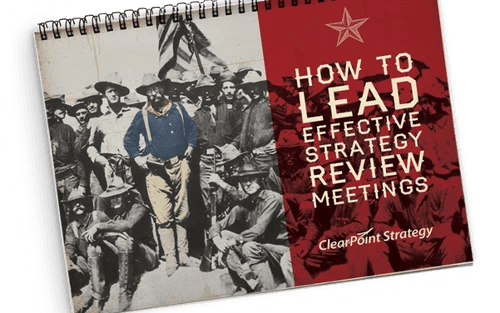
- Run every review with the strategy review meetings guide. Open on red, keep it to an hour, and leave with owners and dates.
It's Tuesday, 9 a.m. The strategy review is on the calendar. The dashboard is built, the targets are set, the owners are assigned. And ClearPoint shows which of those owners haven't updated their number yet, so the team can follow up before the review.
This article is about the gap between the leader a plan describes and the leader it gets.
Every list of strategic leadership characteristics gives you the same ten things: communicate, listen, stay positive, be humble. They are all true, and they are on every other page that ranks for this search. So we looked at over 20,000 strategic plans, 31.2 million rows of execution data from 2017 to 2024, and asked which of these ten traits separate the plans that run from the rest.
The answer reorders the list.
Most strategic plans don't fail in the strategy. They fail on a Tuesday.
Before we rank the traits, one number sets the table.
Across the 20,000+ plans, initiatives with a named owner are completed 2.5x as often: 21.5% vs. 8.7%. High performers get three-quarters of their projects done or better. The difference is whether someone keeps the plan alive between kickoff and the finish line.
Ownership and completion
Initiatives completed, with and without a named owner
Source: ClearPoint platform data · 2026 Strategic Planning Report · over 20,000 plans analyzed, 2017–2024.
So when we talk about strategic leadership "characteristics," we mean who puts a name on the work and pushes completion higher, not who inspires the room. Here are the ten traits, reordered by what the data can see.
The three traits our data can actually measure
1. Honesty — specifically, the nerve to look at red
Every list says honesty matters. Here is what it costs a strategic leader.
Across the dataset, ClearPoint shows which measures have a live performance status and which are still blank. Skipping the on-the-record "here's how we're actually doing" is the easy path.
That is a courage problem, not a data problem. Marking something red means owning it in the room on Tuesday, so leaders leave it blank. Blank feels safer than red.
Accountability, on the record
What ownership and focus change
with an owner
Blanks aren't green. They're unexamined.
Source: ClearPoint platform · 150+ organizations · 2026.
The leaders whose plans survive do the opposite. They open the review on the reds and let the greens wait.
You can see this in the open. Germantown, Tennessee, a 2019 Baldrige National Quality Award winner and a ClearPoint customer, publishes its strategic scorecard where residents can see it, progress and shortfalls alike. Its neighbor Bartlett does the same. Showing the work in public is the surest sign of a leader who runs the plan.
The move: in your next review, spend the first ten minutes only on what's off-track. Ban the green victory lap until every red has an owner and a date.
2. Focus — the discipline to track less
Passion gets the press. Focus does the work.
When a plan tracks fewer than three measures per objective, it gets scored 48.9% of the time. Load it with twelve or more, and scoring collapses to 15.7%. The plans that stay alive run a median of 2.2 measures per objective. The others run 5.9.
Focus predicts follow-through
The fewer measures per objective, the more the plan gets used
% of measures given a performance status, by measures-per-objective
Source: ClearPoint platform · organizations with 20+ measures and 3+ objectives · 2026.
More metrics feel like more rigor, but they work against it. Every measure you add is a measure someone has to update, forever. A leader's job is to decide what not to track.
The move: cap each objective at three measures. If a fourth matters more, something else comes off.
3. Collaboration — connect the strategy to the work
On most lists, collaboration means "be a team player." Ours means something you can measure: whether the strategy connects to the projects underneath it.
Leaders who link their objectives to the work get scored far more often. Among those who don't link, 73% score zero objectives at all. Among those who do, the figure is 14%. That is a five-fold gap.
The linking keystone
Connect each objective to the projects that move it
Connecting strategy to the work with dependencies is the structural link that makes the difference.
Source: ClearPoint platform · 153 local governments · 2026. Correlation, not causation.
The plan sits in one place. The work happens in another. Nobody can see the thread between them.
The move: draw one strategy map: one objective, connected to the two or three projects that move it. That single link does more than anything else on this page.
The communication cluster
4. Strong communication
Now the traits everyone agrees on, starting with the one that's non-negotiable.
For a strategic leader, communication means your team can name the strategy without opening a file. When Bartlett, Tennessee built "Bartlett Vision 2030," their Chief Administrative Officer, Steve Sones, described the old problem plainly: departments working in silos, each carrying its own version of the plan. The fix was one shared picture of the strategy that everyone could point to. They built it in 13 months.
The move: if your team can't state the top three priorities from memory, the plan isn't communicated. It's just written down.
5. Good listening
Listening is where the reds come from. The strategy review meeting is the one hour a month when the people closest to the work tell you what the dashboard can't. A leader who talks through the whole review learns nothing new. A leader who asks what's blocked, what changed, and what people need hears the problem while it's still small.
The move: in the review, ask before you tell. The owner of a red number knows why it's red. Let them say it first.
6. Diplomacy — and its limit
No list admits that diplomacy and honesty pull against each other.
A leader who softens the red on a failing initiative so the board stays comfortable is trading execution for comfort. We can see the cost. The plans that get scored are the ones run by people willing to make the room slightly uncomfortable. Diplomacy gets you into the conversation. Honesty is what makes the conversation worth having.
The move: be gracious about people, blunt about numbers. Never blend the two.
The human traits — and where the data goes quiet
Four traits are left. Our platform can measure completion, ownership, and links. It cannot measure a heart. So here we'll be honest about where the data stops.
7. Positivity — handle with suspicion
"A positive attitude is contagious," every article says. So is a stalled plan.
Positivity, left unchecked, is how reds quietly become blanks. Chasing green is pleasant and mostly useless, because a missing status isn't green. It's unexamined. The leaders who execute are the ones who can sit with a red number without flinching, not the sunniest people in the building. Be optimistic about the mission and realistic about the metric, in that order.
8. Passion and commitment — measured in month nine, not month one
Everyone's committed in January: 26.9% of all projects start that month. Then December comes, and 27.8% of them end, many because the year ran out rather than the work finished.
Commitment shows when the owner still updates the number in month nine, after the novelty is gone and the dashboard has gathered dust. ClearPoint shows which owners have stopped, so someone can follow up. Passion that doesn't survive to autumn was enthusiasm, not commitment.
9. Empathy
The data can't see empathy directly, but it can see its shadow.
When an owner never touches the elements they're assigned, that's rarely laziness. It's usually a leader who assigned work without asking whether the person had the time, the tools, or the authority to do it. Empathy, in operational terms, is not quietly overloading the people who carry your plan.
The move: before you assign an owner, ask them one question: "what would you have to stop doing to keep this current?" If they can't answer, you've found your next phantom owner.
10. Humility
We can't measure humility, but we can measure its absence.
A leader who won't mark red, cut a metric, or admit the plan grew too big is not showing confidence. That plan is on its way to drifting. Humility sits underneath the other nine traits: the willingness to be corrected by your own numbers, every Tuesday, in front of your own team.
Where all of this happens: the strategy review
Many of these traits play out in the same room. Honesty, listening, diplomacy, and focus show up in the strategy review meeting, not in a personality test. That hour is where a good strategic leader is made, or quietly unmade.
The habit with the highest return on this page is to run the review well. Our short guide covers how to open on red, keep it to an hour, and leave with owners and dates instead of good intentions.
Get the guide to leading effective strategy review meetings
The bottom line
Strategic leadership is a set of small, unglamorous choices, repeated every Tuesday, in front of a dashboard most people would rather close.
The ten traits are real. A good strategic leader is the one whose strategy is still alive in month nine, because they had the nerve to look at what wasn't working and the discipline to keep it small enough to fix.
The plan is a promise. Leadership is keeping it.
Common questions
What are the characteristics of a strategic leader?
The ten most-cited characteristics are strong communication, good listening, passion and commitment, positivity, innovation, collaboration, honesty, diplomacy, empathy, and humility. But in ClearPoint's data on over 20,000 strategic plans, three of these predict execution more than the rest: honesty (specifically, the willingness to mark and address red), focus (tracking fewer measures per objective), and collaboration (linking strategy to the underlying work).
What is the most important trait of a strategic leader?
Accountability to red. Across over 20,000 plans, ClearPoint shows which measures still need a performance status and which owners haven't logged an update yet. The leaders whose plans get executed are the ones who face what's off-track instead of leaving it blank. It's the trait most correlated with a plan that's still alive a year later.
Can strategic leadership be learned?
Yes. Most strategic leadership is behavior, not temperament — how you run a review, how many metrics you keep, whether you connect strategy to work. Those are habits, and habits are teachable. The soft traits like empathy and humility are harder to install, but the execution-critical ones are almost entirely learnable.
Where does the data in this article come from?
From ClearPoint's proprietary platform: an analysis of over 20,000 strategic plans and 31.2 million rows of execution data spanning 2017 to 2024, plus current platform data across 150+ public-sector organizations. Completion, ownership, and scoring figures are measured directly. "Never updated" refers to owners with zero recorded updates; "given a performance status" refers to elements with an active evaluation status.
How do strategy review meetings develop strategic leadership?
The review meeting is where most of these traits become visible: honesty (facing red), listening (hearing owners), focus (keeping the agenda short), and diplomacy (handling people while being blunt about numbers). A leader who runs a disciplined monthly review is practicing eight of the ten traits at once. It's the single highest-leverage habit for building strategic leadership.