How online engagement, 311, social media and reporting software help local governments share performance data and build citizen trust.
- Link each budget item to the long-term goal it supports. Charting spending over time with plain explanations shows residents their taxes are well managed.
- Pair every published number with what the city is doing about it. Raw data dumps overwhelm residents who do not work in performance management.
- Post reports online where residents can reach them in a few clicks. A report hidden 15 clicks deep does not convey transparency.
- Ask residents to rate both satisfaction and importance for every service. Satisfaction acts as a lagging indicator; importance shows where to put resources next.
- Pick public measures from the free local government KPI library. Then publish them on a community dashboard tied to your strategic plan.
Local government transparency has become a widely discussed topic. City and county leaders know that to be effective, they need to be as open with their citizens as possible. The hard part is how: building a culture of openness and giving residents clear visibility into strategic outcomes.
According to a recent Deloitte study, one of the key drivers of trust in state and local government is a government’s digital capabilities: Individuals who are pleased with a government’s digital services tend to rate that government highly in measures of overall trust. For local government, that means the simpler it is to find information and interact with municipal leaders online, the more likely citizens are to view those leaders as competent, reliable, and trustworthy.
Technology can help with that.
Many good tech tools can improve the online experience your municipality offers residents, whether the goal is to collect citizen feedback, provide access to services, or share performance data. In this article, we cover technologies that can improve your online services, plus two other considerations that affect transparency and trust.
ClearPoint Strategy provides a platform that helps municipalities improve transparency by simplifying strategic planning, performance tracking, and data management. With ClearPoint, local governments can create user-friendly reports, dashboards, and data visualizations that make it easier for citizens to access and understand important information.
8 Technologies To Improve Local Government Transparency
1. Online Citizen Engagement
Technology has made it easier than ever for citizens to participate in open discussions with municipal leaders. If a citizen can ask the mayor a question online from home after hours, for example, that saves them a great deal of time and effort.
A couple of technology solutions make this easier. OpenGov’s Open Town Hall, for example, offers several product offerings for municipalities to engage their citizens in this way.
2. Neighborhood Networks
Indianapolis, Indiana uses a program called My Neighborhood. It is an interactive map that lets citizens find the government services nearest to them, from libraries and fire stations to bus routes, youth shelters, hospitals, and more.
Nextdoor is another unique network for transparency and citizen engagement. It brands itself as a private social network neighborhood and allows users to create accounts and post classifieds, participate in communication threads, look at crime watches, and more. Promoting or using these services may encourage your citizens to be more involved in their communities and help your municipality stay on the leading edge of technology.
3. Online 311 Software
Citizens need a forum to submit requests and complaints, and ask questions. Customer service “311” phone lines used to handle these nonemergency calls. Today, those services come as software applications, and 311 software has become very popular. Residents use it to report a wide range of issues, from leaking hydrants to potholes to graffiti to noise complaints.
Some of the top 311 software applications are:
311 systems help governments find and fix problems before they get too big, and they give residents a voice. Many modern 311 systems are also cloud-based and capture a lot of data, which you can use to set performance goals. For example, if the department of public works guarantees they’ll fill newly reported potholes within 72 hours, such metrics can be tracked for accountability and shared with the public online.
Get the ebook of 142 local government KPIs
4. Social Media
Social media platforms are low-cost tools for local government transparency. Municipalities can use them to share information, gather citizen feedback, and gauge public sentiment.
When cities are engaged, residents notice. They’ll learn quickly that your municipal Twitter account gives them a steady, useful stream of information, including the latest weather updates, road closures, citywide events, and even local news. You can also publish informational links related to public meetings, financial reports, or budgets.
Sharing information freely builds trust, but communication is a two-way street. Encourage people to provide feedback on certain topics or initiatives, and to show up at city council meetings. Respond to the questions and concerns people raise on social media. The more interactive your accounts are, and the more human your presence (in both the literal and broader sense of the word), the more satisfied people will be.
5. Web Presence & User Interface
A lot of municipal websites are painfully outdated. The look and feel are behind the times, and the user interface (UI) is often poorly thought out. That hurts transparency. If someone has to spend a long time digging through their city’s website to find what they need, they’ll feel the municipality has let them down.
Citizens need to see that you’re putting the information they want where it is natural and easy to find. (We recommend taking a look at govAccess and Civic Plus, two municipal-focused website providers.)
Note: So much web browsing happens on a smartphone or tablet that your website must be responsive. Your programmers or IT department should be able to help you integrate a web design that works on any kind of device.
6. Balanced Scorecard & Reporting Software
Download the balanced scorecard Excel template
Municipalities can use report generation software to create data-driven, visual reports that can be distributed across different channels for both internal use and citizen interaction and engagement. There are many options on the market, including our own reporting software, ClearPoint, which is used by numerous local governments. (Some of our local government case studies are below.)
Note: Being transparent doesn’t mean gathering all of your data from reporting software and dumping it online. That approach asks a lot of your citizens. A better alternative is something we call strategic transparency, which we cover in the information-sharing section below.
7. Stat Programs
Stat programs are performance measurement tools that focus on data analysis. They have become popular among local governments and help drive performance and innovation. You can also think of Stat as a way of managing rather than a particular technology.
Several different companies can help you manage a Stat program in your city. If you want to learn more about Stat programs in local government, we suggest looking at these two municipal examples:
See Also: Stat Programs Aren’t Just For Sports Fans
8. Community Dashboard
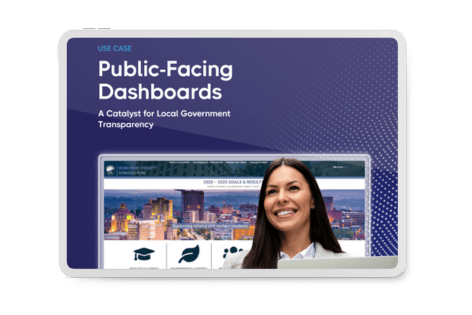
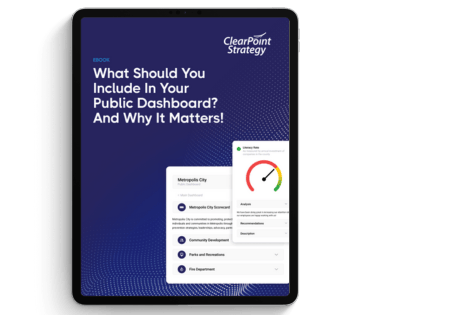
A community dashboard is one way your city can become more transparent, and ClearPoint Strategy can help you build one. It gives your municipality a way to tell the story of how you’re executing your strategic plan.
This article explains why community dashboards matter and how each part of one can increase municipal transparency.

Arapahoe County in Colorado created an online performance management dashboard so citizens can dig into the details of performance as related to finances, service, and quality of life.
Keep This In Mind...
Some citizens prefer to be involved in a more hands-on way. For them, hold public forums or town hall meetings to bridge the gap. These meetings should offer a review of your strategic “big picture” and key initiatives, as well as a candid look at your shortfalls.
Other Ways To Improve Local Government Transparency
Using one or more of the tools above will go a long way toward improving your citizens’ online experience and building trust. You also need to consider how to share and gather information in a manner that is fully transparent.
The next two sections cover two other ways to build relationships with residents and increase transparency in local government.
Transparency In Information-sharing
In any municipality, citizens are curious about certain things.
- “Why do we need another 1% sales tax increase?”
- “Are we running on a budget surplus or deficit?”
- “Our motto is ‘The Safest City’—what are we doing to make our city safer?”
From taxes to budgets to city-wide goals, residents want to understand why local officials make certain decisions and how they allocate city funds.
As these requests become more common, local governments need to share more data with their citizens. Often, this information is shared in the form of a strategic or departmental report.
Sharing these reports with your citizens is a good idea for many reasons, and they all come down to transparency. Locals are saying, “I’m a tax-paying member of this community—and I want to know where the money is going.” And these requests are both straightforward and fair.
The reports also help people looking to relocate to the area, not only current residents. These documents help them understand how funds are being allocated, offer a better idea of what the community is like, and show whether local services are modern and competitive.
Those seeking this report want to know that the fund pool they are contributing to is well-managed.
What Should You Report On?
To demonstrate you’re managing things wisely and appropriately, report on these three things:
Your Strategic Plan
This is simple if you have one in place. If you don’t, it’s time to create one. Every municipality should have a strategic plan that is both clear and manageable. (For more on how to create a strategic plan, read this article, which covers the topic thoroughly.)
Strategic performance management entails defining your long-term goals and creating a clear plan to achieve them. For example, you may create a number of projects that allow you to track quantitative progress toward a particular part of your citywide goal.
Every municipality should monitor strategic performance and track citywide progress. If you don’t communicate the results to residents, though, the process holds far less value. Current and prospective citizens and business owners want to understand:
- Is the city organized?
- Is the leadership capable of executing strategy?
- Is the city well-managed?
- Are members of the leadership fiscally responsible?
When a strategic plan is added online in plain sight, citizens feel more comfortable that their local government is on target for short- and long-term growth. They can see the numbers in context, follow trends over time, and understand the municipal strategy far more easily. Performance management software helps here. Municipal leaders can create scorecards and dashboards and display the results right on their city’s website.
Read more on business strategy best practices in the ClearPoint blog
Your Operations
This aids in the “local government transparency factor,” because it allows citizens to understand which areas of the city are excelling and which are falling short of expectations.
Your Finances
Good financial management is key to realizing your community’s vision, and the budget is among the primary tools guiding that pursuit. It represents plans for the community’s future and holds local leaders financially accountable. That makes reporting on the municipality’s financial status and activities a core part of local government transparency.
Keep in mind that your goal is to provide user-friendly financial data. Traditional spreadsheets, financial statements, and other complex data sets the average person can’t make heads or tails of won’t reassure people that their tax money is being well-spent.
Instead, present your finances in connection with your strategy. Link budget items to your government’s long-term goals, clearly showing how each activity and its expenses support them. Chart your budget performance over time to demonstrate fiscal responsibility. And consider adding textual explanations alongside the numbers to tell the full story of your spending and how it’s contributing to the community’s future.
When people can clearly see that public funds are being allocated and spent in ways that will positively affect them, they’re more likely to have a positive view of government spending.

ClearPoint users can create charts like these that show city-wide costs and costs by department.
It’s not all about the numbers…
Reports should be both quantitative and qualitative. Quantitative reporting will answer questions like, “What is the crime rate?” or, “How fast is the fire and police response?” Qualitative reporting will answer, “The crime rate or fire and police response rate is X—what is the city doing to improve these results?”
3 Rules Of Thumb For Sharing Reports
1. Make the reports easily accessible
With the advent of big data, citizens expect data about their cities to be readily available. Accessible reports are easier for citizens to get, and they show a commitment to transparency.
- First, make sure your reports are online. Hard copies that are only available through mail or in-person are a thing of the past.
- Use a clean, organized format. A simply designed PDF usually works best.
- Optimize your website so citizens can easily find the reports. Hiding your reports in a deep, dark corner of your website, a place that takes 15 clicks to reach, doesn’t convey transparency.
- Share your reports on social media to build interest and get people sharing them.
2. Be sure the information you’re releasing is relevant
Residents don’t care about reports and data that are several years old. They want to know what has happened recently, on a quarterly, semi-annual, and annual basis.
The reports you publish will likely also be read by prospective businesses looking to move to your municipality, peers in nearby towns, those in municipalities across the country, and more. Write your strategic reports for that broader audience.
3. Make sure the information is digestible
Some municipalities believe that publishing loads of data sheets online (i.e., “data dumping”) is useful. The Open Data Index defines open knowledge as “any content, information, or data that people are free to use, reuse and redistribute—without any legal, technological or social restriction.” They stress that “open knowledge is what data becomes when it’s useful, usable and used” and explain that the data “must be available as a whole” for it to be considered open.
For the average citizen, that is often too much information to digest. Publishing data online in any format is a step in the right direction, but whether that data builds transparency and citizen trust is an open question.
We’ve found that transparency works best when citizens can read the information in an accessible format, because your citizens don’t all work in performance management or municipal government. They want to know where their tax dollars are going, how safe their city is, and more generally, how well the city is performing. Wading through a pile of data to figure this out is frustrating and time-consuming.
3 Examples Of Local Government Transparency Using ClearPoint Strategy Software
Local governments that use ClearPoint manage and track their strategic plans and use its reporting features. Governments have the option to build public-facing dashboards or create custom reports for public consumption on the web. Either option produces clear reports that link to your strategy and give citizens the data they need to stay informed and engaged.
Here’s how three local governments are currently using ClearPoint to increase transparency:
1. Durham, North Carolina
Durham, North Carolina, didn’t have a strategic plan for many years. When the economy took a hit, they decided to implement one. Using performance management software, Durham city officials were able to create and publish their dashboard and display their strategic performance measures for citizens in an easily digestible format. This helped improve local government transparency:
“Since implementing the strategic plan, there’s been more of a collaborative effort. We’ve seen better communication between departments, a stronger partnership with the county, and more opportunities to engage with our residents.” Jay Reinstein, former Strategic Plan Project Manager (Durham, North Carolina)
2. Cuyahoga County, Ohio
Calling its performance platform “Cuyahoga Performance,” Cuyahoga County uses data to identify where the county is making progress toward goal achievement and where opportunities for improvement exist. As the site notes, “by monitoring and reporting our performance, the county hopes to increase transparency, show the impact of county programs, and engage the community in conversations about how we can achieve positive results for our community.”
Cuyahoga’s online public dashboard provides quarterly updates on five areas of focus:
- Regional Growth
- Economic Opportunity
- Individual Well-being
- Mobilize Cross-sector Resources
- Provide Superior Services
Residents can click on any of these categories to see the status of goals and measures and dive even deeper into the data in any area they wish. The information is clear and easy to digest. The communications strategy seems to be working: the county government achieved new highs in external and social media reporting in Q1 of 2022.
3. Buncombe County, North Carolina
Similar to Cuyahoga County, Buncombe County also publishes its ClearPoint data in a public-facing way, showing performance data for each of its four focus areas:
- Educated & Capable Community
- Environmental & Energy Stewardship
- Resident Well-being
- Vibrant Economy
Visitors can move between performance areas using a drop-down menu, where they can see the most recently reported results via simple gauge and column charts. Each of the county’s goals is explained, and reporting periods are identified. Its government site also includes the full strategic plan, community survey results, and recent community presentations.

For more examples of local government transparency, take a look through the websites of Vaughan, Canada, and Charlottesville, Virginia. You’ll likely walk away with a few ideas on how to connect with citizens and manage your municipal strategy.
See Winnebago County's transformation in our case study video
Transparency In Citizen Interaction
Beyond conveying information, another major part of transparency is how the city responds to citizen interaction. Usually, this interaction takes the form of citizen feedback.
Surveying
For the reasons above, sharing strategic data in reports is an important step toward visibility and transparency. You also need a way for citizens to give feedback on how you’re performing, and citizen satisfaction surveys do that well.
We spoke with Jason Morado from ETC Institute, a leading provider of citizen survey tools for municipalities, to get his thoughts. Here’s what he had to say about why citizen satisfaction surveys are important, what to include in these surveys, and more.
Why is a citizen satisfaction survey important?
You need to gauge what your constituents think about the areas your city focuses on. Before you send out a survey (or even create one), know what the survey is for and what you’ll do with the data. It’s unfair to those who spend the time answering your questions if you don’t plan on utilizing the information.
Gathering feedback at city hall meetings is one way to gauge citizen satisfaction, but it isn’t statistically valid. City hall meetings may also attract only a certain demographic (for instance, stay-at-home parents or those who have a vested interest in the topic at hand), whereas a survey can represent the feedback of your entire community.
What should be included in the survey?
Cover all the areas your municipality focuses on so you know where to dedicate your time and resources. But keep in mind that areas your citizens are satisfied with will be different from areas they feel are important, so ask about both. For example, a citizen may feel that the fire department isn’t meeting their satisfaction while feeling that the fire department is critically important. Cover every department and service so each citizen feels heard on the areas that matter to them.
When should the survey be sent out?
Ideally, you’ll either send out a survey when you’re in the preliminary stages of drafting your strategy or when you’re adjusting your current strategy. Either way, send it while you’re working through your strategy so you can use the feedback.
How will the survey impact your strategy?
If you’re measuring how satisfied someone is with a department or service, that may act as your lagging indicator (i.e., how you’ve performed so far). If you’re measuring how important your citizens think your departments or services are, that may act as your leading indicator (i.e., where you need to dedicate resources going forward).
How frequently should a survey be sent out?
This depends entirely on your city. Most larger municipalities send out a survey every year or two. If you’re a smaller municipality, you could send it more often, say, biannually. It all depends on how your survey fits into your strategic planning process.
What medium should be used?
Nearly any medium works, but we recommend mail and email as the most efficient. Phone surveys are losing popularity because many people no longer have a landline and won’t answer a call from an unrecognized number on their cell phone.
How many questions should be included?
We recommend including 30-40 questions. But keep in mind that a single question could have many subsections beneath it. For example, you may want to ask, “How would you rate the following parks and recreation services (on a scale of 1–10)?” and follow the question with 5–10 unique things your parks and rec department does (i.e., family nights, swimming lessons, etc.)
How can the data we gather be used to improve our city?
There are two things you can do with this feedback that may play a key role in your strategy:
- Benchmark yourself against other municipalities to see how you’re doing. If you keep your survey consistent over time, you can also see how your municipality is improving throughout the years.
- Use the data to understand how to improve your metrics. It’s one thing to measure how you’re performing and another to put real initiatives in place because of the data you’ve harvested.
Once citizens have taken the survey, thank them. You could mail or email a thank-you card, and you should highlight the changes you made based on their feedback. This raises participation in future surveys and improves trust in local government.
Remember, the more channels you use, and the more connected you are on them, the better chance you have of being perceived by your citizens as transparent.
Get the Strategy Execution Toolkit
Take The Next Steps Toward Cultivating Transparency & Visibility
Cities are, for lack of a better word, “competing” against other cities for residents, businesses, tax dollars, state grants, and federal grants. Anything your municipality does to gain an edge matters. In the next 3-5 years, many of these practices will become the norm. If you adopt these ideas and technologies now, we’re confident you’ll quickly lead your area (and your citizens will notice).
It also helps to explain to other municipal employees why transparency matters. This may sound obvious, but many organizations do not share their strategy and results with their employees.
Whatever your sector, apply the same thinking internally to get these benefits:
- First, sharing all your performance data with every employee is a good communication goal, and it requires the organization to build several ways to communicate the data.
- Second, sharing performance data and results helps employees understand where the organization is going and how it will get there. In other words, they understand the strategy. They see how they fit into the organization’s plans and look for ways to contribute.
- Third, better understanding of the strategy by employees leads to greater buy-in to that strategy. It is hard for people to agree to implement a strategy they have never seen, let alone understand. If the strategy, data, and results are communicated so that they understand them, they are much more likely to buy in.
- Finally, once staff buy-in to the strategy and performance measures, it is much easier to get them to implement it and coordinate that implementation across the organization. The idea is that this coordination leads to better execution, and better execution to better results.
This slideshow covers types of local government transparency, the steps to create visibility in your municipality, and examples from municipalities that have done transparency well.
Build Trust and Transparency with ClearPoint Strategy
ClearPoint Strategy helps local governments communicate openly, simplify processes, and improve citizen engagement. Our software helps you build a culture of transparency and accountability, so citizens can find information and reach municipal leaders more easily. Book a personalized demo to see how ClearPoint can work for your municipality.
See how ClearPoint runs your government's strategic plan — book a demo
Common questions
What are the challenges of using technology to improve transparency in local government?
The challenges of using technology to improve transparency in local government include:
- Digital Divide: Ensuring all citizens have equal access to digital tools and the internet.
- Cybersecurity Risks: Protecting sensitive data from breaches and cyberattacks.
- Data Privacy: Balancing transparency with the need to protect personal information.
- Resistance to Change: Overcoming resistance from government employees and stakeholders accustomed to traditional methods.
- Implementation Costs: Managing the financial investment required for new technologies and systems.
- Technical Complexity: Integrating new technologies with existing legacy systems.
What are some specific examples of how technology has been used to improve transparency in local government?
Specific examples of technology improving transparency in local government include:
- Open Data Portals: Cities like New York and Chicago have launched open data portals where citizens can access government data on budgets, spending, and public services.
- Online Public Records: Many local governments provide online access to public records, including meeting minutes, contracts, and permits.
- GIS Mapping: Geographic Information Systems (GIS) are used to visually display data on crime rates, zoning, and infrastructure projects.
- Mobile Apps: Apps like SeeClickFix allow citizens to report issues such as potholes or broken streetlights directly to local authorities.
- E-Government Services: Platforms like GovTech in Singapore provide a one-stop shop for accessing various government services and information.
How can local governments use technology to improve transparency?
Local governments can use technology to improve transparency by:
- Implementing Open Data Initiatives: Making data on government operations and spending available online in accessible formats.
- Creating Interactive Websites: Developing user-friendly websites that provide information on government activities, budgets, and services.
- Utilizing Social Media: Using platforms like Twitter, Facebook, and YouTube to communicate with citizens and share real-time updates.
- Developing Mobile Apps: Offering apps that allow citizens to report issues, access services, and provide feedback.
- Hosting Virtual Town Halls: Using video conferencing tools to hold public meetings and engage with the community online.
- Providing Online Dashboards: Offering real-time dashboards that display key performance indicators and progress on government initiatives.
What are the benefits of using technology to improve transparency in local government?
The benefits of using technology to improve transparency in local government include:
- Enhanced Accountability: Makes it easier for citizens to monitor government actions and hold officials accountable.
- Increased Citizen Engagement: Provides more opportunities for citizens to participate in government processes and decision-making.
- Improved Trust: Builds public trust by demonstrating a commitment to openness and honesty.
- Better Decision-Making: Facilitates data-driven decision-making by providing access to comprehensive and accurate information.
- Efficiency Gains: Streamlines processes and reduces the need for physical paperwork, making government operations more efficient.
- Greater Accessibility: Ensures that information is accessible to all citizens, including those who may not be able to attend in-person meetings.
How can citizens use technology to hold their local government accountable?
Citizens can use technology to hold their local government accountable by:
- Accessing Open Data: Utilizing open data portals to analyze government spending, performance, and decision-making.
- Engaging on Social Media: Following and interacting with government officials and agencies on social media platforms.
- Participating in Online Forums: Joining online communities and forums to discuss local issues and hold discussions with government representatives.
- Using Reporting Apps: Reporting issues and tracking the resolution of problems using apps designed for civic engagement.
- Attending Virtual Meetings: Participating in virtual town halls and public meetings to voice concerns and provide feedback.
- Monitoring Online Dashboards: Regularly checking online dashboards that display government performance metrics and project progress.