.svg)
Get answers like this one, first.
Google’s AI Overviews now favor the sources you choose. Add ClearPoint once, and our research shows up in your AI answers — badged and prioritized.
Add ClearPoint as a Preferred SourceFree · one click · applies only to your own Google results.

PESTEL surfaces the forces reshaping healthcare. The hard part is next: 89% of healthcare strategic objectives have no owner. Here's how to close the gap.
A hospital CFO can name every force bearing down on her system. The reimbursement squeeze. The nursing shortage. The AI vendor knocking weekly. She runs the PESTEL analysis, fills the six boxes, presents it to the board. Then the quarter starts, and the slide is never opened again.
A PESTEL analysis in healthcare scans the six external forces that shape a healthcare organization — Political, Economic, Social, Technological, Environmental, and Legal — so strategy can move before those forces force the decision. In healthcare, the scan is rarely the problem. What happens to it next is.
We can watch it happen, objective by objective. Of the 6,282 strategic objectives that 50 health systems set on the ClearPoint platform, 89% have no owner. 72% never get a single status update. The median one is reviewed exactly zero times. The analysis was sound; the follow-through never started. This guide covers both halves — the six forces with current 2026 examples, and the part every other PESTEL article skips.
The 6 PESTEL forces in healthcare (2026)
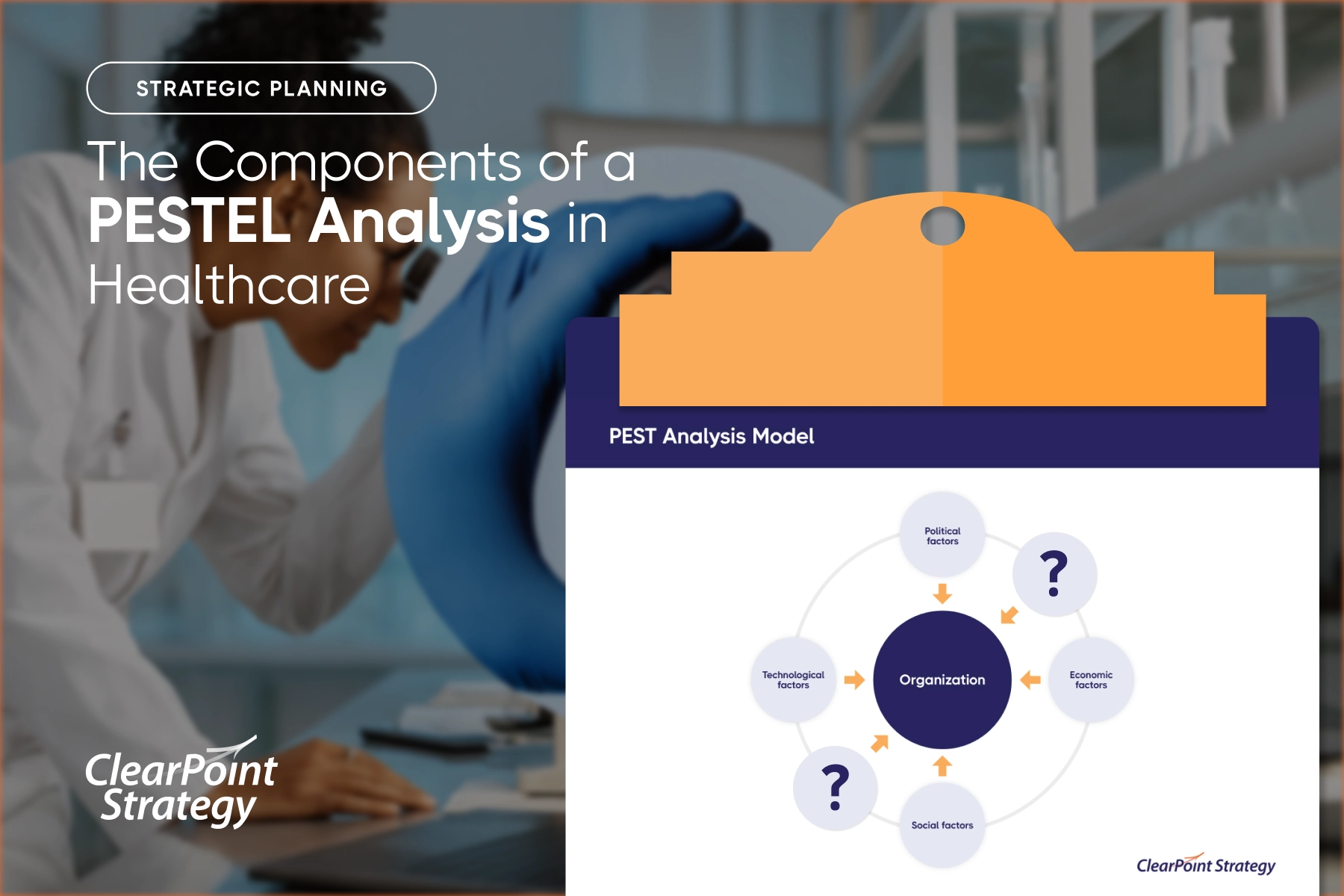
Each force is one of the external factors pressing on your organization — and a question it's already asking you. PEST stops at the first four; healthcare needs all six, because it's governed by Legal forces and increasingly by Environmental ones.
| Force | 2026 signal in healthcare | The question it forces |
|---|---|---|
| Political | Enhanced premium tax-credit expiry, Medicare/Medicaid policy, telehealth reimbursement | Who pays you, and when? |
| Economic | Labor inflation, reimbursement lagging costs, deferred elective care | Which revenue survives a downturn? |
| Social | Aging, chronically ill population; digital-front-door expectations; clinician burnout | Does your care model fit tomorrow's patients? |
| Technological | Clinical AI, ambient documentation, telemedicine, interoperability, cybersecurity | What redefines your standard of care? |
| Environmental | Climate resilience for facilities, medical-waste rules, supply-chain decarbonization | Can you run through a climate event? |
| Legal | HIPAA, accreditation, malpractice, AI governance — Texas's TRAIGA took effect Jan 1, 2026 | What becomes non-negotiable? |
That table is most of what other PESTEL articles give you. It's the easy half. Here's the half they leave out — the half we can see from inside the platform.
The part every other PESTEL article skips
A PESTEL scan produces strategic objectives — "shift to value-based care," "stand up an AI governance committee," "harden three facilities for climate risk." Each one needs an owner, a measure, and a review date. In healthcare, most never get the first one.
Healthcare is the worst offender of any major sector we track: 89% of its strategic objectives have no owner, ahead of government (83%) and financial services (57%). An objective with no owner is a sentence in a slide deck. It is not a plan.
And the objectives healthcare is most excited about are the most orphaned of all. Group those 6,282 objectives by what their titles are about, and the ones tagged to technology — AI, telehealth, EHR, digital — are unowned 95% of the time, the highest of any theme. The AI governance committee gets announced; nobody's name goes next to it.
It gets quieter from there. 72% of those healthcare objectives never receive a single real status update — no red, yellow, or green, ever. Another 10% are scored exactly once, then go dark. Only 19% are ever reviewed more than once. The median objective is reviewed zero times.
This isn't abstract. Real objectives in these plans read "Improve and Expand Access to Care" and "Improve the patient experience through enhancing healthcare navigation" — set, unowned, and never once given a status. A strategy built from sentences like that isn't executed. It's archived.
Here's the part that surprised us. Across the whole platform, giving an objective an owner roughly doubles its odds of ever going green — 46% owned versus 22% unowned. In healthcare, that lever barely works: 24% versus 19%. Why so weak? Because healthcare's owners don't review either. Platform-wide, owned objectives get measured 57% of the time; in healthcare, even owned objectives are measured just 33%. The name goes on; the review never happens. Ownership only pays off when it's wired to a cadence — and in healthcare it usually isn't.
You may have heard that "70% of strategies fail." That figure has no credible source — it's been repeated since the 1980s without one. Here are numbers with a source: 89% unowned, 72% never measured, a median of zero reviews, across 6,282 live healthcare objectives. The forces were never the problem. The silence after the scan is.
How to run a PESTEL analysis in healthcare that survives the meeting
- List the forces that actually move you. Use the six above; pull signals from regulation trackers, payer announcements, and your own frontline staff. Score each on impact and likelihood, and keep the few that would genuinely change a decision.
- Convert each high-impact force into an objective. "Telehealth reimbursement is shrinking" becomes "protect virtual-care margin by Q3." A force you don't convert is just anxiety.
- Put a name on every objective. In healthcare, 89% never get one. An unowned objective is no one's job by Monday.
- Wire each one to a measure and a recurring review date. This is where healthcare dies: the median objective is reviewed zero times. An objective nobody revisits is a wish, not a plan.
Where PESTEL fits with the rest of your plan
PESTEL maps the forces you don't control; a SWOT analysis weighs them against the strengths and weaknesses you do. Run PESTEL first, pour its findings into the opportunities and threats of your SWOT, and carry the survivors into your healthcare strategic plan as owned, measured objectives — not bullet points.
From scan to living plan
A PESTEL analysis tells you what's coming. It doesn't make anyone act on it. Closing that gap — between the scan and the follow-through — is the whole job of strategy execution, and it's why ClearPoint exists. Every objective gets an owner, a measure, and a cadence; the ones that drift turn red before the board meeting, not after.
The health systems already running their plans this way don't talk about prettier reports — they talk about the loop. When the American Association of Critical-Care Nurses moved its plan into ClearPoint, its business strategy specialist put it this way:
"We were able to realign our planned work to our desired results and create new custom reports to help us see the impact of our efforts on our nursing community."
— Tracey Birosak, Business Strategy Specialist, American Association of Critical-Care Nurses
Cancer centers, trauma hospitals, and health departments run on the same loop — Fox Chase Cancer Center, Carilion Clinic, and San Juan Regional Medical Center among them.
Picture the CFO again. Same six forces, same board slide. The difference isn't a sharper analysis — it's that each objective now carries a name, a number, and a date it gets reviewed. The virtual-care-margin objective turns yellow in week six, not at year-end. That's the whole game: not predicting the future, but staying awake to it.
A PESTEL analysis is a list of promises the outside world is about to test. In healthcare, the median promise is never checked again. The forces were never the hard part. Whether anyone looks is.
Frequently asked questions
What is a PESTEL analysis in healthcare?
A PESTEL analysis in healthcare scans the six external forces shaping a healthcare organization — Political, Economic, Social, Technological, Environmental, and Legal — so strategy can react before those forces force the decision. The harder, more important step is turning each high-impact force into an objective the organization actually owns, measures, and reviews.
What is the difference between PEST and PESTEL analysis?
PEST covers four forces — Political, Economic, Social, and Technological. PESTEL adds Environmental and Legal. In healthcare those two are decisive: the sector is shaped heavily by regulation (Legal) and increasingly by climate resilience and waste rules (Environmental), so PESTEL is the more complete fit.
What are examples of PESTEL factors in healthcare in 2026?
Political: premium tax-credit expiry and telehealth reimbursement. Economic: labor inflation and deferred elective care. Social: an aging, chronically ill population and clinician burnout. Technological: clinical AI, telemedicine, and cybersecurity. Environmental: climate resilience and medical-waste rules. Legal: HIPAA, accreditation, and new AI governance laws such as Texas's TRAIGA, effective January 1, 2026.
What should you do after completing a PESTEL analysis?
Convert each high-impact force into a strategic objective, then give every objective an owner, a measure, and a review date. This last step is where healthcare fails: on the ClearPoint platform, 89% of healthcare strategic objectives have no owner and 72% never receive a single status update.
Why do healthcare strategic plans fail to act on PESTEL findings?
Not because the analysis is wrong, but because the objectives it creates are never owned or measured. Across 6,282 healthcare objectives on the ClearPoint platform, 89% have no owner and 72% never get a real status update — the median objective is reviewed zero times. Even objectives that get an owner are marked on-track only 24% of the time versus 19% for unowned ones, because healthcare's owners rarely review either. The review loop, not just ownership, is missing.
How often should a healthcare organization update its PESTEL analysis?
Review it at least annually, and again whenever a major external force shifts — a new reimbursement rule, an AI regulation, a merger, or a climate event affecting facilities. The bigger discipline is reviewing the objectives it produced on a fixed cadence; on our platform, the objectives that get reviewed more than once are the rare ones that ever reach on-track.
Is PESTEL or SWOT better for healthcare strategy?
They do different jobs, so use both. PESTEL maps the external forces you don't control; SWOT weighs those forces against your internal strengths and weaknesses. Run PESTEL first and feed its findings into the Opportunities and Threats of your SWOT.